
Where Science Meets Love
Best Peptides for Dogs: An Evidence-Aware Guide
The best peptides for dogs depend on the exact ingredient, the question you are researching and the evidence behind its delivery format. This guide ranks collagen peptides, BPC-157, TB-500 and AOD-9604 by evidence relevance, then helps you compare the ten Longevity Puptides food-bowl sprays by their real ingredients.
Published · Updated
In this guide
What should “best” mean when you are choosing for a dog?
The most useful starting point is best-supported for the question you are asking, not the ingredient with the boldest name. If you are comparing something added to food, research in dogs using a meal route is more relevant than an injected experiment in another animal. If you are curious about a molecule, a laboratory study can still be worth reading without becoming a shopping recommendation. Our peptides for dogs guide explains the broader category.
Longevity Puptides plans to sell its own forthcoming collection and therefore has a commercial interest in this topic. We disclose that relationship before discussing our products. The collection is not awarded first place simply because we publish this guide, and no invented star rating determines the order below.
Four details determine the ranking: the exact test material, whether living dogs were studied, how it was administered, and what was measured. A relevant result also needs a credible comparison and a clearly described population. Those details let you separate useful evidence from a familiar ingredient name repeated across unrelated products.
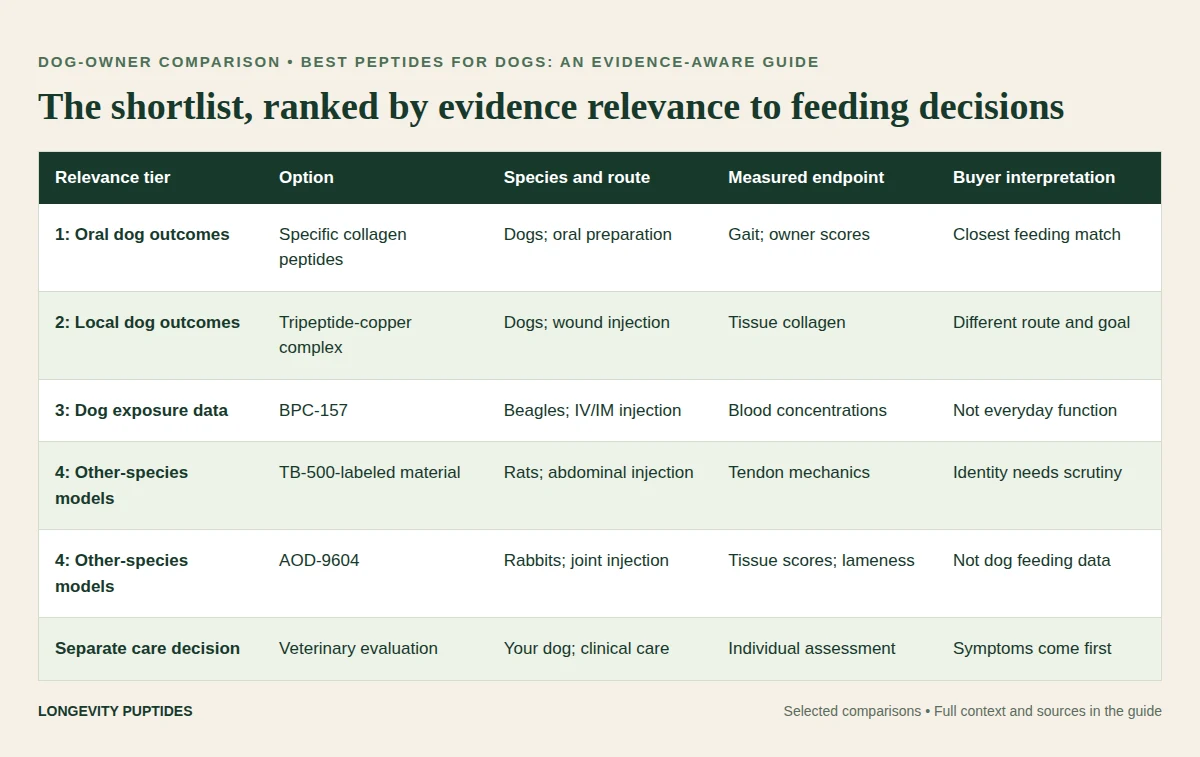
The shortlist, ranked by evidence relevance to feeding decisions
For this shortlist, dog outcome data using an oral preparation comes first. Dog outcome data using local injection comes next, followed by canine concentration-time research. Other-species experiments belong in a more distant tier. The table compares representative evidence, not products tested against one another; its order does not mean the second ingredient works better than the third.
Veterinary care sits outside that retail ranking. An examination answers what is happening to your dog, while a study answers a narrower research question. Collagen belongs to nutritional comparisons; BPC-157, TB-500 and AOD-9604 belong to experimental-molecule discussions. Follow the originals linked below or use the research library to keep each source attached to its actual experiment.
| Relevance tier | Option | Species and route | Measured endpoint | Buyer interpretation |
|---|---|---|---|---|
| 1: Oral dog outcomes | Specific collagen peptides | Dogs; oral preparation | Gait; owner scores | Closest feeding match |
| 2: Local dog outcomes | Tripeptide-copper complex | Dogs; wound injection | Tissue collagen | Different route and goal |
| 3: Dog exposure data | BPC-157 | Beagles; IV/IM injection | Blood concentrations | Not everyday function |
| 4: Other-species models | TB-500-labeled material | Rats; abdominal injection | Tendon mechanics | Identity needs scrutiny |
| 4: Other-species models | AOD-9604 | Rabbits; joint injection | Tissue scores; lameness | Not dog feeding data |
| Separate care decision | Veterinary evaluation | Your dog; clinical care | Individual assessment | Symptoms come first |
First for feeding relevance: a specific collagen preparation
Collagen peptides are protein fragments from collagen, not another name for BPC-157 or TB-500. A collagen nutrition question concerns a particular preparation and its place alongside the dog's diet. It should not be merged with the research around defined experimental signaling molecules. The dog nutrition and longevity guide provides a separate foundation for thinking about complete food and optional additions.
The most directly relevant example here is Dobenecker and colleagues' 2024 oral collagen trial, published September 19. Forty-one dogs with naturally occurring osteoarthritis were randomized, and thirty-one completed twelve weeks. The study compared a specific bioactive collagen-peptide preparation, an omega-3/vitamin-E preparation and placebo, using a force-plate treadmill, owner questionnaires and activity monitors.
Selected gait measures favored the collagen preparation. The owner-reported quality-of-life change was significant compared with the omega-3 group but only numerically greater than placebo; pain scores did not differ significantly, and activity-monitor measurements were unaffected. That is a more informative description than saying every outcome improved.
GELITA AG funded the study, one author was its employee, and another disclosed patents concerning collagen use. These interests deserve attention alongside the small completed sample and selected patient population. The trial earns the closest feeding-route match on this shortlist, not a blanket endorsement of every collagen powder. Ask whether a candidate identifies the preparation actually studied rather than citing the paper only because its label contains the word collagen.
Second tier: canine tissue data is not a coat-product comparison
A dog study can be genuine while answering a different buyer question. Swaim and colleagues' March 1996 study, “Effect of locally injected medications on healing of pad wounds in dogs,” involved twelve mature English Pointers. Researchers administered a tripeptide-copper complex directly into experimentally created paw-pad wounds and compared tissue measurements with controls.
The tripeptide-copper wounds contained more type-I collagen at measured time points, including a significant difference at day fourteen. This is a local tissue endpoint in dogs, which places it above other-species tissue research for canine relevance. It is not an observation about the appearance of an ordinary coat after something was added to dinner.
The GHK-Cu for dogs article explores this evidence separately. For a buyer, the useful question is whether the claim matches the measured endpoint. Words such as collagen, skin and copper can make studies sound connected, but they do not erase the distinction between a local wound experiment and a mealtime product.
Third tier: BPC-157 has canine exposure research
BPC-157 deserves a precise description rather than dismissal or promotion. He and colleagues' 2022 primary paper measured the compound in six Beagle dogs after intravenous and intramuscular administration. Pharmacokinetics means tracking a substance's concentration over time; it does not mean measuring whether daily walks, digestion or recovery changed.
The measured parent peptide had an elimination half-life under thirty minutes in the reported experiments. That result belongs to those blood-concentration measurements. It does not tell an owner how long a benefit lasts, how many sprays to use, or whether a dog should receive an experimental ingredient. The distribution and metabolism portions using a radioactive tracer were conducted in rats and should not be relabeled as canine findings.
If a retailer presents this paper as a dog recovery trial, the description has skipped its actual endpoint. Use the BPC-157 for dogs guide to examine the compound, then ask whether a proposed product supplies evidence for its own route and intended question. Canine exposure data is a useful research milestone, but it cannot fill every missing line in a buyer comparison.
TB-500: exact identity matters more than the stack nickname
TB-500 and full-length thymosin beta-4 should not be treated as interchangeable study materials. The Longevity Puptides catalog describes TB-500 as a related fragment. When another paper uses the name for a different material, its findings cannot be reassigned simply because the name looks familiar. This is especially important when BPC-157 and TB-500 are marketed together under the informal Wolverine stack nickname.
A 2026 study by Biçer and colleagues tested BPC-157, TB-500-labeled material, their combination and control in thirty-two rats after Achilles tendon surgery. Administration was by intraperitoneal injection, meaning into the abdominal cavity. The biomechanical analysis used four tendons per group. Only the TB-500 group reached the reported adjusted significance threshold against control for maximum load to failure; the combination did not show an additional benefit.
That finding gives no basis for declaring a two-ingredient formula superior in dogs. The study's material terminology also needs to remain distinct from the catalog's fragment description. Our Wolverine stack for dogs guide addresses the combination question without treating an appealing nickname as evidence. For buying decisions, request molecule-level clarity before giving extra credit to a bundle.
AOD-9604: movement-themed research is still another-species research
AOD-9604 is the ingredient named in Flex & Fetch. Its relevance here comes from a specific experiment, not the implication that a movement-themed name establishes a result. Kwon and Park's 2015 paper, “Effect of Intra-articular Injection of AOD9604 with or without Hyaluronic Acid in Rabbit Osteoarthritis Model,” studied thirty-two rabbits in a chemically induced knee model.
The researchers used ultrasound-guided injections into the joints and compared saline, hyaluronic acid, AOD9604 and the combination. Tissue scores and observed lameness periods differed across groups, with the combination reporting lower tissue scores and a shorter lameness period than the other groups. Those endpoints describe that rabbit experiment, not dogs eating a product at home.
The practical decision is whether you are investigating a research topic or selecting something with directly relevant canine feeding evidence. AOD-9604 belongs in the former category on the sources used here. Its tied fourth-tier placement reflects species and route distance, not a negative score for the molecule and not a prediction about your dog.
When is the right next step care rather than a purchase?
A dog newly limping, struggling to rise, vomiting, losing appetite or showing persistent distress needs veterinary evaluation rather than a peptide selected from a symptom list. These observations are reasons to find out what is happening, not instructions to match the word recovery, calm or balance on a bottle. A nutritional addition or experimental molecule does not substitute for an examination or an existing veterinary plan.
For older dogs, the 2023 AAHA Senior Care Guidelines for Dogs and Cats describe evidence-guided assessment that includes medical care, behavior, other health conditions and environmental support. Aging is not itself a diagnosis. Our canine longevity guide keeps those care priorities separate from interest in emerging ingredients.
Bring a short description of what changed, when it began, the current food label and a complete list of additions and medicines. A video of ordinary movement may help explain your concern without asking your dog to perform a difficult maneuver. The dog joint supplements guide can organize nutritional questions, while the clinician assesses the medical situation.
What documentation should win your attention?
Start with an identifiable product, an exact ingredient description and the intended route. A link to an authentic paper is more useful when the seller explains its species and endpoint rather than calling it clinical proof. For a feeding product, ask whether the cited preparation matches what is in the bottle. A citation to a mixture cannot isolate one ingredient's contribution, and separate ingredient papers cannot establish a new combination.
A useful paper summary also tells you what did not change. In the collagen trial, an unchanged activity monitor result helps define the finding rather than canceling the gait measurements. In the rat combination experiment, a result without demonstrated added benefit matters when a bundle is presented as inherently superior. Ask for the comparison group and the number of animals analyzed for the particular endpoint, not just the largest enrollment number on the page. A small tissue subgroup and a whole-study sample are different denominators.
Then separate bottle information from outcome evidence. Net volume and a metered count describe packaging; they do not establish a duration of use or an improvement in your dog. Route clarity also means recognizing that a food-bowl spray is applied to food, not a nasal preparation or an injection. The oral peptides for dogs guide compares those research contexts.
For value, compare what can actually be documented before calculating a bargain. A larger bottle or more ingredients is not evidence of a more useful result. Without verified product pricing and applicable label directions, a cost-per-day comparison would be invented. Keep the questions practical: what exact item is being offered, what information accompanies it, and which unanswered question would change your decision? If the seller cannot supply that information, leaving the purchase undecided is a reasonable outcome. You do not need to choose a winner just because a search page promises one.
The FDA's Animal Food Labeling and Pet Food Claims guidance lists product identification, net quantity, manufacturer or distributor information and ingredients among federal labeling requirements. It also explains that disease claims and certain nonfood structure/function claims can indicate a new animal drug. A food-style presentation therefore is not evidence of regulatory approval. Prefer precise documents to assurances that a category label settles every question.
Where Recovery Ranger and Flex & Fetch fit
For owners researching active-day ingredient science, Recovery Ranger names TB-500 + BPC-157. For owners exploring AOD-9604 research, Flex & Fetch names AOD-9604. Those are catalog matches to topics covered here, not first-place treatments or an assertion that one delivers better results. The relevant sources remain the injected canine BPC-157 experiment and the separately identified rat and rabbit studies.
The forthcoming Longevity Puptides collection contains exactly ten 2 fl oz / 60 mL metered food-bowl sprays, each with 600 metered sprays. Collagen is not an ingredient in that collection, and this guide does not introduce powders, injections or additional product formats. The shared bottle count is a format detail, not dog dosing or an estimate of how long a bottle should last.
Your decision can remain simple: investigate collagen separately when your question is nutrition, read experimental-molecule evidence at its actual level, and take medical concerns to your veterinarian. If Recovery Ranger or Flex & Fetch matches your research interest, compare its ingredient page with the original paper rather than allowing its name to decide. That is a thoughtful way to explore a future collection without turning curiosity into an unsupported promise.
Common questions
What are the best peptides for dogs based on evidence?
For a feeding-product question, the specific oral collagen preparation discussed here has the closest canine outcome evidence. Experimental compounds have different, narrower evidence. This is a relevance ranking, not proof that one peptide is the best treatment or that every collagen product shares the same results.
Are collagen peptides the same as BPC-157?
No. Collagen peptides are fragments from collagen used in nutritional preparations; BPC-157 is a defined experimental peptide. Their study materials and questions differ. The canine collagen feeding trial cannot be borrowed as evidence for BPC-157 or a catalog spray.
Why does GHK-Cu appear above BPC-157 in this table?
The representative tripeptide-copper study measured a tissue endpoint in dogs, while the BPC-157 study measured blood concentrations. Neither matched food-bowl delivery. That distinction explains the ordering; it does not establish greater efficacy for GHK-Cu or recommend it for a coat concern.
Does the BPC-157 dog study show better recovery?
The cited Beagle study measured concentrations after intravenous and intramuscular administration, not everyday recovery or mobility. Its canine component is exposure research. A recovery claim would need an appropriately designed study measuring that outcome with the relevant preparation and route.
Is a BPC-157 and TB-500 combination automatically better?
No. Separate ingredient studies do not establish a combination. The cited rat tendon experiment did not show an additional benefit from the pair. Its test material, injected route and animal model also differ from a canine food-bowl product.
Does AOD-9604 rabbit research establish a dog feeding result?
No. The cited study used local joint injections in a chemically induced rabbit knee model. Tissue scores and lameness observations belong to that experiment. They do not establish an outcome in dogs consuming a food-applied preparation.
Does 600 metered sprays mean a particular dog-use schedule?
No. It is the catalog's bottle-format count, not sprays per meal, a dog-use schedule or a duration estimate. This guide gives no dosing instructions. Product-format comparison and individual veterinary decisions are separate questions.
Is this an independent comparison of Longevity Puptides products?
No. Longevity Puptides authors and publishes the guide and has a commercial interest in its forthcoming collection. No independent clinician endorsement is claimed. Primary sources and explicit ranking criteria are provided so readers can inspect the basis for the comparison.
Can I use this ranking to choose for a limping dog?
A new or worsening limp needs veterinary evaluation, not an ingredient selected from this table. The ranking explains research relevance and does not diagnose the cause or substitute for a veterinary plan. Bring the exact label and your observations to the appointment.
About this guide
Author and publisher: Longevity Puptides.
Written and published by Longevity Puptides using linked primary studies and official guidance. Longevity Puptides is commercially involved in its own forthcoming collection; this is organizational editorial authorship, not independent veterinary review or clinician endorsement.
Editorial standards and correctionsRead the original sources
- Dobenecker et al. (September 19, 2024): The oral intake of specific Bioactive Collagen Peptides (BCP) improves gait and quality of life in canine osteoarthritis patients—A translational large animal model for a nutritional therapy option ↗
- Swaim et al. (March 1996): Effect of locally injected medications on healing of pad wounds in dogs ↗
- He et al. (2022): Pharmacokinetics, distribution, metabolism, and excretion of body-protective compound 157, a potential drug for treating various wounds, in rats and dogs ↗
- Biçer et al. (2026): Effects of BPC-157 and TB-500 on Achilles tendon healing in rats: A histopathological and biomechanical study ↗
- Kwon and Park (Summer 2015): Effect of Intra-articular Injection of AOD9604 with or without Hyaluronic Acid in Rabbit Osteoarthritis Model ↗
- AAHA: 2023 AAHA Senior Care Guidelines for Dogs and Cats ↗
- FDA (current March 2, 2026): Animal Food Labeling and Pet Food Claims ↗