
Where Science Meets Love
Pet Peptides: Comparing Dogs, Cats and Horses
Pet peptides are short amino-acid chains discussed in animal nutrition, experimental research and veterinary medicine, not one interchangeable treatment category. When comparing peptides for cats and dogs—or horses—the exact molecule, species, formulation, route and measured outcome matter; evidence from one combination cannot simply be transferred to another, and Longevity Puptides products are dog-only food-bowl sprays.
Published · Updated
In this guide
What does the term pet peptides include?
A peptide is a chain of amino acids. The phrase peptides for pets can refer to food-derived protein fragments, naturally occurring signaling molecules or synthetic compounds investigated as drugs. Those categories have different purposes. A nutritional ingredient and a laboratory peptide do not become equivalent because both contain amino acids. Our peptides for dogs guide explains the dog-focused landscape in more detail.
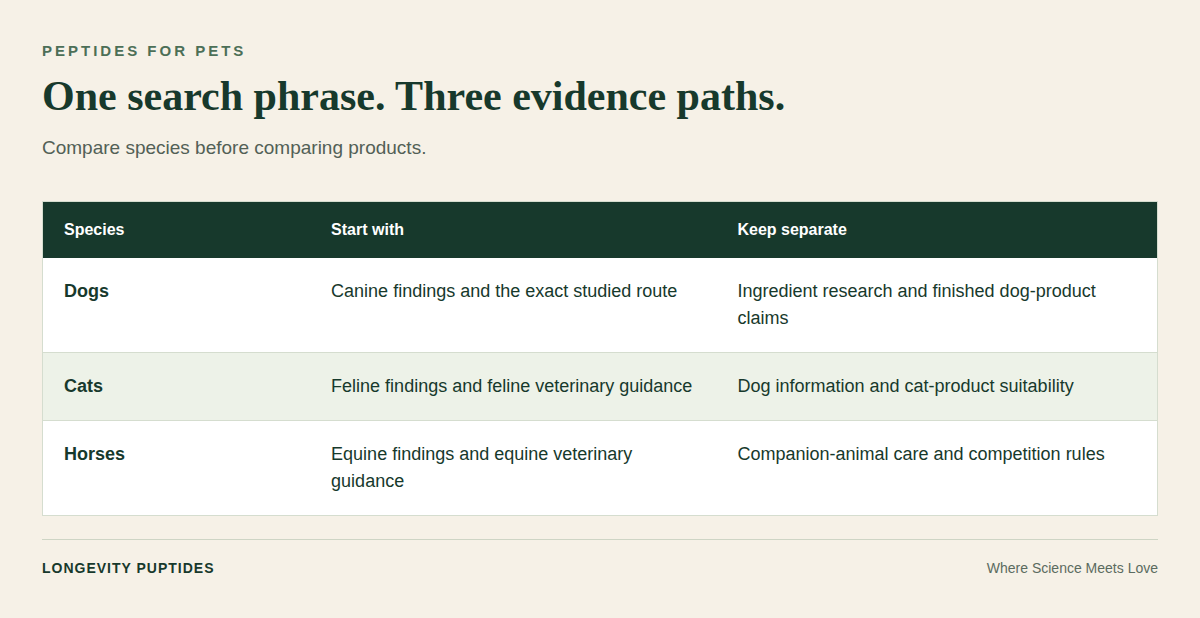
The important comparison is therefore not whether dogs, cats and horses all have peptide biology. It is whether a particular study tested the same molecule and formulation in the relevant animal, by the relevant route. The examples below deliberately separate blood-concentration studies, behavioral experiments, clinical trials and anti-doping analysis. Each can be useful, but they answer different owner questions.
Dogs versus cats versus horses: a practical comparison
These are examples of research, not a ranking of species or a recommendation to use any compound. The canine, feline and equine papers are linked in the following sections; the research library provides a starting point for ingredient reading. Open original papers rather than assuming that every item described as a pet study has the same relevance.
| Comparison | Dogs | Cats | Horses |
|---|---|---|---|
| Research example | Injected BPC-157 pharmacokinetics; intranasal oxytocin behavior experiment | Extended-release exenatide pharmacology and a controlled feline clinical trial | TB-500 fragment and metabolite detection in plasma and urine |
| What was measured | Blood exposure or specific social behaviors, depending on the paper | Exposure, glucose-related measures or remission duration, depending on the paper | Analytical detection after administration, not clinical recovery |
| Route distinction | Nasal or injected experiments are separate from swallowed food-bowl products | An injected depot formulation cannot be substituted with a dog spray | Post-administration testing cannot establish a feeding method |
| Species-specific issue | Healthy research dogs do not represent every age, breed or medical history | Feline-specific formulation and monitoring matter; body weight alone is insufficient | Digestive anatomy, handling and competition rules require equine expertise |
| Longevity Puptides scope | Dog-only metered food-bowl sprays | No feline products or feline-use directions offered | No equine products or horse-use directions offered |
Dogs: distinguish exposure research from behavior research
The 2022 BPC-157 pharmacokinetic paper studied rats and Beagle dogs. The canine experiments used intravenous and intramuscular administration and measured how concentrations changed over time. The often-repeated bioavailability figure of roughly 45–51% refers to intramuscular administration in those dogs—not oral absorption. The paper's rat distribution and metabolism experiments should also remain labeled as rat findings.
Another useful distinction is half-life versus duration of benefit. In the Beagle experiments, the measured parent BPC-157 disappeared rapidly from plasma, with elimination half-lives under 30 minutes. That describes a concentration-time relationship under specified research conditions. It does not tell an owner when a dog would feel different, whether an effect would persist after blood concentrations fell, or how often any product should be used. Those are separate clinical and formulation questions.
This makes the study relevant to the question, ‘Has BPC-157 been measured in dogs?’ It does not turn a blood-concentration curve into evidence about everyday digestive comfort or mobility. The existing BPC-157 for dogs article explores the ingredient separately from the finished products that contain it.
A different question was examined in Romero and colleagues' oxytocin experiment. Sixteen companion dogs received intranasal oxytocin or saline in counterbalanced sessions. Researchers observed affiliation and orientation toward owners and familiar dogs. Those specific social behaviors are not synonymous with relief of clinical anxiety. The nasal research route is educational context, not a description of any Longevity Puptides product.
Cats: direct feline research still needs endpoint-specific reading
Feline peptide research is not simply canine research at a smaller body weight. In a study of six healthy cats, researchers examined an injected, microencapsulated extended-release formulation of exenatide, a glucagon-like peptide-1 receptor agonist. They measured blood exposure and glucose-related responses. This was a specific feline formulation experiment, not a trial of BPC-157, a food topper or a dog spray.
A later controlled study in 22 cats examined exenatide extended-release in cats whose diabetes was in remission. It found no difference between groups in remission duration, although a blood-glucose-related marker, hemoglobin A1c, differed. Both groups also received supervised dietary and weight management. The study illustrates why the selected endpoint matters: a laboratory marker and a durable clinical outcome are not interchangeable.
Study design adds another layer. Owners were blinded to group assignment in that trial, but attending clinicians were not. The final groups contained 12 cats receiving exenatide and 10 receiving placebo, and only three cats left because diabetes relapsed. With few relapse events, a result showing no detected difference should not be inflated into proof that every possible feline use is ineffective. Equally, the marker finding cannot be promoted into a general wellness benefit.
Exenatide is included here only as a veterinary research example; it is not a Longevity Puptides ingredient or product. A cat owner should seek feline-specific veterinary assessment rather than borrow a dog product, substitute routes or assume that the existence of one feline peptide trial validates unrelated compounds.
Horses: anti-doping research is not a healing trial
Horses appear in peptide searches partly because laboratories investigate how to detect prohibited substances. In the 2012 equine TB-500 paper, scientists developed methods to identify N-acetylated LKKTETQ and its metabolites in urine and plasma after administration. That is an analytical finding about identifying exposure, not a controlled demonstration of tendon healing, athletic recovery or another clinical benefit.
A detection method is judged by whether it reliably identifies the substance in a sample, including at low concentrations. A recovery trial would instead need appropriate animals, comparison groups and predefined clinical outcomes. Reading an analytical paper as though it were a treatment trial skips those requirements. This is particularly important when a retailer repeats the paper's introductory description of claimed uses as if those claims were the experiment's findings.
The molecular distinction also matters. Full-length thymosin beta-4 and a synthetic fragment are not identical study materials. A paper about the full protein cannot automatically support claims about the fragment sold under a TB-500 label. The current Longevity Puptides catalog preserves this distinction when describing ingredient science.
Competition adds a separate regulatory layer. The FEI 2026 prohibited list lists synthetic thymosin fragments as banned. Horse owners need their equine veterinarian and the applicable sport or racing authority, not human anti-doping rules or a retailer's reassurance. No withdrawal interval, clearance estimate or horse dose can be inferred from this guide.
Why metabolism cannot be reduced to animal size
Pharmacokinetics describes how a substance is absorbed, distributed, metabolized and eliminated. Species differences can affect these processes, and individual health matters too. The MSD Veterinary Manual describes differences in drug-metabolizing enzymes and the importance of liver and kidney function. A larger animal is not automatically a slower or faster version of a smaller one.
Cats, for example, are deficient in some glucuronosyltransferase enzymes involved in handling certain drugs. That familiar veterinary example supports caution about cross-species assumptions; it does not demonstrate that a particular experimental peptide uses that pathway. Peptide breakdown may involve enzymes that cut amino-acid chains, and the relevant processes depend on the molecule and formulation.
Horses add a different digestive setting. Their foregut includes a simple stomach and small intestine, while bacterial fermentation occurs in the cecum and colon, as explained in the MSD equine digestive guide. Anatomy alone does not predict absorption. It explains why a formulation needs species-specific evaluation rather than an adjustment based solely on kilograms.
Route changes the question: injection, nasal research and food
An intravenous experiment places a test material directly into circulation. An intramuscular experiment measures uptake from muscle. An injected depot can release material over time, while nasal delivery interacts with a different tissue surface. These descriptions explain research design; they are not instructions or formats available from Longevity Puptides. Compounding likewise describes preparation of a formulation, not a universal route.
Swallowed peptides face digestive enzymes and the intestinal barrier. The oral-delivery review explains why protection, release and passage across the intestinal lining are distinct challenges. It is a review of delivery science, not a canine spray trial. A formulation that releases its contents at a chosen pH has addressed a different question from whether intact peptide reaches circulation.
Longevity Puptides describes its platform as pH-responsive nano-encapsulation & delivery technology. Small carriers are designed to protect peptides through stomach conditions and release them as intestinal pH changes. That is a design description, not a measured absorption or outcome result. See enteric peptide delivery for the terminology behind that distinction.
US regulation: approved drugs, compounding and food claims
‘Pet peptides’ is not an FDA approval category. Under AMDUCA, veterinarians can prescribe certain approved human or animal drugs outside their approved labeling when specified conditions are met, including a valid veterinarian-client-patient relationship. That is not blanket authorization for an unapproved research compound. FDA also states that AMDUCA's extralabel framework does not permit bulk-substance compounding or extralabel use in animal feed.
FDA's GFI #256 questions and answers address circumstances in which the agency does not intend to take enforcement action against certain bulk-drug compounding. Patient-specific prescriptions and office stock are different circumstances. An enforcement policy, nomination or list entry is not product approval and does not establish safety or effectiveness.
Calling something a food topper does not settle its legal classification either. FDA explains that disease claims and certain nonfood structure/function claims can indicate intended use as a new animal drug. These US distinctions require product-specific review; other countries and equine competition systems have separate rules.
What a useful species-specific veterinary conversation includes
Bring the complete label, ingredient list, intended species and formulation—not just a peptide name. Ask which original paper is relevant and whether its animals resemble your own. A study in healthy adult animals leaves different questions than a study involving older animals with concurrent illness. Include all current medicines, supplements and relevant health history so the veterinarian can assess the complete situation.
Practical details matter without becoming a dosing schedule. In a multi-pet home, shared bowls can obscure which animal encounters a product. In feline care, appetite and handling may affect whether a proposed formulation is practical. For horses, stable records and competition obligations add questions beyond those faced by a household dog owner. None of these circumstances justifies transferring another species' instructions.
Use the product research checklist to organize documents before a dog-focused appointment. A change in appetite, movement or behavior calls for assessment rather than choosing an ingredient from a symptom list. Research literacy should improve the veterinary conversation, not replace it.
Where Longevity Puptides fits: dogs only
The Longevity Puptides collection consists only of 2 fl oz / 60 mL metered food-bowl sprays with 600 metered sprays per bottle, intended for dogs. There are no cat or horse products in this collection. The bottle's spray count describes the format, not sprays per meal, treatment duration or a cross-species regimen.
For example, Calm Companion contains Oxytocin + Selank + Semax. Its catalog invitation is: ‘For the moments when a familiar routine matters most.’ Recovery Ranger contains TB-500 + BPC-157, while Belly Balance contains BPC-157. These names identify collection ingredients; the research examples above do not establish the combinations or finished sprays.
Dog owners can explore the collection hub, then join the existing waitlist for product updates. Cat and horse owners should keep this page as comparative education, not a route into dog-product use. For a deeper canine discussion, continue with peptides for dogs and read the original sources linked from the research library.
Common questions
Are pet peptides the same as peptides for dogs?
The search terms overlap, but pet peptides is broader. It can include nutrition, experimental compounds and veterinary medicines across several species. Dog evidence should remain attached to the molecule, formulation and route actually tested. A study involving cats or horses is useful comparative context, not automatic support for a canine product.
Can cats use the same peptide products as dogs?
Do not assume so. A feline veterinarian needs the exact ingredients and formulation, plus the cat's health and medication history. Body-weight scaling does not resolve species differences. Longevity Puptides products are dog-only; this page provides no feline-use directions and does not recommend sharing dog sprays with cats.
Have peptides actually been studied in cats?
Yes. The linked exenatide papers include direct feline pharmacology research and a controlled study in cats with diabetes in remission. Those studies examined a particular injected formulation and specific outcomes. They do not establish a general benefit for all peptides, nor do they test any Longevity Puptides product.
Does horse research prove that TB-500 helps pets recover?
No. The equine paper discussed here developed methods to detect a TB-500 fragment and its metabolites after administration. Identifying exposure is not the same as measuring clinical recovery. Full-length thymosin beta-4 findings also need to remain separate from findings about a synthetic fragment.
Are peptides for pets safe?
There is no responsible category-wide safety guarantee. The molecule, formulation, species, route and individual animal all matter. Short studies or tolerability observations answer narrower questions than long-term safety. Ask a veterinarian to assess the exact item, especially when an animal has medical conditions or takes other medicines.
Does a food-bowl spray work like an injection?
The routes are not interchangeable. A swallowed formulation encounters digestion and the intestinal lining, while an injection bypasses some of those barriers. A pH-responsive carrier describes an intended release strategy. It does not by itself establish absorption, equivalence to an injection or a finished-product outcome.
Are compounded pet peptides FDA-approved?
Compounding does not make a finished animal drug FDA-approved. FDA distinguishes permitted extralabel use of certain approved drugs from bulk-substance compounding addressed by enforcement guidance. Whether a particular preparation fits an applicable framework is a veterinarian-and-pharmacy question, not something established by the words research peptide or pet supplement.
Does Longevity Puptides sell products for cats or horses?
No. The collection described here is for dogs only: 2 fl oz / 60 mL metered food-bowl sprays, each with 600 metered sprays. Cats and horses appear in this guide to explain genuine research differences, not as intended users. Dog owners can use the existing collection and waitlist links for updates.
About this guide
Author and publisher: Longevity Puptides.
Source-led educational guide. Veterinary review: no veterinarian is credited for this guide.
Editorial standards and correctionsRead the original sources
- He et al. (2022): BPC-157 pharmacokinetics in rats and dogs — primary study ↗
- Romero et al. (2014): Oxytocin promotes social bonding in dogs — primary experiment ↗
- Rudinsky et al. (2015): Exenatide extended-release pharmacology in healthy cats — primary abstract ↗
- Gilor et al. (2025): Exenatide and feline diabetic remission — primary controlled study ↗
- Ho et al. (2012): TB-500 detection in equine urine and plasma — primary publisher abstract ↗
- MSD Veterinary Manual: Disposition and Fate of Drugs — professional veterinary reference ↗
- MSD Veterinary Manual: Introduction to Digestive Disorders of Horses — veterinary reference ↗
- Oral delivery of protein and peptide drugs (2022) — delivery-science review ↗
- FDA: Animal Medicinal Drug Use Clarification Act — official guidance ↗
- FDA: Q&A on GFI #256 animal-drug compounding — official guidance ↗
- FDA: Animal Food Labeling and Pet Food Claims — official guidance ↗
- FEI: 2026 Equine Prohibited Substances List — official sporting rules ↗