
Where Science Meets Love
Where to Buy Peptides for Dogs
Where to buy peptides for dogs depends on whether you need prescribed veterinary medicine or are comparing pet-wellness products. This guide explains the veterinarian, licensed compounding-pharmacy and pet-supplement routes, then shows how to explore the Longevity Puptides food-bowl spray collection and join its shipping-announcement waiting list.
Published · Updated
In this guide
Choose the purchasing category before the brand
The most useful answer to where to buy peptides for dogs is a purchasing pathway, not a list of websites. The same search can return prescription medicines, compounded preparations, nutritional products and laboratory materials. Those listings are not interchangeable. First identify the exact ingredient and what the seller says the finished item is for. Our peptides for dogs guide explains why a peptide name alone cannot tell you which category you are comparing.
If the search began because your dog is limping, vomiting, scratching persistently or behaving differently, arrange veterinary evaluation rather than selecting a product by symptom. A buyer guide cannot diagnose those changes, and a supplement is not a substitute for that assessment or prescribed care. For a general wellness interest, write down your question before browsing: are you comparing nutritional ingredients, reading an experimental paper or trying to fill a prescription? That small distinction makes the next step much clearer.
This guide uses United States FDA sources. State requirements also matter, especially for pharmacy licensing and animal-food labeling; purchases in other countries require their own local checks. No retailer ranking or current inventory claim is made here.
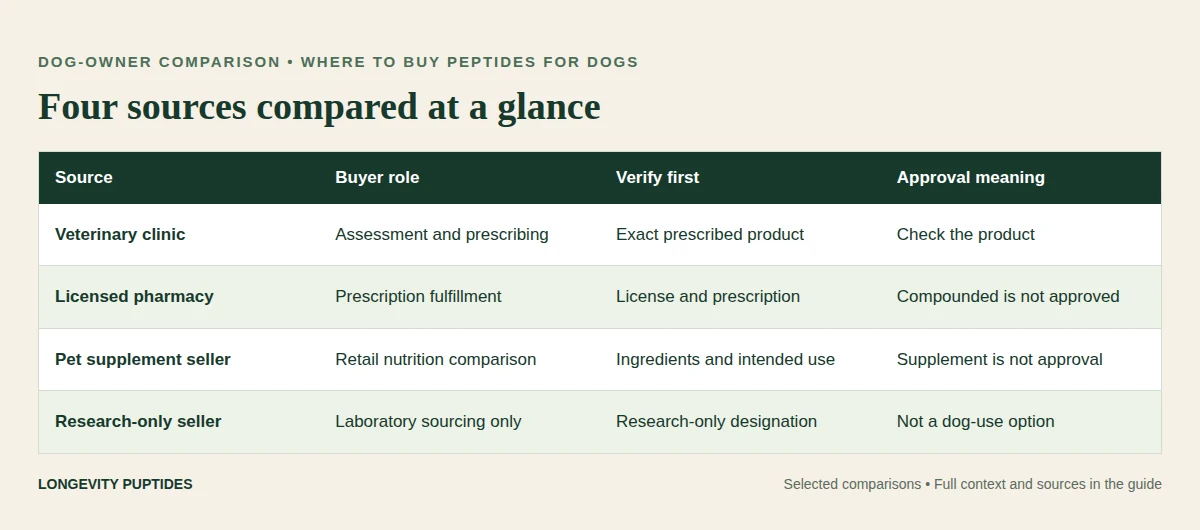
Four sources compared at a glance
A veterinarian and a pharmacy can be parts of the same purchase, rather than competing alternatives. The veterinarian determines the medical plan; a pharmacy may fill the resulting prescription. By contrast, an ordinary retail supplement listing is not a prescription, and a research-only listing belongs outside an owner's dog-use shortlist. FDA's pharmacy-compounding comparison explains why approved drugs and compounded preparations also need separate identification.
Use this table to decide what documentation to request. It compares the role of each source, not whether a particular compound is suitable for your dog. A professional-looking checkout cannot resolve the missing category information.
| Source | Buyer role | Verify first | Approval meaning |
|---|---|---|---|
| Veterinary clinic | Assessment and prescribing | Exact prescribed product | Check the product |
| Licensed pharmacy | Prescription fulfillment | License and prescription | Compounded is not approved |
| Pet supplement seller | Retail nutrition comparison | Ingredients and intended use | Supplement is not approval |
| Research-only seller | Laboratory sourcing only | Research-only designation | Not a dog-use option |
When the veterinarian is the right starting point
A veterinary appointment adds information that a shop page cannot: examination findings, medical history and a reason for considering a particular medicine. Bring the complete product label or listing, not just a screenshot of an ingredient name. Include current medicines and supplements. FDA's online pet-medicine guide specifically recommends discussing online purchases with the veterinarian who knows the animal's medication history.
Ask whether the recommendation is for an FDA-approved animal drug, an approved human drug used extralabel or a compounded preparation. These are different answers. Approval of a human drug does not mean it is approved for dogs, while an appropriately prescribed extralabel use has a defined regulatory framework. You do not need to understand every regulation before asking which framework applies to the actual item.
The appointment need not end with a peptide purchase. A useful outcome may be a diagnosis, a different medical plan or a decision that the evidence does not support the proposed item. For owners comparing movement-related nutrition rather than filling a prescription, our dog joint supplements guide offers a separate reading path. Keep the veterinary assessment and the shopping comparison distinct so a persuasive product name does not decide the medical question.
How to verify a compounding pharmacy
If your veterinarian recommends compounding, ask for the dispensing pharmacy's legal business name, physical address and pharmacist contact. Verify the license with the relevant state board rather than relying on a badge printed on the website. FDA says United States pharmacies must be licensed in the state where they are based and where they fill prescriptions. Its Website A.W.A.R.E. checklist also identifies missing contact information and the absence of an available licensed pharmacist as red flags.
For prescription veterinary medicines, a website should request a valid veterinary prescription or verify it with the clinic. A checkout that bypasses this step is not an advantage. Ask who actually prepares and dispenses the item, particularly when a marketplace or referral service sits between you and the pharmacy. The website operator and the dispensing pharmacy may not be the same business.
Licensure is essential, but it does not certify every preparation as FDA-approved or establish that every proposed bulk ingredient fits federal policy. A lawful pharmacy business still needs an appropriate basis for the particular prescription. Request written product identification and ask the veterinarian and pharmacist to explain the source material, the reason for compounding and the applicable requirements.
AMDUCA: approved drugs used outside their labeling
The Animal Medicinal Drug Use Clarification Act of 1994, usually shortened to AMDUCA, permits veterinarians to prescribe certain approved animal or human drugs outside their approved label directions under specified conditions. That is called extralabel use. FDA's AMDUCA explanation requires a valid veterinarian-client-patient relationship and compliance with the implementing regulations in 21 CFR 530. It is not permission for owners to choose an experimental molecule and create their own medical plan.
Compounding from approved finished drugs can also be permissible under the relevant conditions. However, FDA explicitly states that the extralabel-use regulation does not permit compounding animal drugs from active pharmaceutical ingredients, also called bulk drugs. AMDUCA therefore cannot serve as a blanket legal explanation for any website selling an unapproved peptide powder.
FDA also excludes extralabel use of approved drugs in or on animal feed from this framework. Consequently, applying something to food does not automatically bring it within AMDUCA. These distinctions explain why the source of a formulation matters: a preparation starting with an approved finished drug and one starting with a bulk substance require different regulatory analysis, even when a seller uses similar ingredient language.
GFI #256: enforcement discretion, not blanket legality
FDA's final GFI #256, Compounding Animal Drugs from Bulk Drug Substances, describes circumstances in which the agency generally does not intend to take enforcement action against certain bulk-drug compounding. FDA says these preparations do not meet the applicable new-animal-drug approval requirements. Enforcement discretion means a stated approach to enforcement under specified circumstances; it does not mean that FDA has approved the product or legalized every bulk-drug preparation.
For nonfood-producing animals, such as household dogs, patient-specific prescriptions and office stock are separate pathways. Patient-specific dispensing involves a veterinarian acting within a valid relationship and the circumstances described in the guidance. Restrictions concerning copies of approved or indexed drugs and the source of the active ingredient also matter. When a preparation is a copy, a documented clinical difference is relevant; a lower price alone is not that difference.
Office stock means preparations kept on hand without a patient-specific prescription. FDA's GFI #256 questions and answers ties bulk-drug office stock to urgent need and the applicable listed or currently under-review substances. A list entry is not approval, and an office-stock policy is not permission to market unrestricted consumer peptide products.
As of November 2, 2026, FDA also lists draft GFI #256B, issued in August 2026, addressing compounding under current good manufacturing practice in federally registered facilities. FDA explicitly marks it not for implementation. Do not treat a proposed future policy or a facility's registration as finished-product approval.
Supplements: read the ingredients and intended use
Pet supplements require a different comparison from prescription fulfillment. FDA states that the Dietary Supplement Health and Education Act, which created a special framework for human dietary supplements, does not apply to animal products. Products marketed as animal supplements are regulated as animal food or animal drugs depending on composition and intended use. Read FDA's Regulation of Pet Food before assuming that a human supplement label provides the right legal model for dogs.
Ask for the entire label, including ingredient names, net quantity and the responsible manufacturer or distributor. FDA's animal-food labeling guidance describes these basic requirements and notes additional state laws. It also explains that disease claims or structure/function claims unrelated to food purposes can indicate intended use as a new animal drug. Calling an item a topper, natural product or wellness supplement does not settle that question.
Do not group food-derived peptides and synthetic signaling compounds together just because both use the word peptide. Compare the actual material and the purpose of the finished product. For the broader mealtime context, our dog nutrition and longevity guide helps organize nutritional questions. A retail label should make the product easier to understand, not require you to infer missing ingredients from advertising.
Research-only sellers are not a dog-use purchasing route
A product labeled research use only or not for human or animal consumption is not a consumer dog-use product. Do not administer it to your dog. A laboratory listing, scientific name or certificate of analysis does not convert it into a veterinary prescription or an animal-food ingredient. This category should be removed from an owner's shortlist, not compared as a cheaper substitute for a clinic or pharmacy.
Disclaimers also do not erase contradictory marketing. In its February 26, 2025 warning letter to USApeptide.com, FDA found evidence of human-drug intended use despite research-only statements. That was a human-drug enforcement example, not a determination about canine products. For animal products, the relevant FDA food-labeling guidance likewise makes intended use important.
If a seller's page combines laboratory-only wording with pet outcome testimonials, the conflict is a reason to stop, not an invitation to interpret the product yourself. Keep the listing for discussion if useful, but do not seek mixing instructions or a dog-use workaround from its customer service team.
Which documents actually help a buyer decide?
Request evidence at the same level as the claim. An ingredient paper identifies what researchers studied; a laboratory report describes particular tests on a sample; a complete label identifies the finished item. None should be silently substituted for another. For a test report, ask which lot was tested, who performed the analysis and what each reported result means. If identity, purity and amount are discussed, establish which question the report actually addresses rather than assuming one number answers all three.
For research, check the original title, publication date, species and route. He and colleagues' December 14, 2022 BPC-157 paper included Beagle dogs receiving intravenous and intramuscular test material. Researchers measured concentration over time and reported rapid elimination, with parent-peptide half-lives under 30 minutes in the tested conditions. Those are injection pharmacokinetic results, not a feeding trial or an owner-observed mobility result. Our BPC-157 for dogs article provides ingredient-specific context.
Use the research library to find papers, then open the original record. A useful seller response explains precisely how a source relates to the item being described. A paper count, impressive journal name or dog photograph cannot supply a missing match between study material and product. Our product evaluation checklist can help you collect those documents in one place.
Compare written costs and fulfillment terms, not guesses
Only compare costs after identifying the appropriate purchasing category. For a prescription, request a written quote for the exact item and separate the examination, dispensing and delivery charges where applicable. Ask whether the quote includes a different formulation or quantity from the one prescribed. A cheaper listing with a different product identity is not a like-for-like comparison. This guide provides no invented clinic fees, pharmacy ranges or peptide prices.
Before ordering, confirm who answers product questions, how the prescription reaches the pharmacy and what happens if the delivered label differs from the order. Read cancellation, return and payment terms before entering financial information. FDA's online-medicine checklist recommends reviewing privacy and security policies and warns about missing contact details. An encrypted checkout protects a connection; it does not establish product approval or pharmacy licensure.
Keep the order confirmation and complete labeling so the clinic and dispensing business can identify the item if questions arise. Ingredient quantity, bottle volume and advertised spray count are different facts, not interchangeable measures of value. For broader comparison criteria, continue with best peptides for dogs, where the decision starts with evidence and product identity rather than a universal winner.
Where Longevity Puptides fits in your research
Longevity Puptides is the publisher of this guide and has a commercial interest in its own collection. The catalog describes ten dog-only metered food-bowl sprays, each in a 2 fl oz / 60 mL bottle with 600 metered sprays. That identifies the collection format; the spray count is not a dog-use schedule or a promised number of days. This page does not establish a current purchase offer, price or store availability.
For ingredient reading, Belly Balance identifies BPC-157, while Skin & Shine identifies GHK-Cu. Their pages allow you to match a catalog name to an ingredient discussion without confusing the collection with a pharmacy or laboratory supplier. Product names should not be read as medical claims.
A thoughtful next step is to compare the exact category, label and supporting documents before making any purchasing decision. If the food-bowl format itself is your question, read oral peptides for dogs. Keep this guide as a practical buying reference, and let the veterinary conversation answer individual medical questions.
Common questions
Can a legitimate veterinary pharmacy operate online?
Yes. Online operation is a purchasing channel, not a separate approval category. Verify the dispensing pharmacy's state licenses, pharmacist contact and prescription process using FDA's Website A.W.A.R.E. guidance.
Does a compounding pharmacy license make every peptide preparation lawful?
No. Business licensure and the regulatory basis for a particular preparation are separate questions. The veterinarian and pharmacist should explain the prescription, source material and applicable federal and state requirements.
Is a compounded medicine the same as an FDA-approved generic?
No. FDA-approved generic drugs undergo an approval process. A compounded animal preparation is not FDA-approved, even if its active ingredient has the same name as an ingredient in an approved product.
Does GFI #256 authorize all peptides for dogs?
No. It describes enforcement priorities and circumstances for enforcement discretion involving certain bulk-drug compounding. It is not approval of a peptide category, a product or unrestricted online consumer sales.
Is the August 2026 GFI #256B draft already in effect?
As checked on November 2, 2026, FDA marks GFI #256B as a draft, not for implementation. Its proposed federally registered facility policies should not be presented as current finished-product approval.
Can I buy research-only peptides and give them to my dog?
No. Do not administer research-only products to your dog. Laboratory designations, test reports and seller testimonials do not turn those materials into dog-use products.
What should I ask when a supplement seller says FDA-registered?
Ask what entity is registered and under which program, then ask separately about the finished product's classification. Facility registration is not FDA product approval, and animal supplements do not use the human DSHEA framework.
Does a certificate of analysis prove a product works for dogs?
No. A certificate reports specified analytical testing on a sample. Check its lot match and scope; a canine outcome claim requires relevant evidence about the actual formulation and endpoint.
Does this guide identify a store currently selling Longevity Puptides?
No. It explains purchasing categories and the approved catalog format. It does not provide a current offer, price, inventory statement or available-store claim for Longevity Puptides.
About this guide
Author and publisher: Longevity Puptides.
Written and published by Longevity Puptides as a source-backed educational buyer guide; no veterinarian or other clinician is credited with reviewing or endorsing it.
Editorial standards and correctionsRead the original sources
- FDA: Need Pet Meds? Protect Yourself and Your Pet—Be Website A.W.A.R.E. (May 21, 2024) ↗
- FDA: Medicines for Your Pet—FDA-approved versus pharmacy-compounded drugs (August 30, 2024) ↗
- FDA: Animal Medicinal Drug Use Clarification Act of 1994—AMDUCA ↗
- FDA: GFI #256, Compounding Animal Drugs from Bulk Drug Substances—final guidance ↗
- FDA: Q&A on GFI #256—patient-specific prescriptions and office stock ↗
- FDA: Draft GFI #256B—Compounding under CGMP in Federally-Registered Facilities (August 2026) ↗
- FDA: FDA's Regulation of Pet Food—animal supplements and intended use ↗
- FDA: Animal Food Labeling and Pet Food Claims (March 2, 2026) ↗
- FDA: USApeptide.com warning letter (February 26, 2025)—human-drug intended-use example ↗
- He et al.: Pharmacokinetics, distribution, metabolism, and excretion of body-protective compound 157, a potential drug for treating various wounds, in rats and dogs (December 14, 2022) ↗