
Where Science Meets Love
Oral Peptides for Dogs: Delivery and Evidence
Oral peptides for dogs include food-derived collagen fragments and experimental signaling peptides, with digestive enzymes and the intestinal lining presenting different formulation challenges. Learn how pH-responsive and enteric designs address those challenges in research, and how to compare a food-bowl spray's ingredients, delivery design and finished-formula evidence.
Published · Updated
In this guide
What are you actually comparing when you search for oral peptides?
Start with the ingredient, not the word oral. Oral describes a route through the mouth; it does not identify a particular molecule or explain what happens after swallowing. Collagen hydrolysates contain food-derived protein fragments. Experimental signaling peptides such as BPC-157 and MOTS-c are different study materials, investigated for different biological questions. Our peptides for dogs guide introduces these categories without treating them as interchangeable additions to a dog's routine.
Next, identify the complete formulation. A powder mixed into a meal, an enteric-coated research dosage form and a liquid containing engineered particles can all be swallowed, yet expose their contents to different conditions. The ingredient may be dissolved, associated with a carrier or chemically modified. Those distinctions are central to the oral-delivery literature, a cross-species and human-focused review rather than a dog-product trial.
For a buyer, this changes the first question from 'Which peptide is strongest?' to 'What exactly was studied?' Write down the ingredient identity, species, route and physical formulation beside any appealing claim. A convenient format is a practical feature. Evidence of what that format delivers is a separate feature, and neither should disappear behind a familiar ingredient name.
Why digestive enzymes matter more than a stomach-proof slogan
Peptides are amino-acid chains joined by peptide bonds. Proteases and peptidases are enzymes that cut these chains. In oral-delivery science, gastric pepsin and intestinal enzymes such as trypsin and chymotrypsin are important obstacles when the research goal requires the original molecule to remain intact. The 2022 delivery review describes these biochemical barriers alongside the physical barriers of the gut.
Acidity and enzymatic cleavage are related but not identical problems. pH describes how acidic or alkaline an environment is. It can alter a molecule's charge or structure, and it affects the behavior of a carrier and digestive enzymes. A peptide that tolerates one acidic laboratory solution has not necessarily been tested against enzymes, a changing meal environment or later intestinal conditions. Acid resistance is therefore a narrower finding than resistance to digestion.
Nor does reaching the intestine end the question. Digestive enzymes remain active there, and mucus covers the epithelial cells lining the gut. A released molecule still encounters that lining. The useful buyer distinction is protection, release and passage across tissue: three different measurements. A graph of release into a laboratory fluid answers the middle question, not all three, even if the graph has an impressive-looking percentage.
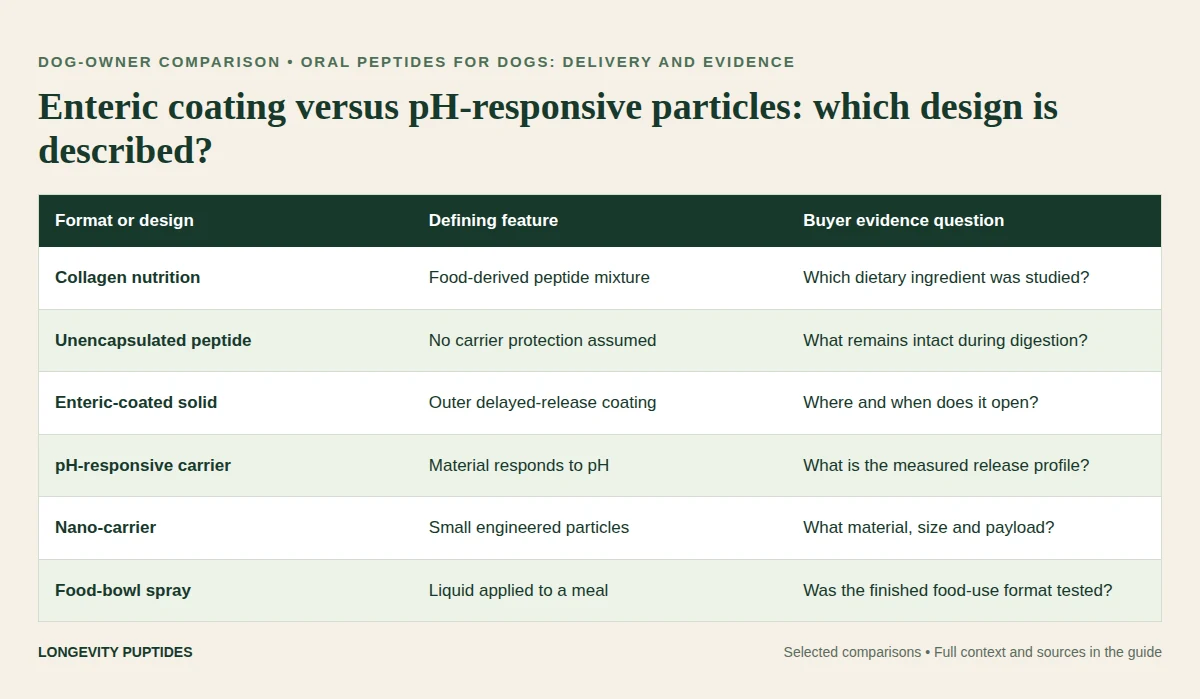
Enteric coating versus pH-responsive particles: which design is described?
Enteric describes a formulation intended to delay release until intestinal conditions are encountered. A conventional enteric coating can surround a solid dosage form. A pH-responsive carrier instead uses material whose behavior changes with pH; depending on its chemistry, it may dissolve, swell or allow its contents to diffuse out. Nano describes a small carrier scale, not an automatic enteric property. These strategies can be combined, but the words do not mean the same thing.
A plausible design uses chemical groups that change their electrical charge as pH changes. This can alter the carrier's structure and release behavior. In Jelvehgari and colleagues' 2010 primary study, insulin nanoparticles made with Eudragit L100-55 and different chitosan molecular weights showed pH-dependent release in laboratory testing at pH 1.2 and 7.4. Changing the chitosan also changed particle characteristics and release profiles. No dogs were given these formulations in that experiment.
That study makes formulation design concrete: material identity matters, not merely a technology label. Its polymers and insulin are research examples, not a disclosure of ingredients in the Longevity Puptides platform. The enteric peptide delivery guide explains the terminology further. Use the comparison below to identify the question a supplier's description actually answers.
| Format or design | Defining feature | Buyer evidence question |
|---|---|---|
| Collagen nutrition | Food-derived peptide mixture | Which dietary ingredient was studied? |
| Unencapsulated peptide | No carrier protection assumed | What remains intact during digestion? |
| Enteric-coated solid | Outer delayed-release coating | Where and when does it open? |
| pH-responsive carrier | Material responds to pH | What is the measured release profile? |
| Nano-carrier | Small engineered particles | What material, size and payload? |
| Food-bowl spray | Liquid applied to a meal | Was the finished food-use format tested? |
Why a food-bowl spray needs its own formulation evidence
A sprayed liquid does not acquire the continuous outer coating of an enteric tablet simply because it contains small particles. A particle-based strategy could instead be designed around individual carriers dispersed in the liquid. The meaningful description would identify the carrier material, how the peptide is associated with it and the conditions intended to trigger release. 'Nano-encapsulated' alone leaves each of those questions open.
Food contact adds a setting that a clean buffer does not reproduce. Wet food and dry kibble differ in moisture and composition, while the time between application and eating varies across households. A useful finished-formula study would examine the actual liquid, pump output and permitted food context before following gastric-to-intestinal conditions. These are questions to ask about documentation, not instructions to change meals or experiment with a formulation at home.
The veterinary formulation review explains that food effects on oral formulations can differ with the molecule and preparation. Food is not universally an enhancer or a barrier. For everyday format comparisons, spray-on dog food toppers discusses the bowl experience separately from peptide-delivery science. A familiar feeding method can be easy to picture while its scientific questions remain precise.
Does a human enteric design translate to dogs?
Not by assumption. In Lui and colleagues' March 1986 primary comparison, researchers used radiotelemetric equipment to record gastrointestinal pH in four Beagle dogs and ten humans. Mean fasting intestinal pH was 7.3 in the dogs and 6.0 in the humans. Quiescent gastric pH also differed. These are measurements in a small research sample, not fixed values for every dog or every meal.
The practical implication is that a release trigger needs canine context. A threshold selected for a human formulation may encounter a different environment in a dog. The 2022 veterinary review specifically calls for careful evaluation of enteric release in dogs because gastric pH fluctuates and small-intestinal transit can be relatively rapid. It also identifies gaps in published information about canine gastrointestinal fluid composition after feeding.
Species is therefore more than a body-weight adjustment. A fed dog, a fasted research Beagle and a human participant are different testing settings. Ask whether a paper measured release in a laboratory buffer, used canine material or administered the complete formulation to dogs. Those details help you judge relevance without turning an old average pH value into a feeding rule.
What has actually been measured with oral nanocarriers in dogs?
A useful direct example is Uhl and colleagues' study, first published June 27, 2023. Its title is A Nanocarrier Approach for Oral Peptide Delivery: Evaluation of Cell-Penetrating-Peptide-Modified Liposomal Formulations in Dogs. Researchers examined liposomes modified with a cyclic cell-penetrating peptide and tested oral formulations in four Beagles. Liposomes are lipid-based carriers; this was a specific engineered laboratory system.
For exenatide, the modified liposomal formulation produced mean absolute oral bioavailability of 0.29%, compared with approximately 0.01% for free exenatide or unmodified control liposomes. Bioavailability here describes the measured extent of systemic exposure relative to an intravenous reference, with the study's calculation accounting for administered amounts. The roughly twentyfold relative increase and the small absolute percentage are two descriptions of the same formulation comparison, not contradictory findings.
Also distinguish a local gastrointestinal question from a systemic one. Systemic exposure means the study measured material in circulation; a local question might instead examine changes within intestinal tissue. The intended endpoint determines what researchers need to measure. The Uhl experiment used blood concentration measurements and an intravenous comparison, which makes its exposure calculation interpretable. It did not ask owners whether their dogs moved differently or measure long-term daily wellbeing. When you read a study, keep the endpoint visible alongside the formulation: a blood result, tissue measurement and everyday observation each describe a different part of the evidence.
The paper separately reported 3.9% for vancomycin in its selected modified liposomes. That number belongs to a different payload. Neither exenatide nor vancomycin is a Longevity Puptides catalog ingredient. The buyer lesson is not to borrow either percentage, but to recognize how much specificity a genuine dog-delivery result contains. The research library helps keep formulation findings attached to their original papers.
Why the same peptide name is not enough
BPC-157 provides a clear route example. He and colleagues' 2022 primary pharmacokinetic paper included six Beagle dogs, but its canine experiments used intravenous and intramuscular administration. Researchers measured blood concentrations over time. Those dog data answer an injection-exposure question; they do not supply an oral percentage. The BPC-157 for dogs article separates that ingredient record from food-bowl products.
Molecule identity adds another distinction. In Jiang and colleagues' study, published online December 15, 2022, researchers compared native MOTS-c with an engineered analogue called MP in a chemically induced mouse colitis model. Oral native MOTS-c did not produce significant improvement in that model; oral MP gave a different result. MP had an added cell-penetrating sequence, so it was not simply native MOTS-c in a convenient format.
This mouse experiment is useful for understanding why chemical modification matters, not for selecting a digestive product for a dog. It also illustrates why an outcome experiment cannot automatically tell you how much intact peptide entered circulation. When a retailer cites 'oral peptide research,' check both the route and the exact molecule before deciding whether the reference matches the label.
Collagen peptides: a different nutrition question
Hydrolyzed collagen is collagen broken into smaller protein fragments. It is a mixture rather than one defined signaling peptide. Its source and hydrolysis process help identify the ingredient being evaluated. A canine nutrition paper can therefore be relevant to a particular collagen preparation without becoming evidence for BPC-157, GHK-Cu or MOTS-c. The shared word peptide does not create that scientific bridge.
In Dobenecker and colleagues' September 19, 2024 study, 31 dogs with diagnosed osteoarthritis completed a twelve-week, blinded, placebo-controlled dietary study. The collagen preparation was derived predominantly from type-I porcine collagen and mixed into regular meals. Researchers reported changes in selected force-plate and owner-questionnaire measures, while accelerometer activity was unaffected. The paper disclosed manufacturer funding and author commercial interests.
That is a specific nutritional study in dogs with an existing diagnosis, not a universal collagen verdict or an experimental-spray comparison. Dietary choices belong within the overall feeding plan. Our dog nutrition and longevity guide puts a complete, appropriate diet first, while dog joint supplements provides owner context for discussing nutrition alongside veterinary care. None of the ten Longevity Puptides formulas is cataloged as a collagen supplement.
Which documents make an oral-delivery claim worth reading?
Begin with the full ingredient list and a paper that matches the ingredient identity. Then look for an actual formulation description rather than a diagram of particles traveling toward an organ. A meaningful report distinguishes carrier-associated peptide from free peptide and uses an assay suited to identifying the intact molecule. Measuring total protein or a label attached to fragments can answer a different analytical question.
For pH-responsive design, look for the test conditions and time course, not just a final release percentage. Ask whether enzymes were included, whether the test followed sequential gastric and intestinal conditions and whether the food-applied formulation was examined. A laboratory release study and a canine concentration-time study have different endpoints. A report about owner-observed changes needs its own comparison group and predefined measures.
A supplier's document is most useful when it states which sample was tested. A raw-ingredient certificate can describe that ingredient's identity or analytical purity, while a carrier-development report describes the material used in that experiment. A finished-formula report should identify the complete preparation and the tested conditions. These records can complement one another, but they should not be collapsed into a single 'lab tested' badge. Ask for the result relevant to the question you are comparing, and check that the report identifies its sample rather than relying on a familiar compound name in the document heading.
Our where to buy peptides for dogs guide addresses sourcing, while the product research checklist helps organize evidence questions. Bring the exact label and your dog's current food, medicines and supplements to a veterinary conversation. Vomiting, appetite loss, pain or a sustained change in movement needs veterinary evaluation, not a switch to a peptide ingredient selected from a symptom list.
Where the Longevity Puptides collection fits
Longevity Puptides offers a ten-formula catalog in one format: 2 fl oz / 60 mL metered food-bowl sprays with 600 metered sprays per bottle. Its platform is described as pH-responsive nano-encapsulation & delivery technology. This describes the intended design approach; the bottle count describes packaging. Neither is a dog-use schedule or a comparison with a prescription formulation.
Belly Balance names BPC-157 as its active ingredient, while Bright Mind names MOTS-c. These are useful pages for checking exact ingredient identity after reading the route and analogue distinctions above. Compare the catalog's disclosed format with the formulation in each cited paper, rather than expecting an ingredient name or collection name to carry the whole evidence story.
Common questions
Are collagen peptides and experimental oral peptides the same?
No. Collagen hydrolysates are food-derived mixtures. Experimental signaling peptides are defined study materials with different identities and research questions. Evidence for a particular collagen preparation does not establish another peptide or spray.
Does pH-responsive mean stomach-proof?
No. It means a material is designed to change behavior with pH. A measured release profile describes the tested formulation and conditions, not freedom from every digestive barrier.
Is nano-encapsulation the same as an enteric coating?
No. Nano describes small carriers; enteric describes intended delayed release in intestinal conditions. A formulation may combine both approaches, but one term does not establish the other.
Have oral peptide nanocarriers been tested in dogs?
Yes. The linked 2023 Uhl study tested engineered liposomal exenatide and vancomycin formulations in four Beagles. It measured formulation-specific systemic exposure, not performance of a catalog food-bowl spray.
Why does a twentyfold increase not mean twenty percent?
A fold change is relative to a comparison value. In the exenatide experiment, the modified formulation reached 0.29% absolute oral bioavailability from a much smaller baseline. Relative improvement and absolute exposure are different numbers.
Can injected BPC-157 dog studies answer oral-delivery questions?
They provide canine injection-exposure information. They do not measure what happens when BPC-157 is swallowed with food, so their percentages should not be relabeled as oral results.
Does an oral MOTS-c analogue validate native MOTS-c?
No. An engineered analogue has a different molecular identity. The cited mouse experiment tested added-sequence MP separately from native MOTS-c; its model findings do not establish a canine formulation.
Does food always improve peptide delivery?
No general answer applies. Food effects depend on the molecule, formulation and testing conditions. A food-bowl product needs evidence in its actual intended meal context, rather than assumptions from fasting or buffer experiments.
What does the 600-spray bottle count tell me?
It identifies the catalog's metered packaging format. It does not specify sprays per meal, a dog dose, a treatment duration or an outcome. This guide supplies no administration schedule.
Should I choose a peptide because my dog has digestive or movement symptoms?
Symptoms need veterinary evaluation. Bring the complete product label and your dog's diet and medication history to that discussion; a buyer guide is not a substitute for assessment or prescribed care.
About this guide
Author and publisher: Longevity Puptides.
Written and published by Longevity Puptides as a source-backed educational buyer guide. The publisher has a commercial interest in its collection; no veterinarian or clinician is credited with reviewing or endorsing this guide.
Editorial standards and correctionsRead the original sources
- Oral delivery of protein and peptide drugs: from non-specific formulation approaches to intestinal cell targeting strategies — Theranostics, January 1, 2022; review ↗
- Jelvehgari et al.: Development of pH-sensitive Insulin Nanoparticles using Eudragit L100-55 and Chitosan with Different Molecular Weights — August 5, 2010; primary laboratory study ↗
- Lui et al.: Comparison of gastrointestinal pH in dogs and humans: implications on the use of the beagle dog as a model for oral absorption in humans — March 1986; primary comparative study ↗
- Uhl et al.: A Nanocarrier Approach for Oral Peptide Delivery: Evaluation of Cell-Penetrating-Peptide-Modified Liposomal Formulations in Dogs — June 27, 2023; primary canine study ↗
- He et al.: Pharmacokinetics, distribution, metabolism, and excretion of body protective compound 157, a potential drug for treating various wounds, in rats and dogs — 2022; primary injection study ↗
- Jiang et al.: Orally administered MOTS-c analogue ameliorates dextran sulfate sodium-induced colitis by inhibiting inflammation and apoptosis — online December 15, 2022; January 2023 issue; primary mouse study ↗
- Dobenecker et al.: The oral intake of specific Bioactive Collagen Peptides (BCP) improves gait and quality of life in canine osteoarthritis patients—A translational large animal model for a nutritional therapy option — September 19, 2024; primary canine nutrition study ↗
- Impact of gastrointestinal differences in veterinary species on the oral drug solubility, in vivo dissolution, and formulation of veterinary therapeutics — February 14, 2022; comparative veterinary review ↗