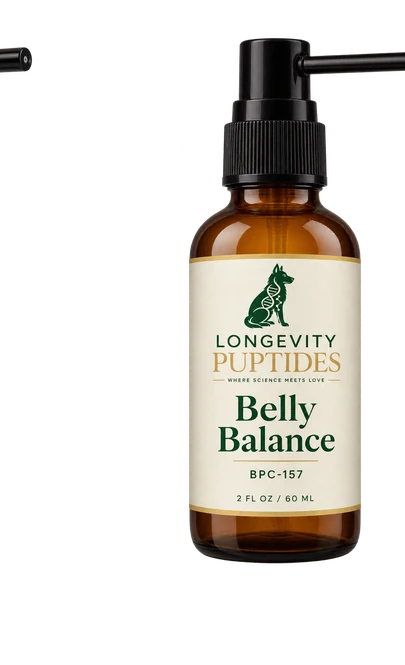
BPC-157 is a 15-amino-acid peptide investigated mainly in laboratory and animal models of tissue and digestive biology. Dog owners searching for BPC-157 need to distinguish those findings from controlled canine trials and from a finished food-bowl spray.
What is BPC-157?
BPC-157 is a synthetic 15-amino-acid peptide that corresponds to a sequence studied as a fragment of a gastric body-protection compound. Researchers have investigated it in gastrointestinal injury models, including how gastric lesions and tissue changes respond after laboratory administration. They have also measured how BPC-157 moves through the blood and is cleared in Beagle dogs after intravenous or intramuscular administration.
How strong is the evidence?
BPC-157 has digestive-model research in rats and injected pharmacokinetic data in dogs. No cited study tested digestive outcomes from Belly Balance.
The best way to judge a paper is to start with what was tested: the molecule, animal or cell model, administration route, comparator and measured endpoint. A laboratory change is different from a dog becoming more comfortable, and a small uncontrolled case series cannot separate the effect of several ingredients from other care.
See the research questions side by side.
Our six-study comparison keeps canine copper-complex injections, a GHK-Cu rat null result and paper-labeled TB-500 tendon research separate. It records the species, route, endpoint and finished-product limits rather than ranking sprays.
canine PK or case series — Beagle dogs; intravenous and intramuscular administration
Pharmacokinetics, distribution, metabolism, and excretion of body-protective compound 157, a potential drug for treating various wounds, in rats and dogs
In six Beagle dogs, single intravenous BPC-157 had a mean plasma half-life of about 5.27 minutes. After intramuscular doses of 6, 30, or 150 micrograms per kilogram, peak plasma concentrations occurred within about 6 to 9 minutes and the measured half-life was about 20 to 29 minutes. Seven daily intramuscular administrations at 30 micrograms per kilogram produced a similar concentration-time pattern to a single administration.
This was a pharmacokinetic study of laboratory BPC-157 delivered by injection. It measured plasma exposure and elimination, not digestive outcomes, oral food exposure, or a food-bowl spray.
He L, Feng D, Guo H, et al. Frontiers in Pharmacology. 2022;13:1026182. doi:10.3389/fphar.2022.1026182.
canine PK or case series — dogs; repeated-dose toxicology with intramuscular test-article administration
Preclinical safety evaluation of body protective compound-157, a potential drug for treating various wounds
This multi-species preclinical program included repeated-dose evaluations in dogs. The report found no abnormal changes between treated and solvent-control groups apart from a creatinine decrease at 2 mg/kg that was not seen at lower doses; the animals recovered after a two-week withdrawal period. The report also described mild local irritation in a local-tolerance test.
This was a preclinical toxicology program using a specified laboratory test article and study routes. It was not a canine digestive study, not a test of oral or food-contact exposure, and not a study of Belly Balance.
Xu C, Sun L, Ren F, et al. Regulatory Toxicology and Pharmacology. 2020;114:104665. doi:10.1016/j.yrtph.2020.104665.
other-mammal — male Wistar rats; intragastric and intramuscular administration
Protective effects of pentadecapeptide BPC 157 on gastric ulcer in rats
In 330 male Wistar rats across indomethacin-, pylorus-ligation-, and acetate-induced gastric-ulcer models, BPC-157 was administered intragastrically or intramuscularly at 200, 400, or 800 nanograms per kilogram. The investigators measured smaller ulcer areas and changes associated with healing in the induced models; intramuscular administration produced stronger effects than intragastric administration in the reported comparisons.
This was induced gastric-injury research in rats using laboratory administration and model-specific endpoints. It is not evidence about everyday canine digestion, a dog's response, or a finished food-bowl spray.
Xue XC, Wu YJ, Gao MT, et al. World Journal of Gastroenterology. 2004;10(7):1032-1036. doi:10.3748/wjg.v10.i7.1032.
review — mixed preclinical and human literature; routes varied by included study
Emerging Use of BPC-157 in Orthopaedic Sports Medicine: A Systematic Review
The review identified 36 eligible studies through June 3, 2024: 35 preclinical studies and one clinical study. It reported that no clinical safety data were found in the included literature and characterized the evidence base as largely level IV and V research.
This review focused on orthopedic sports-medicine mechanisms, musculoskeletal outcomes, metabolism, and safety rather than canine digestive outcomes or food-bowl delivery. It is useful for describing the breadth and limitations of the literature, not for predicting a result in a dog.
Vasireddi N, Hahamyan H, Salata MJ, et al. HSS Journal. 2025;21(4):485-495. doi:10.1177/15563316251355551.
An injection, laboratory cell exposure and oral formulation can produce very different exposure. Swallowed peptides encounter stomach conditions, digestive enzymes, mucus and the intestinal barrier. Enteric carrier design addresses a delivery step; it does not convert an injected study into a food-bowl spray trial.
Use the original papers to understand why scientists investigate this ingredient, not to create a dosing schedule. For a dog with symptoms or taking medication, discuss the actual formulation and full ingredient list with your veterinarian. New or persistent changes in movement, appetite, sleep or behavior deserve a veterinary assessment rather than an ingredient experiment.
Products with this ingredient.
Ingredient membership—not a claim that the studies tested these sprays.
These additional papers help an owner understand how BPC-157 has been studied in intestinal injury, surgical reconnection models, and enteric-nerve signaling, while keeping the evidence anchored to the species and routes actually tested. Together they add mechanistic and gastrointestinal context, but they do not test Belly Balance, a food-bowl spray, or digestive outcomes in dogs.
mechanism review
Cytoprotective Mechanism of the Novel Gastric Peptide BPC157 in Gastrointestinal Tract and Cultured Enteric Neurons and Glial Cells
Wang XY, Qu M, Duan R, et al. Neuroscience Bulletin. 2019;35(1):167-170. doi:10.1007/s12264-018-0269-8. PMID:30116973. · Ex vivo human jejunum, ileum, and colon strips; rat stomach, jejunum, ileum, and colon strips; cultured rat ileal and colonic enteric neurons and enteric glial cells; direct bath or culture-medium exposure to BPC-157, not a live-animal treatment route.
In isolated rat and human intestinal preparations, 40 micromol/L BPC-157 reduced the amplitude of spontaneous muscle contractions. It also lowered measured enteric 5-HT in rat ileal and colonic samples, while the human 5-HT result was inconsistent and did not show the same reduction in samples from patients with colonic cancer. In rat cell cultures, 100 micromol/L BPC-157 increased four-week survival of ileal enteric neurons from 19.23% in controls to 31.69% and increased enteric-glial proliferation from 147.98% to 159.95% of the day-three cell count.
Why it belongs here: This is useful broader mechanism reading because it connects BPC-157 with enteric serotonin measurements, intestinal motility, enteric neurons, and enteric glia rather than relying only on ulcer-area endpoints. The mixed human tissue findings also show why a laboratory mechanism should not be treated as a uniform digestive effect.
What this paper can—and cannot—tell us
The study used isolated tissues and cultures, not dogs or a food-applied product. Concentrations were direct experimental exposures, and the authors stated that the detailed signaling pathway in enteric neurons and enterocytes still required further investigation; the results do not establish oral absorption, finished-product performance, safety, or a clinical digestive outcome.
Stable gastric pentadecapeptide BPC 157 in trials for inflammatory bowel disease (PL-10, PLD-116, PL14736, Pliva, Croatia) heals ileoileal anastomosis in the rat
Vuksic T, Zoricic I, Brcic L, et al. Surgery Today. 2007;37(9):768-777. doi:10.1007/s00595-006-3498-9. PMID:17713731. · Rats with surgically created ileoileal anastomoses; BPC-157 10 micrograms/kg, 10 nanograms/kg, or 10 picograms/kg administered intraperitoneally once daily, beginning after surgery and ending 24 hours before assessment.
At the two higher tested doses, the investigators reported improvement across macroscopic, histologic, and biomechanical measures of anastomotic healing. Edema was lower from day one, granulocyte numbers decreased, and from days four or five the study reported less necrosis with more granulation tissue, reticulin, collagen formation, and epithelialization; adhesion formation remained slight and temporary mild obstruction was observed.
Why it belongs here: This adds a distinct intestinal-surgery model to the existing gastric-ulcer evidence and shows the kinds of tissue-integrity endpoints researchers have used for BPC-157. It may help explain why intestinal repair is a recurring research topic without converting a postoperative rat result into an everyday-digestion claim.
What this paper can—and cannot—tell us
This was a rat surgical-injury experiment with intraperitoneal dosing, not a canine study, routine feeding study, or food-bowl spray. It measured healing of a deliberately created anastomosis rather than normal gastrointestinal function, and it does not establish absorption, dosing, safety, stability, or efficacy for Belly Balance.
Stable gastric pentadecapeptide BPC 157 heals cysteamine-colitis and colon-colon-anastomosis and counteracts cuprizone brain injuries and motor disability
Klicek R, Kolenc D, Suran J, et al. Journal of Physiology and Pharmacology. 2013;64(5):597-612. PMID:24304574. · Wistar rats with intrarectal cysteamine colitis or colon-colon anastomosis; BPC-157 given intraperitoneally at 10 micrograms/kg or 10 nanograms/kg once daily, or orally in drinking water at 0.16 micrograms/mL or 0.16 nanograms/mL; the paper also used an intragastric route in a separate cuprizone model.
In the reported experiments, untreated controls did not heal the cysteamine colitis or colon-colon anastomosis, whereas BPC-157 treatment was described as producing efficient healing in both models. The authors tested both intraperitoneal dosing and drinking-water exposure, and assessed colon injury and anastomosis endpoints alongside histologic and functional measures; the same paper also reported less cuprizone-related neural damage and better motor measures, which are separate from the GI experiments.
Why it belongs here: This is one of the more directly relevant broader readings for gastrointestinal research because it includes chemically induced colitis, a colon surgical model, and an oral drinking-water exposure rather than only injection. It helps distinguish a controlled injury model from a claim about a healthy dog’s ordinary digestion.
What this paper can—and cannot—tell us
All intervention findings were in rats, with induced disease or surgery and laboratory administration. The drinking-water route is not equivalent to a metered spray applied to dog food, and the study did not test dogs, the finished product, palatability, stability in food, or clinical digestive outcomes.
Stable Gastric Pentadecapeptide BPC 157 and Intestinal Anastomoses Therapy in Rats—A Review
Bajramagic S, Sever M, Rasic F, et al. Pharmaceuticals. 2024;17(8):1081. doi:10.3390/ph17081081. PMID:39204186. · Review of preclinical rat studies involving intestinal and other gastrointestinal anastomoses, fistulas, short-bowel and colitis models; routes across the reviewed studies include intraperitoneal, oral/drinking-water, intragastric, and local administration.
The review organizes reported BPC-157 findings across esophagogastric, colocolonic, jejunoileal, and ileoileal anastomoses, as well as several fistula and intestinal-adaptation models. It presents recurring discussions of epithelial and endothelial integrity, nitric-oxide and prostaglandin systems, and collateral vascular responses as possible explanatory themes, while the underlying evidence remains predominantly rat preclinical work.
Why it belongs here: This provides a broader map of the gastrointestinal literature and clarifies that the research question is often surgical tissue repair or induced injury, not routine digestive wellness. It is useful for understanding how proposed mechanisms are assembled across multiple models and routes.
What this paper can—and cannot—tell us
This is a narrative review rather than a new controlled trial, and its conclusions depend largely on a preclinical literature concentrated in rats and on studies from related research programs. It does not establish canine efficacy, oral bioavailability from food, finished-spray safety or stability, a dose, or prevention or treatment of disease in an individual dog.