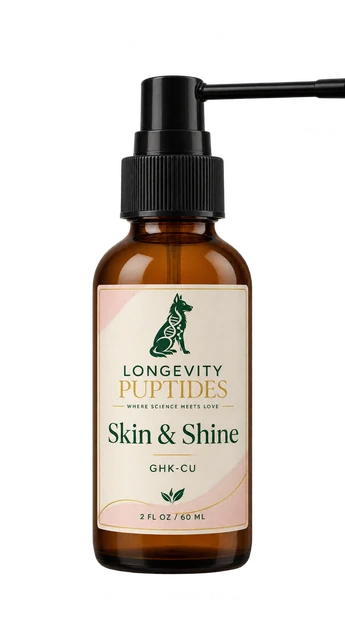
GHK-Cu is a copper-binding tripeptide studied in skin and connective-tissue biology. The selected dog, rat and cell experiments used different routes and did not test a finished food-bowl spray. Meet the ingredient behind Skin & Shine.
What does the copper in GHK-Cu mean?
GHK stands for glycyl-L-histidyl-L-lysine, a peptide made from three amino acids. It has an affinity for copper(II) ions; GHK-Cu names the copper-bound complex. Here, copper binding describes a chemical association, not a delivery result. The original Maquart fibroblast study identifies this complex and investigates its effect on collagen synthesis in cultured cells.
The distinction is worth keeping on a label as well as in a paper. GHK without specified copper binding, GHK-Cu and a broadly named copper ingredient are not interchangeable descriptions. The name GHK-Cu does not establish that a dog needs additional copper, or show how a particular formulation behaves after it reaches the food bowl. Ingredient identity is the beginning of the question, not the answer to every question about use.
Why researchers look at collagen-producing cells
Fibroblasts are cells involved in producing connective-tissue material. In the 1988 cell-culture experiment, direct exposure to GHK-Cu increased collagen synthesis without a change in cell number. That makes this a useful, specific observation: the researchers measured collagen production, rather than simply finding more cells in the culture.
It is not an observation of a dog’s fur. A culture allows controlled contact between a test material and cells; it does not reproduce a meal or measure a living dog’s coat. The accessible abstract does not specify the fibroblast species. GHK’s reported isolation from human plasma is not enough to label those cultured cells as human.
The dog experiment tested local paw-pad injections
There is canine research in this selected evidence set. Swaim and colleagues’ 1996 experiment involved twelve mature English Pointers with experimentally created paw-pad wounds. Researchers injected a material described as a tripeptide-copper complex directly into those wounds and compared it with saline and a separate immunostimulant.
Copper-complex wounds contained more type-I collagen than controls at day six and significantly more than the other wound groups at day fourteen. The abstract’s strongest early healing-rate and hydroxyproline findings concerned the immunostimulant, not the copper complex. Keeping those findings with the correct material matters. The canine result concerns local wound tissue; it does not test healthy coat appearance, hair growth or GHK-Cu applied to food.
Two rat models, with different results
The often-cited Canapp study from 2003 used twenty-four adult male Sprague-Dawley rats, not dogs. A topical copper-tripeptide gel was tested on surgically created wounds with restricted blood supply. Wound area was smaller than in untreated controls at several time points; significant comparisons with the gel vehicle occurred on days three and nine, not throughout the experiment. Selected tissue-marker concentrations were also lower than in untreated controls.
The contrasting null result comes from Parker and colleagues in 2013. In irradiated surgical skin flaps in rats, topical GHK-Cu did not significantly differ from control ointment for flap ischemia, blood-vessel measurements or VEGF expression at the study’s statistical threshold. VEGF is a vessel-growth marker. Canapp’s positive findings and Parker’s null findings both belong in the account. Different wound models gave different results; neither measured coat changes in dogs.
A topical gel is not a food-bowl spray
Local injection places the test material into wound tissue. Topical application places a gel on the study site. Cell-culture exposure brings a material directly into contact with cells. A food-bowl spray represents a different formulation and route. None of these selected experiments follows GHK-Cu from application to dog food through to a measured canine coat outcome.
The collection’s delivery-platform wording is pH-responsive nano-encapsulation & delivery technology. That is a catalog description, not a finding from these GHK-Cu papers. Questions about release, exposure and an owner-visible outcome remain separate. The existing delivery-science guide explains the terminology without turning an injected or topical result into evidence for a finished spray.
Collagen findings and coat questions are different
An owner may reasonably wonder about coat appearance, shedding or a change noticed during grooming. Those questions require relevant measurements in dogs, not a renamed wound endpoint. More collagen in a tissue sample does not tell us whether a coat looks different. Lower concentrations of selected markers in a rat wound do not answer an owner’s question about persistent scratching.
Evidence for an exact spray would need to identify the finished formulation, use its intended route and measure a clearly defined canine outcome against an appropriate comparison. The selected papers do not provide that chain. This leaves room for genuine scientific interest while keeping the promise to your dog no larger than the evidence.
Questions a clear label should help answer
Start with the exact ingredient description: does it identify GHK-Cu, rather than leave the peptide and copper association unclear? Then separate the complete formulation from the headline active ingredient. Other ingredients, the stated product format, manufacturer details and lot information help identify the actual item being discussed; a paper title alone cannot do that.
A useful evidence question is, “Was this exact formulation studied in dogs through this route, and what was measured?” A second is, “What product-specific information supports the delivery language?” The product research checklist provides a place to organize those questions. A concise answer that names a remaining gap is more informative than a long list of loosely related papers.
When the question is about your dog’s skin
Curiosity about an ingredient is different from understanding a skin change in an individual dog. Persistent scratching, hair loss or recurring skin changes belong in a veterinary conversation rather than being interpreted through collagen research. The AAHA allergic-skin-disease guidelines describe a clinical assessment framework; they are not an endorsement of GHK-Cu.
That conversation can put the complete product label alongside your dog’s regular food, other products, medications and recent changes. This guide explains what the selected studies tested. It does not establish individual suitability or replace an assessment of why a dog’s skin or coat has changed.
GHK-Cu in the existing collection
Skin & Shine is the existing Longevity Puptides food-bowl spray listing GHK-Cu in the Skin & Coat family. This is ingredient membership and catalog context, not a statement that Skin & Shine was used in any of these studies. The research-library comparison keeps the canine injection result and rat null result visible together.
See the research questions side by side.
Our six-study comparison keeps canine copper-complex injections, a GHK-Cu rat null result and paper-labeled TB-500 tendon research separate. It records the species, route, endpoint and finished-product limits rather than ranking sprays.
Canine controlled experimental wound study — primary abstract verified; random allocation not established by the accessible abstract
Effect of locally injected medications on healing of pad wounds in dogs
In twelve mature English Pointers, locally injected tripeptide-copper complex was associated with more type-I collagen than saline controls at day six and significantly more than other wound groups at day fourteen. Early healing-rate and hydroxyproline findings favoring the separate immunostimulant are not attributed to copper complex.
Created paw-pad wounds and intralesional injection. The abstract’s material name is retained; this is not proof of GHK-only activity, food-bowl delivery or coat benefit from Skin & Shine.
Swaim SF, Vaughn DM, Kincaid SA, et al. American Journal of Veterinary Research. 1996;57(3):394–399. PMID: 8669775.
The effect of topical tripeptide-copper complex on healing of ischemic open wounds
Wound area was smaller than untreated controls at several time points. Significant gel-versus-vehicle differences occurred on days three and nine. TNF-alpha, MMP-2 and MMP-9 concentrations were lower than untreated controls at sampled time points.
Restricted-blood-supply wound model in rats, not dogs. Positive, comparator-specific findings are not a coat outcome or a finished-spray result; this is not the rat null-result paper.
Canapp SO Jr, Farese JP, Schultz GS, et al. Veterinary Surgery. 2003;32(6):515–523. doi:10.1111/j.1532-950X.2003.00515.x.
Effects of topical copper tripeptide complex on wound healing in an irradiated rat model
No significant differences in flap ischemia, blood-vessel number or area, or VEGF expression at the prespecified P < .01 threshold. The ischemic-area comparison’s P = .011 did not meet that threshold.
A model-specific null result, not proof of universal ineffectiveness or statistically significant harm. No canine food-route or finished-product testing.
In vitro mechanism experiment — direct cultured-fibroblast exposure; primary abstract verified; cell species unspecified
Stimulation of collagen synthesis in fibroblast cultures by the tripeptide-copper complex glycyl-L-histidyl-L-lysine-Cu2+
GHK-Cu increased collagen synthesis in cultured fibroblasts independently of a change in cell number under the tested conditions.
A cell-culture measurement, not a living-dog coat endpoint. Human-plasma origin of GHK does not establish the cultured-cell species; no finished food-bowl spray was tested.
Maquart FX, Pickart L, Laurent M, et al. FEBS Letters. 1988;238(2):343–346. doi:10.1016/0014-5793%2888%2980509-X.
GHK names the three-amino-acid peptide; GHK-Cu names its copper-bound complex. A generic copper ingredient is not the same description. Copper-binding terminology does not establish a nutritional need in your dog.
Was the Canapp study carried out in dogs?
No. Canapp’s 2003 study tested a topical gel in rats with experimental ischemic wounds. The canine paper here is Swaim’s 1996 local-injection experiment. Parker’s 2013 rat paper supplies the contrasting null result.
Does more collagen mean my dog will have a shinier coat?
Not from these findings. Collagen synthesis in cells and collagen content in wound tissue are different measurements from coat appearance. None of the selected studies measured a coat benefit from a GHK-Cu food-bowl spray.
Does encapsulation mean these studies apply to a meal?
No. Delivery-platform wording does not change the route used in an original experiment. Evidence about an exact formulation’s release or exposure would be separate from evidence about an owner-visible canine outcome.
Which existing Longevity Puptides product lists GHK-Cu?
Skin & Shine lists GHK-Cu in the existing Skin & Coat collection. That identifies the catalog formula, not a product tested in these papers. Its product page and complete label are distinct from the ingredient-study records.
Products with this ingredient.
Ingredient membership—not a claim that the studies tested these sprays.
These additional papers help an owner understand how GHK-Cu has been studied beyond the existing canine injection, topical rat, and fibroblast cards: extracellular-matrix remodeling, wound-stage biology, and the limits of translating topical human findings to a dog product. Together they add mechanistic depth and an important negative clinical result without treating laboratory, topical, or wound-model evidence as proof for an oral food-bowl spray.
mechanism review
Regenerative and Protective Actions of the GHK-Cu Peptide in the Light of the New Gene Data
Pickart L, Margolina A. Regenerative and Protective Actions of the GHK-Cu Peptide in the Light of the New Gene Data. International Journal of Molecular Sciences. 2018;19(7):1987. doi:10.3390/ijms19071987. · Review of human-cell, animal, and tissue-repair literature; routes and models varied and were not standardized to oral or food delivery.
The review describes GHK/GHK-Cu research involving collagen, elastin, glycosaminoglycan, fibroblast, angiogenesis, inflammatory, and gene-expression measurements. It emphasizes that the literature spans multiple biological systems and proposed pathways rather than one demonstrated skin or coat outcome.
Why it belongs here: It explains why GHK-Cu is studied in connective-tissue remodeling and places collagen-related findings alongside broader cellular observations. It also helps separate mechanistic and preclinical evidence from evidence about a finished canine spray.
What this paper can—and cannot—tell us
This is a narrative review, not a new controlled canine study. It includes heterogeneous studies, some involving GHK rather than the copper complex, and does not establish oral absorption, product stability, safety, or a skin or coat benefit in dogs.
A Systematic Review of the Mechanisms and Therapeutic Applications of GHK-Cu (Glycyl-L-Histidyl-L-Lysine-Copper Complex) in Topical Microneedle Delivery: A Case for Expanded Clinical Trials
Najafi N, Maatouk H, Vardanyan KG, Vartanian KB, Agrawal DK. A Systematic Review of the Mechanisms and Therapeutic Applications of GHK-Cu (Glycyl-L-Histidyl-L-Lysine-Copper Complex) in Topical Microneedle Delivery: A Case for Expanded Clinical Trials. Archives of Internal Medicine Research. 2026;9(3):269-293. doi:10.26502/aimr.0255. · Systematic review of in vitro, ex vivo, rodent, non-rodent, and human studies, with emphasis on topical and microneedle delivery; no canine food-bowl route was tested.
The review retained 64 records and reports that the human literature remains small and heterogeneous. It identifies a major gap: no adequately powered published human randomized trial had evaluated GHK-Cu delivered by a microneedle platform, while study concentrations, topical formulations, outcomes, and methods varied substantially; it also notes that most human studies were small and often incompletely reported.
Why it belongs here: This is useful for understanding delivery as a separate scientific question from ingredient mechanism. It supports cautious interpretation of topical and enhanced-delivery results and makes clear that those findings cannot establish behavior in a meal-applied spray.
What this paper can—and cannot—tell us
The review is recent and its conclusions depend on the quality and reporting of the included studies; it is not a canine efficacy or safety trial. Microneedle, cream, ex vivo skin, and cell studies do not demonstrate that GHK-Cu survives food contact, reaches canine skin, or produces a finished-product outcome.
The tripeptide-copper complex glycyl-L-histidyl-L-lysine-Cu2+ stimulates matrix metalloproteinase-2 expression by fibroblast cultures
Siméon A, Emonard H, Hornebeck W, Maquart FX. The tripeptide-copper complex glycyl-L-histidyl-L-lysine-Cu2+ stimulates matrix metalloproteinase-2 expression by fibroblast cultures. Life Sciences. 2000;67(18):2257-2265. doi:10.1016/S0024-3205(00)00803-1. PMID:11045606. · Cultured dermal fibroblasts; direct in-vitro exposure to GHK-Cu, copper ions, or GHK without a live-animal route.
GHK-Cu increased matrix metalloproteinase-2 in fibroblast-conditioned media and increased MMP-2 messenger RNA. It also increased secretion of tissue inhibitors of metalloproteinases TIMP-1 and TIMP-2; copper ions reproduced the effect, whereas GHK alone did not under the study conditions.
Why it belongs here: The findings add a specific extracellular-matrix remodeling mechanism rather than treating collagen synthesis as the only relevant endpoint. The paired MMP and inhibitor findings help explain why remodeling biology is more complex than simply increasing one structural protein.
What this paper can—and cannot—tell us
This was a cell-culture experiment with no dog, no intact skin, no oral exposure, and no coat endpoint. Changes in MMP and TIMP measurements do not show improved healing, absorption, safety, or efficacy of a food-bowl spray.
Expression and activation of matrix metalloproteinases in wounds: modulation by the tripeptide-copper complex glycyl-L-histidyl-L-lysine-Cu2+
Siméon A, Monier F, Emonard H, Gillery P, Birembaut P, Hornebeck W, Maquart FX. Expression and activation of matrix metalloproteinases in wounds: modulation by the tripeptide-copper complex glycyl-L-histidyl-L-lysine-Cu2+. Journal of Investigative Dermatology. 1999;112(6):957-964. doi:10.1046/j.1523-1747.1999.00606.x. PMID:10383745. · Male Sprague-Dawley rats with subcutaneous wound chambers; serial local injections of 2 mg GHK-Cu or saline.
In this wound-chamber model, GHK-Cu did not alter interstitial collagenase activity. It increased pro-MMP-2 and activated MMP-2 during later healing stages, while the study described stage-specific expression of MMP-2 and MMP-9 across the healing process.
Why it belongs here: The paper is useful because it shows a time-dependent remodeling result and includes a negative finding, rather than implying that every wound enzyme endpoint moved in the same direction. It gives context for how GHK-Cu may be investigated in tissue repair without converting rat injection data into canine coat claims.
What this paper can—and cannot—tell us
This was a rat wound model using local injections, not a dog study and not oral or food delivery. The enzyme changes are surrogate mechanistic measurements; they do not establish a visible benefit, general skin improvement, dose equivalence, or finished-spray performance.
Effects of topical copper tripeptide complex on CO2 laser-resurfaced skin
Miller TR, Wagner JD, Baack BR, Eisbach KJ. Effects of topical copper tripeptide complex on CO2 laser-resurfaced skin. Archives of Facial Plastic Surgery. 2006;8(4):252-259. doi:10.1001/archfaci.8.4.252. PMID:16847171. · Randomized human topical study; 13 patients completing post-CO2-laser resurfacing regimens with or without a GHK-Cu skin-care product.
Blinded evaluators and computer analysis found no statistically significant difference in the speed or resolution of erythema. Objective assessments also found no significant between-group improvement in wrinkles or overall skin quality, although questionnaire-based satisfaction favored the GHK-Cu group.
Why it belongs here: This small randomized study adds an important mixed result: subjective satisfaction differed, while the main objective skin measures did not. It helps prevent broad claims that topical GHK-Cu consistently improves visible skin outcomes and reinforces that human topical evidence is not canine oral evidence.
What this paper can—and cannot—tell us
Only 13 patients completed the study, and the intervention followed laser resurfacing in human skin rather than routine use in dogs. It did not test ingestion, food contact, coat or hair endpoints, long-term safety, or the finished spray.
Published: November 2, 2026 · Substantive update: November 3, 2026
Focused ingredient studies with primary-abstract/full-text provenance, species and administration routes. Veterinary review: no veterinarian is credited for this guide.