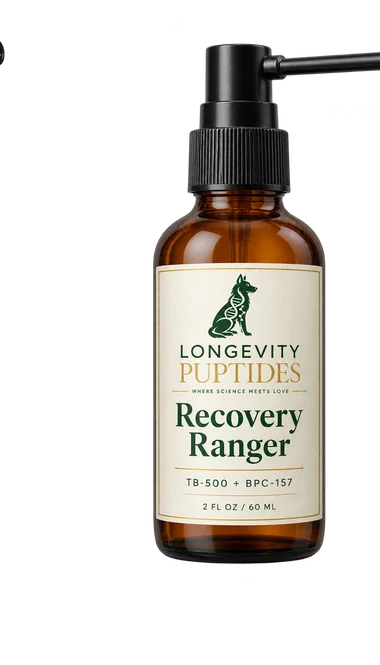
TB-500 is associated with a thymosin beta-4 fragment. Full-length protein, motif and rat tendon findings need separate labels; none of the selected studies tested a finished canine spray. Explore the ingredient science behind Recovery Ranger.
TB-500 and thymosin beta-4: related names, different questions
Full-length thymosin beta-4 is a 43-amino-acid peptide. The Longevity Puptides catalog describes TB-500 as a fragment associated with thymosin beta-4, not as that complete molecule. A fragment contains only part of a longer sequence. Sharing a connection to the same molecule does not make a fragment and the full-length peptide interchangeable research materials.
The name TB-500 also needs attention within a paper. In the selected rat tendon study, the authors call their material synthetic thymosin beta-4 and label it TB-500. They provide a supplier and catalog code, but their reported methods do not establish its amino-acid sequence, length, or batch characterization. That leaves a specific identity gap: the paper does not confirm that its material matches the catalog-described fragment.
What the cell and motif experiment actually showed
Philp and colleagues’ 2003 study examined full-length thymosin beta-4 and a seven-amino-acid actin-binding motif. A motif is a particular short region within a sequence; here, the researchers investigated the region associated with actin binding. The full-length molecule and this motif showed similar activity in the reported cell-migration and vessel-sprouting assays. Peptides missing part of the motif were inactive under those conditions.
The experiments involved human umbilical-vein endothelial cells and chick aortic-arch preparations, not dogs. Endothelial cells are the vessel-related cells used in these assays, and vessel sprouting is the growth process reflected in the paper's term angiogenesis. This is useful mechanism research. It does not identify the material in a TB-500 bottle or show how a dog moves, feels, or responds after a meal.
The rat tendon study—and the combination result
Biçer and colleagues compared control, BPC-157, paper-labeled TB-500, and combined BPC-157 plus TB-500 groups in 32 young male rats after surgical Achilles tendon transection and repair. The research materials were administered by intraperitoneal injection, into the abdominal cavity. The study examined tissue sections and mechanical properties; it was not an everyday activity experiment or a food-bowl study.
Only the paper-labeled TB-500 arm significantly exceeded control for maximum load to failure in adjusted pairwise comparisons. The combination did not show added benefit over either single-agent arm. This does not establish a head-to-head winner: a significant difference from control in one arm is not proof of superiority over another ingredient. Nor does this small experiment prove that every possible combination would behave the same way.
There were four tendons per group in each analysis stream. The study had one early assessment, no functional recovery assessment, and no prospective power calculation. Mechanical testing was coded and histopathology was blinded, while surgery and treatment administration were not. These details limit how confidently its selected tissue findings can be interpreted, alongside the unresolved TB-500 identity question.
Where dogs enter the research—and where they do not
Neither the motif experiment nor the tendon experiment studied dogs. The canine paper included here concerns BPC-157, the other ingredient listed in Recovery Ranger, rather than TB-500. In six beagles, He and colleagues measured blood concentrations after intravenous and intramuscular BPC-157 administration. The intact peptide peaked rapidly after intramuscular administration and was rapidly eliminated under the tested conditions.
Those measurements are pharmacokinetics: how a research material is handled over time. They are not a canine recovery result, a TB-500 result, or evidence for the two ingredients together. A dog appearing in a related ingredient's paper does not turn the entire formula into a dog-tested combination. Keeping that distinction visible gives canine evidence its proper place without borrowing more than it establishes.
From research material to food-bowl formulation
The collection's catalog-approved platform wording is pH-responsive nano-encapsulation & delivery technology. That describes the formulation platform; it is not a result from the selected ingredient studies. None tested Recovery Ranger or another finished Longevity Puptides spray. Direct exposure in a laboratory assay and research injections leave the bottle, food contact, and mealtime context unanswered.
For a finished formulation, distinct questions include the identity of the peptide present, its integrity during storage and food contact, and how the carrier behaves under the intended conditions. Release from a carrier, measurable exposure in a dog, and an owner-relevant outcome are separate findings. A platform description does not answer all three, and a tendon measurement cannot supply the missing formulation evidence. These remain questions rather than established product properties.
TB-500 in the current Longevity Puptides collection
Recovery Ranger is the metered food-bowl spray listing TB-500 + BPC-157. It is the only formula in the current ten-spray collection that lists TB-500. These are catalog facts, separate from the experimental findings above.
The Recovery Ranger name and its placement in Recovery & Mobility provide collection context, not measured recovery or movement results. Likewise, listing both ingredients does not establish synergy. The rat combination arm is relevant to that research question precisely because it did not show added benefit in the tested model; it is not a trial of this finished spray.
A few words that make the papers easier to read
Histopathology means examining tissue under a microscope. Biomechanics concerns mechanical behavior: in the tendon paper, maximum load to failure measured how much force an isolated tendon specimen withstood before failing. Neither term means that comfort, willingness to walk, or daily function was measured. Those would require different endpoints in an appropriate dog study.
A comparator is the group against which a result is assessed. A statistically significant comparison is tied to that comparison and endpoint, not to every possible benefit. Together with molecule identity, species, and route, these words help explain why a paper can be scientifically interesting while leaving an owner's most personal question—what this finished formulation would mean for their own dog—unanswered.
See the research questions side by side.
Our six-study comparison keeps canine copper-complex injections, a GHK-Cu rat null result and paper-labeled TB-500 tendon research separate. It records the species, route, endpoint and finished-product limits rather than ranking sprays.
Primary mechanism experiment — human endothelial cells and chick tissue; related-molecule context
The actin binding site on thymosin beta4 promotes angiogenesis
Full-length thymosin beta-4 and its seven-amino-acid actin-binding motif showed similar activity in the reported migration and vessel-sprouting assays; peptides missing part of the motif were inactive.
Verified at primary-abstract level. No dogs or finished spray were tested. The motif findings do not establish the identity or behavior of the catalog-described TB-500 fragment.
Philp D, et al. The actin binding site on thymosin beta4 promotes angiogenesis. 2003. PMID: 14500546.
Effects of BPC-157 and TB-500 on Achilles tendon healing in rats: A histopathological and biomechanical study
Only the paper-labeled TB-500 arm significantly exceeded control for maximum load to failure in adjusted comparisons. Selected tissue scores also differed. The combination did not show added benefit over either single-agent arm.
Verified from publisher full text. Four tendons per group per analysis stream, one early assessment, and no functional recovery assessment. Reported methods do not establish TB-500 sequence, length, or batch characterization. No canine or finished-spray trial.
Biçer O, Adanir O, Güleryüz Y, et al. Effects of BPC-157 and TB-500 on Achilles tendon healing in rats: A histopathological and biomechanical study. Joint Diseases and Related Surgery. 2026.
Primary canine pharmacokinetic study — six beagles; intravenous and intramuscular BPC-157
Pharmacokinetics, distribution, metabolism, and excretion of body-protective compound 157, a potential drug for treating various wounds, in rats and dogs
The canine arm measured blood concentration over time. Intact BPC-157 peaked rapidly after intramuscular administration and had an elimination half-life under 30 minutes in the tested conditions.
Verified from publisher full text. Included only as related-ingredient canine context. It did not test TB-500, the combination, food-route exposure, recovery outcomes, or a finished spray.
He L, Feng D, Guo H, et al. Pharmacokinetics, distribution, metabolism, and excretion of body-protective compound 157, a potential drug for treating various wounds, in rats and dogs. Frontiers in Pharmacology. 2022;13:1026182. doi:10.3389/fphar.2022.1026182.
Why do TB-500 explanations cite papers about full-length thymosin beta-4?
They concern related research, but not necessarily the same material. The complete 43-amino-acid peptide, a studied motif, and a catalog-described fragment need separate labels. A full-length paper can explain scientific interest without becoming evidence for TB-500 in a finished product.
Did combining TB-500 with BPC-157 work better in the tendon study?
The combination did not show added benefit over either single-agent arm in that rat experiment. Its small endpoint samples and unresolved TB-500 identity limit interpretation. It neither demonstrates synergy for Recovery Ranger nor establishes how every formulation containing both ingredients would perform.
Does a stronger tendon specimen mean a dog would walk more comfortably?
No such conclusion was measured. Maximum load to failure concerned isolated rat tendon specimens after experimental surgery. Comfort, normal walks, and daily function were not assessed, and the experiment did not involve dogs or a food-bowl spray.
Does pH-responsive encapsulation mean the finished spray has been studied?
No. That phrase identifies the catalog's delivery platform. The selected papers did not test its behavior in the bottle or food bowl, exposure after mealtime use, or finished-product outcomes. A delivery description and evidence from the actual formulation are different things.
Which current product lists TB-500?
Recovery Ranger lists TB-500 + BPC-157 and is the only TB-500-containing product in the current collection data. That identifies ingredient membership; it does not mean Recovery Ranger was the material used in either the thymosin mechanism experiment or the rat tendon study.
Products with this ingredient.
Ingredient membership—not a claim that the studies tested these sprays.
These additional papers help an owner understand how BPC-157 has been studied in gastrointestinal and vascular-healing models, and why those findings remain preclinical rather than canine product evidence. They also clarify that full-length thymosin beta-4 is not automatically the same material as TB-500, while broader oral-peptide research explains why a food-applied route requires its own stability and absorption evidence.
mechanism review
Brain-gut Axis and Pentadecapeptide BPC 157: Theoretical and Practical Implications
Sikiric P, Seiwerth S, Rucman R, et al. Brain-gut Axis and Pentadecapeptide BPC 157: Theoretical and Practical Implications. Current Neuropharmacology. 2016;14(8):857-865. doi:10.2174/1570159X13666160502153022. · Review of mainly rodent and other laboratory studies; included gastrointestinal injury models and varied experimental administration routes rather than a canine food route.
The review describes BPC-157 as the 15-amino-acid sequence GEPPPGKPADDAGLV and summarizes reported effects in experimental gastrointestinal lesions, intestinal anastomoses, fistulas, and tissue injury. It discusses nitric-oxide signaling, endothelial protection, and EGR-1/NAB2 and FAK-paxillin/JAK-2 pathways as proposed explanations, not established clinical mechanisms.
Why it belongs here: It gives useful biological context for why BPC-157 is discussed in gastrointestinal and tissue-healing research, while keeping the ingredient separate from TB-500 and full-length thymosin beta-4.
What this paper can—and cannot—tell us
This is a narrative review that emphasizes positive preclinical findings and does not establish a finished-spray result, canine benefit, oral absorption, or long-term safety. Its summarized experiments are heterogeneous and mostly use small laboratory animals.
MODULATORY EFFECT OF GASTRIC PENTADECAPEPTIDE BPC 157 ON ANGIOGENESIS IN MUSCLE AND TENDON HEALING
Brcic L, Brcic I, Staresinic M, Novinscak T, Sikiric P, Seiwerth S. MODULATORY EFFECT OF GASTRIC PENTADECAPEPTIDE BPC 157 ON ANGIOGENESIS IN MUSCLE AND TENDON HEALING. Journal of Physiology and Pharmacology. 2009;60(Suppl 7):191-196. · Human endothelial-cell angiogenesis assay and male Wistar rats with muscle-crush, quadriceps-transection, or Achilles-tendon-transection injuries; BPC-157 10 micrograms/kg intraperitoneally in rats.
BPC-157 did not significantly increase tubule branching in the cell-culture assay at the tested concentrations. In the rat injury models, treated tissue showed an earlier or stronger pattern of VEGF, CD34, and FVIII immunostaining, which the authors interpreted as an in-vivo angiogenic or angiomodulatory response during healing.
Why it belongs here: The negative cell result is important: the paper does not show a simple direct angiogenic effect. Its rat findings provide a specific example of the proposed vascular-healing mechanism for exact BPC-157, separate from evidence about TB-500.
What this paper can—and cannot—tell us
The work used small rat groups, induced injuries, intraperitoneal dosing, and tissue markers rather than canine outcomes or food exposure. Marker changes cannot establish that a food-bowl spray reaches injured tissue or improves an individual dog's recovery.
Multifunctionality and Possible Medical Application of the BPC 157 Peptide—Mechanisms of Action and Probable Toxicity
Józwiak M, et al. Multifunctionality and Possible Medical Application of the BPC 157 Peptide—Mechanisms of Action and Probable Toxicity. Pharmaceuticals. 2025;18(2):185. doi:10.3390/ph18020185. · Critical review of predominantly rat and mouse studies using varied routes; it also discusses limited dog and other preclinical material.
The review summarizes proposed BPC-157 interactions with nitric-oxide, vascular, inflammatory, and repair pathways but stresses that the mechanism, metabolic enzymes, binding interactions, and adverse effects remain incompletely defined. It notes that most studies are small-animal experiments with limited routes and that completed clinical efficacy studies are absent.
Why it belongs here: This newer review adds a needed counterweight to highly positive mechanistic summaries: it helps an owner distinguish a plausible research mechanism from demonstrated safety or efficacy for Recovery Ranger.
What this paper can—and cannot—tell us
It is a secondary review, not a new canine efficacy study, and its conclusions cannot determine the behavior of a particular formulation in food. The authors specifically call for more systematic toxicity, pharmacokinetic, interaction, and mechanism work.
The actin binding site on thymosin beta4 promotes angiogenesis
Philp D, Huff T, Gho YS, Hannappel E, Kleinman HK. The actin binding site on thymosin beta4 promotes angiogenesis. FASEB Journal. 2003;17(14):2103-2105. doi:10.1096/fj.03-0121fje. PMID:14500546. · Human umbilical-vein endothelial-cell migration and adhesion assays plus chick aortic-ring sprouting; natural full-length thymosin beta-4, proteolytic fragments, and synthetic peptides tested in vitro or ex vivo.
The paper identifies full-length thymosin beta-4 as a 43-amino-acid, approximately 5-kDa G-actin-sequestering peptide. A seven-amino-acid actin-binding motif reproduced angiogenic activity near 50 nM in endothelial-cell migration and chick aortic-ring assays, while peptides missing part of that motif were inactive; soluble actin inhibited adhesion and sprouting.
Why it belongs here: It explains a concrete cellular mechanism often invoked for thymosin beta-4 tissue research and makes the molecule distinction explicit. These findings should not be reassigned to an incompletely specified TB-500 material or to BPC-157.
What this paper can—and cannot—tell us
The experiments were cell-based or ex vivo and did not test dogs, oral or food delivery, a finished formula, or functional recovery. A fragment's activity in these assays does not establish that a commercial TB-500 preparation has the same sequence, exposure, or effect.
Progress on the Function and Application of Thymosin β4
Xing Y, et al. Progress on the Function and Application of Thymosin β4. Frontiers in Cell and Developmental Biology. 2021;9:767395. doi:10.3389/fcell.2021.767395. · Review spanning cell culture, rodent and other mammalian models, and selected human studies with topical, local, systemic, or experimental administration; not a TB-500 dog study.
The review describes full-length thymosin beta-4 as 43 amino acids and summarizes work in which thymosin beta-4 or its fragments affected endothelial-cell migration, capillary-like structures, VEGF-associated signaling, proliferation, and apoptosis-related measures. It also notes that different sequence regions have been assigned different activities.
Why it belongs here: This is useful background for reading thymosin literature without treating every beta-4 fragment or derivative as TB-500. It supports discussing mechanism as broader molecule context, not as direct evidence for Recovery Ranger.
What this paper can—and cannot—tell us
The review combines heterogeneous models, routes, sequences, and outcomes, so it cannot identify the sequence or predict exposure of the finished ingredient. It does not establish canine efficacy, food-route stability, dosing, or safety for TB-500 plus BPC-157.
Oral delivery of protein and peptide drugs: from noninvasive to invasive delivery strategies
Chen G, et al. Oral delivery of protein and peptide drugs: from noninvasive to invasive delivery strategies. Theranostics. 2022;12(3):1419-1443. doi:10.7150/thno.66931. · General review of oral protein and peptide delivery research, including in-vitro, animal, and translational formulation studies; not specific to BPC-157, TB-500, dogs, or a food-bowl spray.
The review explains that oral peptides face salivary, gastric, and intestinal proteases, mucus and epithelial barriers, enzymatic metabolism, efflux, and post-absorptive clearance. It describes nanoparticles, lipid systems, hydrogels, absorption enhancers, and pH-sensitive enteric coatings as investigated approaches, while noting limited drug loading, aggregation, manufacturing difficulty, instability, possible cytotoxicity, and the need for more translation work.
Why it belongs here: It gives an evidence-based reason not to infer oral or food-route absorption from injected BPC-157 or thymosin studies. It also helps an owner understand why a delivery claim requires direct stability, exposure, and formulation testing rather than a mechanism analogy.
What this paper can—and cannot—tell us
This is broad delivery literature and does not test either Recovery Ranger ingredient or the finished spray. Improvements reported for other peptides, carriers, or enteric systems cannot be transferred to this product without direct experiments.
Published: November 2, 2026 · Substantive update: November 3, 2026
Focused ingredient studies with primary-abstract/full-text provenance, species and administration routes. Veterinary review: no veterinarian is credited for this guide.