
Where Science Meets Love
Wolverine Stack for Dogs: What the Evidence Says
The Wolverine stack for dogs is a search term built around the informal BPC-157 and TB-500 pairing discussed in media and experimental research. Learn what those studies and stories actually cover, then explore Recovery Ranger's two-ingredient food-bowl spray profile as a separate format with its own evidence questions.
Published · Updated
In this guide
What are you actually comparing when you search for a Wolverine stack?
The search usually starts with a familiar hope: keeping a much-loved dog involved in walks, play and everyday life. The name sounds decisive, but Wolverine stack identifies a pairing rather than a finished product. In current coverage, it means BPC-157 plus TB-500. It does not specify the exact TB-500 material, the formulation or the method of administration. Those details determine which research is relevant to the item you are considering.
The terminology is also loose. Some writers call BPC-157 alone the Wolverine peptide; others use Wolverine shot or Wolverine stack for the two-ingredient combination. Business Insider's October 31, 2026 report explicitly identifies the pair. Seeing the same nickname on two pages is therefore not enough to conclude that both pages describe the same thing.
Start by separating three buyer questions: which ingredients are named, what the original experiment measured, and what format the catalog offers. Our peptides for dogs guide gives the wider context. Here, the useful decision is narrower: whether a combination label adds meaningful evidence beyond the individual ingredient names.
What did Business Insider and Men's Health actually cover?
Business Insider published They took peptides — then decided to give them to their dogs on September 26, 2026, with a byline from Gabby Landsverk and Hilary Brueck. Its current original-page heading and date are verifiable. The accessible page did not expose the full article body during this guide's source check, so we do not repeat participant quotations, claimed results or details that could not be read there.
A separate, accessible Business Insider article by Gabby Landsverk appeared on October 31, 2026: Gym bros love BPC-157, the peptide in the 'Wolverine shot.' Now it could go mainstream. It discusses human use, personal accounts and the gap between market enthusiasm and controlled research. Its reported human experiences are not measurements of canine recovery.
Men's Health published Peter Flax's They Call It the 'Wolverine Peptide.' And Everyone from Biohackers to the Marathoner Next Door Wants It Now. on February 19, 2026. The feature covers human fitness interest in BPC-157 and includes discussion of the BPC-157/TB-500 stack. It is not a dog trial or an endorsement of a Longevity Puptides formula.
This coverage explains why the phrase is familiar. It does not establish which purchase is appropriate for your dog. A story can accurately report somebody's experience without establishing that a peptide caused the change. For a buyer, the next useful step is opening the original experiment rather than counting how many publications mention the nickname.
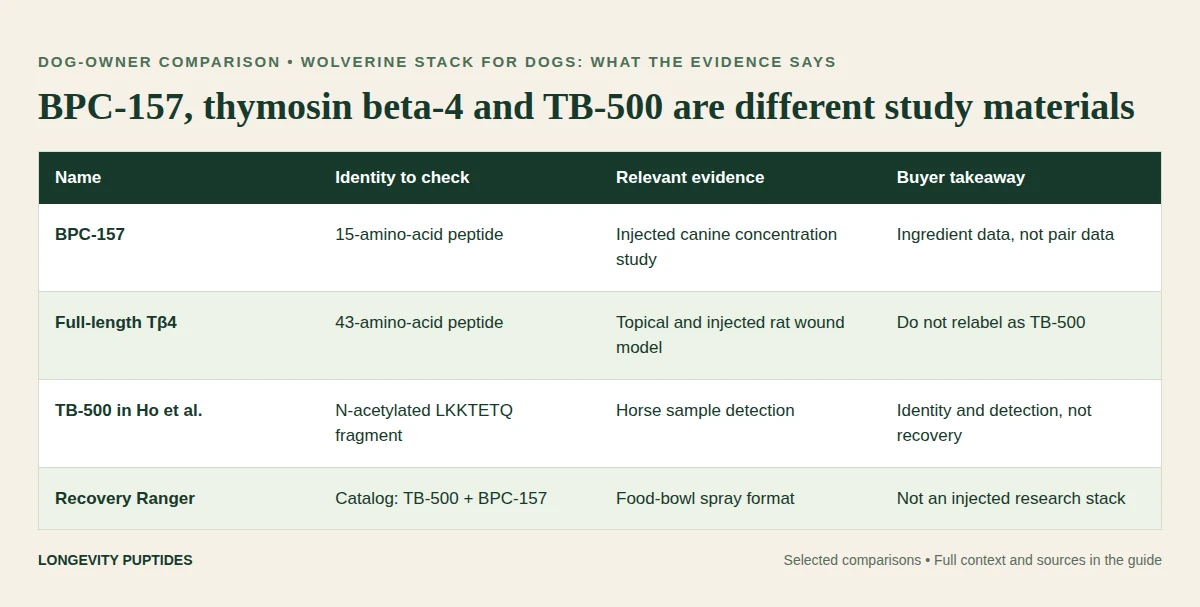
BPC-157, thymosin beta-4 and TB-500 are different study materials
BPC-157 is a synthetic 15-amino-acid peptide investigated in laboratory and animal research. Full-length thymosin beta-4, often abbreviated Tβ4 or Tbeta4, is a separate 43-amino-acid peptide. TB-500 refers to a thymosin beta-4-related synthetic material; the exact identity needs checking rather than assuming that every use of the name denotes the full-length molecule.
A particularly useful identity reference is Ho and colleagues' 2012 analytical paper. The preparation they examined contained N-acetylated LKKTETQ: a seven-amino-acid sequence matching an internal region of thymosin beta-4, with a chemical modification at one end. That is not the complete 43-amino-acid peptide. The paper supplies a concrete molecular definition, not a reason to assign every thymosin beta-4 finding to every TB-500 label.
This distinction matters when a seller cites a full-length Tβ4 study beside a TB-500 listing. The citation may describe related biology while testing a different substance. Ask whether the cited paper and the product specification match at the sequence level. The approved Recovery Ranger catalog names TB-500 but does not itself supply that sequence or its modification state. Our BPC-157 ingredient guide keeps the other half of the pair separate.
| Name | Identity to check | Relevant evidence | Buyer takeaway |
|---|---|---|---|
| BPC-157 | 15-amino-acid peptide | Injected canine concentration study | Ingredient data, not pair data |
| Full-length Tβ4 | 43-amino-acid peptide | Topical and injected rat wound model | Do not relabel as TB-500 |
| TB-500 in Ho et al. | N-acetylated LKKTETQ fragment | Horse sample detection | Identity and detection, not recovery |
| Recovery Ranger | Catalog: TB-500 + BPC-157 | Food-bowl spray format | Not an injected research stack |
What does the direct dog research tell an owner?
The 2022 study by He and colleagues included six Beagle dogs receiving laboratory BPC-157 intravenously or intramuscularly. Researchers measured concentrations in plasma over time, including after repeated intramuscular administration. This is pharmacokinetics: describing the concentration-time pattern of a specified material under specified experimental conditions.
The parent peptide's reported elimination half-life was under 30 minutes. That finding answers a blood-measurement question. It does not tell an owner how long a dog would experience a benefit or whether a dog would return to ordinary activity sooner. The study did not measure those outcomes. A scientific-sounding number becomes misleading when it is used to answer a question the researchers never tested.
The canine part also used BPC-157 alone. There was no TB-500 combination arm. Other parts of the paper examined radiolabeled material in rats, and those results should remain labeled as rat experiments. In the research library, look for the species, route and endpoint together. A paper containing the word dogs is a useful starting point, not the end of a product comparison.
Did testing both ingredients show an added benefit?
The closest direct comparison in the reviewed record is Biçer and colleagues' 2026 study, Effects of BPC-157 and TB-500 on Achilles tendon healing in rats: A histopathological and biomechanical study. Thirty-two male Sprague-Dawley rats underwent standardized tendon transection and surgical repair. Researchers assigned them to control, BPC-157, TB-500 or combination groups, using daily intraperitoneal injections for 30 postoperative days.
The mechanical test measured maximum load to failure: how much force a harvested tendon tolerated before failing. Only the TB-500 group differed significantly from control in the adjusted pairwise comparisons for that endpoint. The combination did not differ significantly from any group on the mechanical measure. Some microscopic tissue scores differed too, including lower total Movin scores in the TB-500 and combination groups than in controls.
Importantly, the authors did not find an additional benefit from combining the two agents compared with either agent alone. Only four tendons per group underwent mechanical testing. This makes the paper an exploratory experiment with a small endpoint sample, not a demonstration that stacking is better. Its authors' TB-500 designation also does not establish that the material matches Recovery Ranger's catalog ingredient.
For buyers, synergy is a claim requiring a comparison, not a synonym for two ingredients. Separate positive findings for each ingredient cannot prove that their combination adds anything. This rat paper actually asked a combination question, and its answer should be preserved rather than replaced with a more attractive marketing story.
Why do thymosin beta-4 papers appear in TB-500 discussions?
The broader thymosin literature gives researchers a biological reason to investigate related materials. In Malinda and colleagues' September 1999 paper, Thymosin beta4 accelerates wound healing, full-length Tβ4 was tested topically or by intraperitoneal administration in a rat full-thickness skin-wound model. The investigators reported increased reepithelialization, meaning regrowth of the surface lining, along with collagen deposition and blood-vessel formation in the model.
Those are specific rat wound findings for full-length Tβ4. They are not results for a defined TB-500 fragment, a healthy dog's activity or a swallowed combination. Likewise, Ho's equine study identified a fragment and its metabolites in horse samples after administration. Detecting a substance establishes an analytical result; it does not show that an animal recovered faster.
A helpful citation tells you both what was tested and what was measured. If a page only presents words such as collagen, migration or angiogenesis, ask which experiment connects those measurements to its proposed outcome. Mechanism language can explain scientific interest without settling an owner-facing purchase decision.
Is a food-bowl spray another version of the injected stack?
No. An ingredient pairing and a delivery method are separate parts of the description. Intravenous, intramuscular and intraperitoneal administration refer to different injection routes used in the studies above. A food-bowl spray is applied to a meal. Sharing ingredient names does not make these methods interchangeable or make one a practical replacement for another.
Longevity Puptides describes its collection platform as pH-responsive nano-encapsulation & delivery technology. That is catalog technology wording, not a clinical comparison with an injection. The format should be evaluated on its own product documentation rather than borrowing the outcome or concentration curve of a laboratory preparation.
This is also why the bottle's 600 metered sprays should not be converted into a research regimen. Spray count describes the catalog format; it is not an instruction for sprays per meal or a duration of use. For a closer look at the format question, read oral peptides for dogs. Keep delivery preferences separate from evidence about the particular product.
How should you compare Recovery Ranger with a BPC-157-only formula?
Recovery Ranger lists TB-500 + BPC-157. Belly Balance lists BPC-157 alone. That is a genuine catalog difference, but it is not an evidence-based ranking. The pair's ingredient count cannot establish that it is stronger, more comprehensive or more appropriate for a particular dog. Equally, one ingredient should not be declared better merely because its label is simpler.
The useful comparison starts with your reading goal. If you want to understand BPC-157 specifically, the single-ingredient page makes that discussion easier to follow. If you want to understand why two related research topics appear together, Recovery Ranger connects to the combination study. Neither page should turn the dog's symptoms into a formula-selection shortcut.
Product names express the collection's themes, not diagnoses or measured clinical results. Read Recovery Ranger's exact active list beside Belly Balance, then compare each citation with the ingredient it actually tested. This keeps the decision grounded in identifiable differences rather than the appeal of the Wolverine nickname.
Which documents make a seller's explanation worth reading?
A useful product explanation begins with the complete label, intended species, named ingredients and finished format. For this pairing, an exact TB-500 sequence and modification description would help connect the catalog material to the literature. A paper title pasted onto a sales page does not supply that identity. Ask for the underlying specification rather than assuming that a familiar abbreviation settles it.
Next, examine the citation's role. Does it document ingredient identity, an animal experiment, a concentration measurement or an actual comparison of the pair? These are different forms of support. The clearest seller explanation makes that role visible and acknowledges its commercial interest. Longevity Puptides publishes this guide and has a commercial interest in the spray collection discussed here.
Keep labeling claims separate from product names. FDA's Animal Food Labeling and Pet Food Claims guidance explains that disease claims and certain nonfood structure/function claims can indicate an intended use as a new animal drug. Calling an item a topper does not settle that distinction. Our where-to-buy guide helps organize seller questions without treating online availability as scientific validation.
What should come before a recovery-related purchase?
A dog who develops limping, pain, reluctance to move or a persistent change in appetite needs veterinary evaluation. These are medical observations, not a menu of ingredients. A stack or food-bowl spray is not a substitute for an examination, diagnosis or the care plan your veterinarian recommends. Bring the exact label if a product has prompted questions.
You can make the appointment more useful by describing when the change began and what your dog was doing beforehand. A short video of ordinary walking can provide context without asking the dog to perform a difficult movement. Include current medicines, supplements and feeding additions. Ask which outcome matters for this dog's situation rather than whether a fashionable compound is generally good.
For everyday planning, the dog joint supplements guide offers a separate nutritional comparison. Owners reading because of an arthritis diagnosis can use peptides for dogs with arthritis for condition-specific context. The immediate decision remains dog-first: understand the reason for the change before comparing catalog themes.
Where Recovery Ranger fits in the Longevity Puptides collection
Recovery Ranger is one of ten named Longevity Puptides formulas, all offered in the catalog's 2 fl oz / 60 mL metered food-bowl spray format with 600 metered sprays per bottle. Its active list is TB-500 + BPC-157, and it sits in the Recovery & Mobility family. That gives you a clear ingredient and format description without renaming it an injected Wolverine stack.
Its appeal is a familiar mealtime format and an invitation to understand the ingredient research behind the catalog. For a dog owner who values careful explanations, the strongest reason to keep reading is that the molecule, experiment and product remain visibly separate. The nickname can open a conversation; it should not decide the purchase.
Common questions
What is the Wolverine stack for dogs?
It is an informal name for BPC-157 plus TB-500. The name does not specify a standardized canine protocol, exact formulation or route.
Is BPC-157 alone also called the Wolverine peptide?
Yes. Men's Health uses that nickname for BPC-157 alone, while Wolverine stack commonly refers to BPC-157 paired with TB-500. Check the active list rather than relying on the nickname.
Are thymosin beta-4 and TB-500 the same molecule?
Not automatically. Full-length thymosin beta-4 has 43 amino acids; the TB-500 preparation in Ho's paper contained the modified seven-amino-acid fragment N-acetylated LKKTETQ. A TB-500 label needs its own identity specification.
Has the combination been tested in dogs?
The selected record did not identify a controlled canine trial of the pair. The direct canine study discussed here tested injected BPC-157 alone and measured plasma concentrations.
Did the rat combination study prove synergy?
No. The 2026 Achilles-tendon experiment did not show an additional benefit from combining the ingredients over either agent alone. Its mechanical endpoint used four tendons per group.
Does Business Insider coverage validate Recovery Ranger?
No. The verified articles document media attention and reported use. Neither article is a trial of the finished Recovery Ranger food-bowl spray.
Does Recovery Ranger contain both named ingredients?
The approved catalog lists TB-500 + BPC-157. Recovery Ranger is a 2 fl oz / 60 mL metered food-bowl spray with 600 metered sprays per bottle, not an injectable product.
What does 600 metered sprays mean?
It is the catalog's stated spray count per bottle. It does not provide sprays per meal, a dog dosing schedule or a course length.
Should I select this pairing for a limping dog?
Limping needs veterinary evaluation, not ingredient matching. Bring the product label to the appointment if you want to discuss it; a food-bowl spray does not replace assessment or prescribed care.
About this guide
Author and publisher: Longevity Puptides.
Written and published by Longevity Puptides using the original sources linked below; no veterinarian or other clinician is credited as a reviewer or endorser.
Editorial standards and correctionsRead the original sources
- Business Insider: They took peptides — then decided to give them to their dogs (September 26, 2026; original heading and date verified) ↗
- Business Insider: Gym bros love BPC-157, the peptide in the 'Wolverine shot.' Now it could go mainstream. (October 31, 2026) ↗
- Men's Health: They Call It the 'Wolverine Peptide.' And Everyone from Biohackers to the Marathoner Next Door Wants It Now. (February 19, 2026) ↗
- He et al. (2022): Pharmacokinetics, distribution, metabolism, and excretion of body-protective compound 157, a potential drug for treating various wounds, in rats and dogs ↗
- Biçer et al. (2026): Effects of BPC-157 and TB-500 on Achilles tendon healing in rats: A histopathological and biomechanical study ↗
- Ho et al. (2012): Doping control analysis of TB-500, a synthetic version of an active region of thymosin β4, in equine urine and plasma by liquid chromatography–mass spectrometry ↗
- Malinda et al. (1999): Thymosin beta4 accelerates wound healing ↗
- FDA: Animal Food Labeling and Pet Food Claims (current page dated March 2, 2026) ↗