
Where Science Meets Love
Peptides for Dogs With Arthritis: Evidence Guide
Peptides for dogs with arthritis span different ingredients, with the most relevant evidence coming from studies of the exact preparation in dogs with osteoarthritis. Compare collagen-peptide findings with experimental ingredients such as AOD-9604, learn what to discuss with your veterinarian, and explore Flex & Fetch's ingredient profile.
Published · Updated
In this guide
Is this a shopping question or a veterinary appointment?
When a much-loved dog hesitates before standing or leaves a favorite toy untouched, it is understandable to look for something new. Start by describing the change rather than naming an ingredient. Stiffness, limping, reduced enthusiasm for walks, difficulty with stairs and new irritability are among the signs described in Cornell's osteoarthritis guide. They deserve veterinary evaluation, not an assumption that your dog is simply getting older.
Osteoarthritis, often shortened to OA, is a chronic, progressive joint condition involving cartilage deterioration and changes around the joint. Pain and altered movement are important parts of the picture. Cornell notes that OA can develop at any age, particularly when other orthopedic problems contribute. An older dog can have another cause of lameness, while a younger dog can have an established joint problem.
Record when the change began, which activities bring it out and whether it is getting worse. Contact your veterinary team promptly for new or worsening symptoms; inability to stand or bear weight, marked distress or a sudden major change calls for urgent guidance. Do not wait for a supplement trial to finish before reporting a problem. The wider peptides for dogs guide is ingredient education, not a way to diagnose a limp.
What does a joint assessment clarify before you compare ingredients?
A useful assessment considers your dog's history, gait, posture and response to a hands-on examination. Imaging may help identify joint or bone changes and an underlying orthopedic problem. A video of ordinary movement at home can add context when the difficulty does not appear in the examination room. Let the dog move naturally; there is no need to provoke a painful jump to capture it.
An X-ray and a pain assessment answer related but different questions. The 2022 AAHA Pain Management Guidelines for Dogs and Cats caution against assuming that every radiographic abnormality represents a source of pain. Your veterinarian interprets imaging alongside examination and function, rather than assigning a care plan from a picture alone.
Ask which joint or joints are involved and what else may explain the change. That information makes research comparisons more meaningful: a trial enrolling dogs with mild or moderate OA is not automatically relevant to a dog with a recent injury or a different diagnosis. Clear diagnosis also gives you a practical starting point for tracking progress.
Which care priorities should come before an optional addition?
Veterinary OA care usually combines several approaches rather than relying on one purchase. Cornell describes weight control, appropriate activity, home adaptations, rehabilitation and individualized prescription decisions. The important buyer decision is where an optional nutritional discussion fits within that plan, not whether an interesting ingredient can stand in for it.
Ask your veterinarian to assess both body condition and muscle condition. A food plan should account for the complete diet, treats and additions, while a movement plan should reflect the affected joints and current function. There is no universal walking distance that suits every dog with OA. A rehabilitation professional can help tailor activity when your veterinary team considers that appropriate.
At home, discuss practical friction points: a slippery route to the water bowl, a high car entry or steps between resting spaces. Cornell includes non-slip rugs and ramps among environmental options. Describe your actual household so recommendations are usable, especially if lifting your dog is difficult. Our dog nutrition and longevity guide helps organize feeding questions without making a disease-specific product recommendation.
Keep prescribed care in place unless the veterinarian changes it. If the current plan is difficult to follow, explain the reason, whether it is handling, scheduling or cost. A workable veterinary plan is more valuable than quietly replacing a recommended element with a product chosen from an online ingredient list.
Which kind of peptide evidence are you actually reading?
The word peptide does not identify one type of joint product. Collagen hydrolysates contain protein fragments produced from collagen. Undenatured type II collagen preserves a different protein structure and should not be treated as the same material. AOD-9604 and BPC-157 are separately defined research compounds. Similar vocabulary does not make their preparations, study designs or outcomes interchangeable.
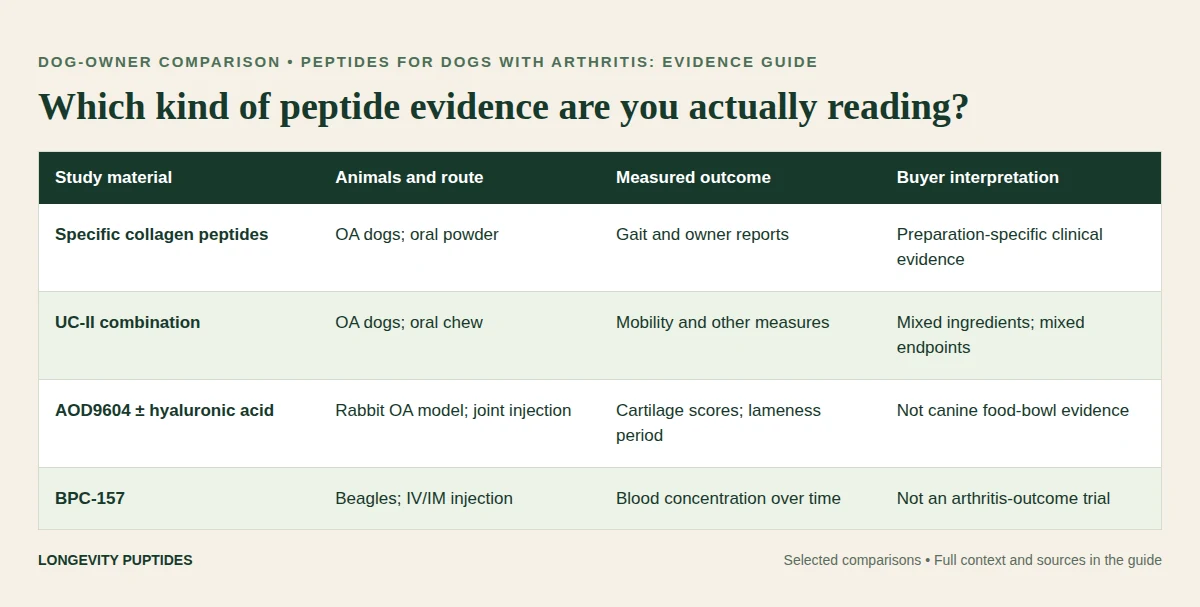
Use the comparison below to identify the question a paper can answer. A controlled study in dogs with naturally occurring OA is closer to an owner's joint-health question than a laboratory concentration measurement, but it still applies to its tested formulation and endpoints. The linked papers are discussed in the next sections; our research library provides broader ingredient context.
When a seller quotes a study, look for the tested material, animals, route, comparison group and outcome before reading the marketing conclusion. If any of those details are missing, request them. A photograph of cartilage, a pain questionnaire and an activity tracker each measure something different.
| Study material | Animals and route | Measured outcome | Buyer interpretation |
|---|---|---|---|
| Specific collagen peptides | OA dogs; oral powder | Gait and owner reports | Preparation-specific clinical evidence |
| UC-II combination | OA dogs; oral chew | Mobility and other measures | Mixed ingredients; mixed endpoints |
| AOD9604 ± hyaluronic acid | Rabbit OA model; joint injection | Cartilage scores; lameness period | Not canine food-bowl evidence |
| BPC-157 | Beagles; IV/IM injection | Blood concentration over time | Not an arthritis-outcome trial |
What did a genuine canine collagen-peptide study find?
A relevant primary paper is Dobenecker and colleagues' The oral intake of specific Bioactive Collagen Peptides (BCP) improves gait and quality of life in canine osteoarthritis patients—A translational large animal model for a nutritional therapy option, published September 19, 2024. It examined a defined collagen-peptide powder given orally with food, alongside placebo and omega-3/vitamin E comparison groups, over twelve weeks.
Forty-one dogs entered the study and thirty-one completed it, including eleven in the collagen group. The researchers used a force-plate treadmill, owner questionnaires and accelerometers. They reported improvement in several gait parameters and the owner-rated quality-of-life outcome in the collagen group. Accelerometer activity did not change. That combination matters: improvement in selected measures does not mean every aspect of movement or pain improved.
The preparation was made from predominantly type I porcine collagen using a specific hydrolysis process. It was not AOD-9604, BPC-157 or a Longevity Puptides formula. The small groups, withdrawals and declared commercial funding and interests are relevant when judging confidence. Dogs unable to discontinue certain medications because of severity could not participate, narrowing the population represented; this research requirement is not an instruction to stop your dog's medicines.
For a buyer, this paper supports asking about the exact collagen preparation and whether other trials reproduce its findings. It does not justify choosing any bottle labeled collagen. The dog joint supplements guide offers a broader framework for comparing nutritional ingredients.
Why is undenatured collagen a separate comparison?
Stabile and colleagues published Effects of a feed supplement, containing undenatured type II collagen (UC II®) and Boswellia Serrata, in the management of mild/moderate mobility disorders in dogs: A randomized, double-blind, placebo controlled, cross-over study on October 30, 2024. Seventeen dogs were randomized; thirteen remained in the final analysis after withdrawal and protocol-related exclusions. The oral chew included other ingredients, including omega-3 fatty acids and vitamin E.
Owners' Liverpool Osteoarthritis in Dogs, or LOAD, scores improved relative to baseline during supplementation. The between-group percentage change favored the supplement significantly at four weeks but not at eight weeks. Gait-lameness scores did not differ significantly between groups, and activity-monitor data were limited. Reading the full results gives a more balanced picture than the abstract's broad wording.
This was a small combination study funded by Vetoquinol, with sponsor involvement in design. It cannot isolate what one ingredient contributed. Undenatured collagen and hydrolyzed collagen peptides should therefore occupy separate rows in your comparison, even though both start with collagen. Neither preparation is an ingredient in Flex & Fetch or Recovery Ranger.
Does the AOD-9604 cartilage paper establish canine outcomes?
Flex & Fetch contains AOD-9604, making its cartilage literature a reasonable reading interest. The frequently cited paper is Kwon and Park's Effect of Intra-articular Injection of AOD9604 with or without Hyaluronic Acid in Rabbit Osteoarthritis Model, published in July–August 2015. Its title is precise about both the species and the route: rabbits received injections directly into a knee joint.
The study used thirty-two rabbits with chemically induced OA, divided into saline, hyaluronic acid, AOD9604 and combination groups. Researchers assessed cartilage appearance and microscopic damage, along with the period of observed lameness. Cartilage-damage scores were lower in the AOD9604 groups than in the saline group; the combination had lower scores than either ingredient alone. AOD9604 alone did not differ significantly from hyaluronic acid alone on those reported comparisons.
These are findings within an induced rabbit model. They are not measurements of canine pain, daily function or the response to a swallowed preparation. Although the authors described cartilage regeneration in their conclusion, the concrete measurements to keep in view are the cartilage scores and rabbit lameness observations. A finding about tissue structure is also not identical to a validated owner pain score.
Read Flex & Fetch as an AOD-9604 catalog page, not as an arthritis selection. Hyaluronic acid was a study comparator and combination ingredient; it is not listed in Flex & Fetch. No direct canine AOD-9604 OA trial was identified in the sources reviewed for this guide.
What does canine BPC-157 research contribute to this decision?
Recovery Ranger contains TB-500 + BPC-157. BPC-157 does have a canine research record, but its purpose matters. He and colleagues' 2022 pharmacokinetics paper included six Beagles receiving intravenous or intramuscular BPC-157. Researchers measured blood concentrations over time; the parent peptide declined rapidly under the tested conditions. They did not measure OA pain, cartilage changes or ordinary walking function.
This answers whether researchers measured injected BPC-157 in dogs, not whether it belongs in a dog's arthritis plan. The experiment also did not test TB-500 or the two-ingredient pairing. Full-length thymosin beta-4 and the related material described as TB-500 are separate study materials, so the catalog's fragment distinction should remain visible when reviewing sources.
The BPC-157 for dogs article can help you read the ingredient record without turning a pharmacokinetic experiment into a mobility result. Compare Recovery Ranger by its disclosed ingredients and documented research questions, not by an assumed stronger effect from having two names on the label.
How can you monitor pain in a way your veterinarian can use?
Choose a monitoring tool with your veterinary team. AAHA identifies the Canine Brief Pain Inventory, or CBPI, and LOAD among commonly used owner questionnaires. CBPI separates perceived pain severity from interference with daily activities. That distinction can make a conversation more useful than a single statement that your dog seems better or worse.
In Brown and colleagues' Ability of the canine brief pain inventory to detect response to treatment in dogs with osteoarthritis, published October 15, 2008, seventy dogs took part in a randomized, blinded, placebo-controlled trial. CBPI detected greater improvement in the carprofen group than the placebo group. The paper supports the tool's ability to track a response; it is not evidence for a peptide product.
Use the original questionnaire rather than shortening it into a homemade validated score. The official CBPI user guide explains that validation applies to its unchanged wording and format. Ideally, the same person who knows the dog well completes each assessment, before hearing other people's impressions at a visit.
Alongside the form, keep brief notes about ordinary activities: getting up from a familiar bed, walking to the garden and settling afterward. Include date, surface, activity and any changes to veterinary care. Short videos can add context. Ask when the team wants updates and which changes warrant an earlier call; the notebook supports that relationship rather than replacing reassessment.
Does a better day show that a new purchase worked?
A better day is welcome, but it cannot identify the cause by itself. Dogs' symptoms vary, and several things may change together: activity, flooring, prescribed care, feeding and the owner's expectations. Write down those changes instead of attributing the whole result to the newest item in the cupboard.
Conzemius and Evans' Caregiver placebo effect for dogs with lameness from osteoarthritis, published November 15, 2012, examined fifty-eight dogs in a placebo group. An owner caregiver placebo effect occurred in 39.7% of assessments, while average force-platform measurements remained unchanged. This illustrates how impressions and an objective gait measure can diverge; it does not mean every improvement an owner notices is imagined.
Your observations remain valuable because you see your dog in familiar surroundings. Make them repeatable, describe specific activities and bring both good and difficult days to follow-up. Do not change medically necessary care simply to create a cleaner home experiment. For older dogs with several overlapping concerns, the companion peptides for senior dogs guide keeps age-related shopping questions separate from medical assessment.
Where do Flex & Fetch and Recovery Ranger fit?
Longevity Puptides offers ten named formulas exclusively as 2 fl oz / 60 mL metered food-bowl sprays, with 600 metered sprays per bottle. Flex & Fetch identifies AOD-9604; Recovery Ranger identifies TB-500 + BPC-157. Those facts describe the catalog and format. The spray count is not a dog-use schedule or a number of days of care.
If either formula interests you, bring its complete ingredient information and the relevant papers to your veterinary team. Ask which evidence concerns the actual ingredient and which concerns another species, preparation or endpoint. The useful outcome of this guide is a clearer decision, including the option not to add anything, while keeping your dog's comfort and veterinary plan at the center.
Common questions
Are collagen peptides the same as AOD-9604?
No. Collagen peptides are fragments made from collagen protein; AOD-9604 is a defined modified growth-hormone fragment. The oral canine collagen trial and injected rabbit AOD9604 experiment tested different materials and cannot be combined into one product claim.
Can arthritis affect a young dog?
Yes. Cornell explains that OA can occur at any age, especially with contributing orthopedic conditions. Age alone cannot explain a limp; a young dog with stiffness or reduced activity still needs veterinary evaluation.
What is the difference between CBPI and an activity tracker?
CBPI records an owner's assessment of pain severity and interference with function. An activity tracker records movement. A dog can show a change in one measure without a change in the other, so ask your veterinarian how to interpret them together.
Should I copy a research study's feeding amount?
No dog dosing is provided here. Research amounts belong to a defined test preparation and supervised protocol, not a transferable food-bowl instruction. Bring the exact product information to your veterinary team rather than converting a study into a regimen.
Does Flex & Fetch contain hyaluronic acid?
The approved catalog lists AOD-9604 as its active ingredient, not hyaluronic acid. Hyaluronic acid appears in this guide because it was a comparator and combination ingredient in the rabbit study.
Did the canine BPC-157 study examine arthritis pain?
No. It measured blood concentrations following intravenous and intramuscular BPC-157 in Beagles. It did not assess OA pain, joint structure or everyday walking, and it did not test the TB-500 + BPC-157 pairing.
What should I bring to a joint-health appointment?
Bring a symptom timeline, short ordinary-movement videos, your dog's food and supplement information, current medicines and completed monitoring forms if your team requested them. Describe practical problems at home, such as stairs or slippery floors, as well as ingredient questions.
Is a quieter dog necessarily more comfortable?
Not necessarily. Reduced activity can be part of a pain-related change, and AAHA emphasizes behavior and function rather than vocalization alone. Note changes from your dog's usual routine and let your veterinary team interpret the pattern.
Can I use a food-bowl spray instead of the veterinary plan?
No. These catalog sprays are not presented as arthritis care or substitutes for prescribed management. If a care-plan element is difficult to follow, discuss the difficulty with your veterinarian so the plan can be adjusted appropriately.
About this guide
Author and publisher: Longevity Puptides.
Written and source-checked by Longevity Puptides as brand-authored education with a commercial interest in its catalog; no veterinarian is credited as a reviewer or endorser.
Editorial standards and correctionsRead the original sources
- Cornell Riney Canine Health Center: Osteoarthritis — updated December 9, 2025 ↗
- Gruen et al. (2022): 2022 AAHA Pain Management Guidelines for Dogs and Cats ↗
- Dobenecker et al. (September 19, 2024): The oral intake of specific Bioactive Collagen Peptides (BCP) improves gait and quality of life in canine osteoarthritis patients—A translational large animal model for a nutritional therapy option ↗
- Stabile et al. (October 30, 2024): Effects of a feed supplement, containing undenatured type II collagen (UC II®) and Boswellia Serrata, in the management of mild/moderate mobility disorders in dogs: A randomized, double-blind, placebo controlled, cross-over study ↗
- Kwon and Park (July–August 2015): Effect of Intra-articular Injection of AOD9604 with or without Hyaluronic Acid in Rabbit Osteoarthritis Model ↗
- He et al. (2022): Pharmacokinetics, distribution, metabolism, and excretion of body protective compound 157, a potential drug for treating various wounds, in rats and dogs ↗
- Brown et al. (October 15, 2008): Ability of the canine brief pain inventory to detect response to treatment in dogs with osteoarthritis ↗
- The Canine Brief Pain Inventory: User Guide — July 2017 edition, University of Pennsylvania host ↗
- Conzemius and Evans (November 15, 2012): Caregiver placebo effect for dogs with lameness from osteoarthritis ↗