
Where Science Meets Love
Peptides for Senior Dogs: Choosing With Care
Choosing peptides for senior dogs starts with your dog's life stage, current diet, medications and the changes you have observed at home. Compare the research behind different ingredients, organize questions for your veterinarian, and explore Prime Pup and Bright Mind through their exact active ingredients and food-bowl presentation.
Published · Updated
In this guide
Start with your dog, not an antiaging shortlist
An older dog's familiar habits deserve more attention than a product category. Before comparing peptides, write down what you actually want to understand: a changed walking routine, a different appetite, interrupted nights or simply the ingredients behind a mature-dog catalog name. These are different questions. A useful shortlist begins with a clear question, not the assumption that every senior dog needs the same addition.
If your dog has new symptoms, the first decision is about veterinary evaluation, not shopping. The 2023 AAHA Senior Care Guidelines for Dogs and Cats emphasize a detailed history and caution against dismissing changes as old age. A spray is not a substitute for an examination, prescribed medication or a veterinary nutrition plan.
This guide helps you organize that history, separate food questions from signaling-peptide research and decide which catalog pages merit a closer read. For the broader category, begin with peptides for dogs. You do not need to find a product match to make this process worthwhile: a better description of your dog's week is already useful.
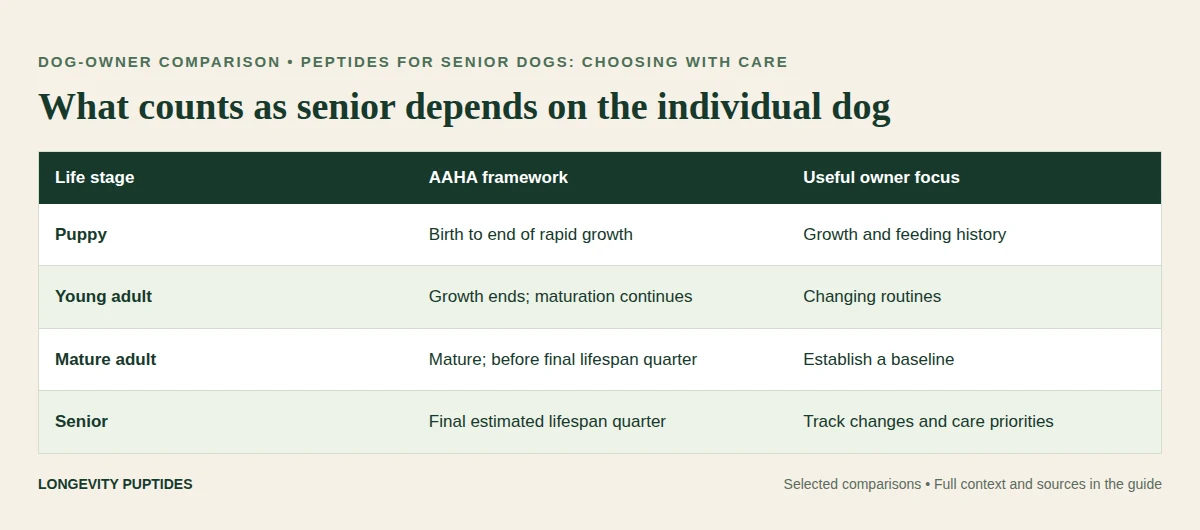
What counts as senior depends on the individual dog
A seventh birthday is not a universal dividing line. The 2019 AAHA Canine Life Stage Guidelines define senior as the last 25% of estimated lifespan through end of life. Breed and size help inform that estimate, while health and lifestyle shape the individual care discussion. Life stages are a planning framework, not a forecast of how long your companion has left.
AAHA distinguishes puppy, young adult, mature adult and senior stages, with end of life considered separately. Physical and social maturation mark the transition into mature adulthood. The guidelines deliberately avoid one uniform age range for mature adults and seniors because variation becomes greater later in life. Ask your veterinary team which stage best describes your dog rather than applying an online age-conversion chart.
That distinction changes a buyer's question. A stable mature adult may prompt ingredient education; an older dog with several changing routines may need a prioritized care discussion first. The word mature in a product description does not establish individual suitability. Our canine longevity guide gives wider context without turning a life-stage label into a reason to buy.
| Life stage | AAHA framework | Useful owner focus |
|---|---|---|
| Puppy | Birth to end of rapid growth | Growth and feeding history |
| Young adult | Growth ends; maturation continues | Changing routines |
| Mature adult | Mature; before final lifespan quarter | Establish a baseline |
| Senior | Final estimated lifespan quarter | Track changes and care priorities |
Make a simple seven-day observation log
Use a notebook or phone note with one dated entry each day. A seven-day window is an organizing choice, not a diagnostic test or a waiting period when your dog needs care. Record the ordinary routine before adding a new optional product, whenever that fits the veterinary plan. A baseline helps keep descriptions specific instead of relying on a general impression of more or less energy.
Note what happened, when it happened and the setting. ‘Paused twice on our usual morning route’ is more informative than ‘seems older.’ Record food offered and left, changes in drinking, toileting, getting up, resting and interaction. AAHA's senior-care history guidance includes these everyday domains and identifies home videos as useful context for movement assessment.
Keep filming comfortable and ordinary; do not ask your dog to repeat a difficult movement for the camera. Include changes in weather, visitors, flooring, walk length or the household schedule. If several people provide care, use the same brief prompts and identify the observer. The goal is a readable account of your dog's day, not an elaborate scoring system that turns an owner into a diagnostician.
| Daily prompt | Example note | Context to include |
|---|---|---|
| Eating and drinking | Left part of breakfast | Food and routine changes |
| Movement | Paused on usual walk | Route, surface, time |
| Rest and interaction | Awake twice overnight | Noise, visitors, activity |
| Toileting | New indoor accident | Timing and frequency |
| Care changes | Prescription changed Tuesday | Clinician's instructions |
Use observations to choose the next conversation
Look for patterns, but leave the explanation open. Reluctance to use stairs, less interaction and nighttime waking do not identify one cause or one ingredient. AAHA recommends exploring eating, movement, elimination, attitude, vision, hearing and the home environment together. A short account of several domains is more useful than selecting only the observation that appears to match a product name.
Contact your veterinary team about new, persistent, worsening or concerning changes rather than filling the entire log first. Describe the timing and ask how promptly your dog should be seen. For a movement-focused discussion, the dog joint supplements guide offers separate nutritional context. The BPC-157 ingredient guide is a research-reading resource, not a way to assign a peptide to a walking symptom.
Before the appointment, choose your two most important observations and one practical goal, such as making the feeding routine easier to understand. Bring the remaining notes as background. This keeps the visit centered on your dog's actual needs rather than on a long shopping list.
Bring every medication and addition into the discussion
Make one complete inventory, including prescriptions, occasional medicines, supplements, oils, topical products and anything mixed into food. Photograph the labels and record why each item is being given, who recommended it and when it was started or changed. Include products used only during travel or stressful events; an occasional item can otherwise disappear from a routine medication list.
AAHA's senior-care guidelines specifically call for this history when evaluating additional products and potential interactions. This does not establish a known interaction profile for the catalog peptides. The useful question is, ‘What information would you need to assess this exact ingredient list alongside my dog's current care?’ Do not interpret an absence of listed interactions on a sales page as individualized clearance.
Ask which care priorities should remain unchanged, whether the veterinarian needs final product documentation and what follow-up observations matter. If the answer is to defer an optional addition, that is a complete decision. Do not stop, reduce or replace prescribed medication to make room for a product. A peptide name is not a substitute for the exact formulation, and an ingredient study cannot resolve your dog's whole medication history.
Check food, body condition and protein before peptide extras
Start with the main diet and the amount actually eaten. Bring the food's nutritional adequacy statement, feeding record and list of treats or additions. If a veterinary diet has been prescribed, include its purpose in the discussion rather than choosing a different food because its front label says senior. AAHA's nutrition chapter notes that AAFCO does not have a separate senior nutrition guideline.
Body weight alone is an incomplete picture. Body condition considers fat stores; muscle condition considers muscle loss. An older dog can lose lean body mass while carrying extra fat, so a steady number on the scale does not answer both questions. AAHA recommends assessing body and muscle condition together to help identify when nutritional adjustment may be needed. Ask your team to show you what to notice between visits.
Protein is a nutritional priority, not an automatic restriction just because a dog is older. AAHA describes modest increases in protein content and quality as a possible feature of healthy senior diets. Its health-specific nutrition chapter also distinguishes healthy pets from patients whose medical circumstances call for tailored protein decisions. Follow your veterinarian's plan rather than making either a low-protein or high-protein switch from age alone.
Dietary protein and a named signaling peptide answer different questions. Do not treat a food-bowl peptide spray as the protein component of a meal or a replacement for a complete diet. Ask whether the current food, actual intake and overall feeding pattern meet your dog's needs first. Our dog nutrition and longevity guide explores that foundation; this page offers no universal protein percentage, calorie target or feeding prescription.
Compare catalog ingredients rather than product-name impressions
The relevant Longevity Puptides names describe collection contexts, not a ranking of senior-dog outcomes. Prime Pup contains CJC-1295 + Ipamorelin and invites reading about mature-dog vitality research. Bright Mind contains MOTS-c and introduces cellular-energy science. Semax is not Bright Mind's listed ingredient: it appears in Calm Companion alongside Oxytocin + Selank. Keeping those identities separate prevents a brain-related research paper from being assigned to the wrong bottle.
Use the comparison below to choose a reading path, not a symptom-to-product match. Ingredients sharing a collection family need not share a mechanism or research base. If your main question is how to compare the documentation across products, continue with best peptides for dogs, where selection criteria matter more than an unsupported winner.
| Catalog name | Listed ingredients | Research-reading focus |
|---|---|---|
| Prime Pup | CJC-1295 + Ipamorelin | Hormonal signaling |
| Bright Mind | MOTS-c | Cellular-energy signaling |
| Calm Companion | Oxytocin + Selank + Semax | Neuropeptide research |
Prime Pup: hormone measurements are not a senior-dog outcome
CJC-1295 is described in the catalog as a growth-hormone-releasing-hormone analog; Ipamorelin is a growth-hormone secretagogue. In plain language, researchers investigate these ingredients in relation to growth-hormone release. That context helps explain why they appear in mature-dog reading, but it does not mean that visible slowing in an older dog identifies a hormone problem.
In Teichman and colleagues' 2006 study, two randomized, placebo-controlled, double-blind trials examined CJC-1295 alone in healthy human adults. Subcutaneous injections increased measured growth hormone and insulin-like growth factor I. Those were hormone measurements, not a trial of older dogs, the paired catalog ingredients or everyday changes in a companion's routine.
A separate 1999 study by Gobburu and colleagues measured Ipamorelin and growth-hormone concentrations after intravenous infusions in healthy men. Researchers modeled the relationship between exposure and a growth-hormone response. For a buyer, the distinction is practical: two papers on separate ingredients do not provide a comparison showing which senior dog should receive their combination. Read Prime Pup's exact catalog page with that question in mind, rather than interpreting hormone-marker changes as a promise of renewed youth.
Bright Mind and Semax lead to different research questions
Bright Mind's MOTS-c ingredient is discussed in mitochondrial signaling research. In Reynolds and colleagues' 2021 Nature Communications paper, researchers administered MOTS-c to mice by intraperitoneal injection and measured physical-performance and muscle-related outcomes. A separate part of the paper measured naturally occurring MOTS-c around exercise in ten healthy young men; the investigators did not give those men the peptide.
The same paper reported no improvement in learning and memory in its young-mouse Barnes-maze assessment. That detail matters when reading a name such as Bright Mind: the name does not turn physical-performance research into cognitive-restoration evidence. The Bright Mind catalog page identifies MOTS-c, not Semax, and should be read as that ingredient's collection context.
Semax has a different research record. Dolotov and colleagues' 2006 paper tested intranasal Semax in rats and studied isolated rat brain membranes. It found increased brain-derived neurotrophic factor protein in the basal forebrain after three hours, but not in the cerebellum. This is a molecular finding in specified rat tissue, not an observation of restored recognition, memory or daily function in senior dogs.
If your dog seems disoriented or interacts differently, bring the observation log to the veterinary team instead of choosing between those research topics. Semax's presence in Calm Companion also does not make a study of Semax alone a study of its three-ingredient catalog combination.
Decide what would make a product worth considering
Use three practical filters: a clear reason for reading about the ingredient, complete product information and a veterinary conversation that accounts for your dog. If a page provides only an aspirational name or a human research result, you still have a reading lead rather than a finished decision. The research library helps locate original papers and keep species, route and measured result attached to each finding.
Request the full ingredient list and final label rather than working from a bottle image alone. Ask what information is available for the finished formulation and which questions remain unanswered. Keep the research route distinct from the catalog format; oral peptides for dogs examines why swallowed-product questions cannot be answered by simply borrowing an injection study.
Practical fit matters too. Who prepares meals, does your dog finish the bowl, and do other dogs share food? Note those details without improvising administration instructions. Preserve the care budget for established priorities and ask the clinic for an estimate specific to the proposed assessment. No purchase, fewer optional additions or further reading can each be a thoughtful outcome; choosing with care does not require choosing a bottle today.
Where the ten-spray collection fits in your reading
Longevity Puptides presents only ten catalog food-bowl sprays for dogs, each 2 fl oz / 60 mL with 600 metered sprays. These are bottle-format facts, not sprays per meal or a promised length of use. The senior-focused reading paths here are Prime Pup for CJC-1295 + Ipamorelin and Bright Mind for MOTS-c; Semax remains part of Calm Companion's separate ingredient list.
Return to your original question before continuing. If it concerns a change in your dog, bring the log, food information and medication inventory to your veterinary team. If it concerns an ingredient, read the exact catalog page and its primary sources. A careful decision keeps your companion's current care at the center, with research serving the conversation rather than directing it.
Common questions
At what age is a dog considered senior?
AAHA defines senior as the final 25% of estimated lifespan, not one birthday for every dog. Breed and size inform the estimate, while individual circumstances shape care. Ask your veterinary team which life stage fits your dog; the label is a planning aid, not a lifespan prediction.
Should every senior dog have a peptide product?
No age label creates a universal need. Start with your dog's diet, medication history, care priorities and the question you want answered. Choosing no optional addition is reasonable. A catalog's mature-dog positioning does not establish individual suitability.
What should I record before a senior-dog appointment?
Record dated observations about eating, drinking, movement, rest, interaction and toileting, plus recent household or care changes. Short videos of ordinary movement can help. Do not delay contacting the veterinary team to complete a seven-day log when a change is concerning.
Does Prime Pup reverse aging or rebuild an older dog's muscle?
The cited CJC-1295 and Ipamorelin studies do not demonstrate those outcomes. They measured the ingredients separately in human hormone research by injected routes. Prime Pup's catalog identity is CJC-1295 + Ipamorelin; muscle changes require veterinary assessment rather than an assumption about hormone levels.
Does Bright Mind contain Semax?
No. The approved catalog lists MOTS-c for Bright Mind. Semax appears in Calm Companion alongside Oxytocin + Selank. Check exact ingredients rather than inferring them from a product name, and keep the research for those molecules separate.
Can these products restore memory in a senior dog?
No cited study establishes cognitive restoration from a finished catalog spray in senior dogs. Semax's rat molecular findings and MOTS-c's mouse physical-performance research answer other questions. New disorientation, altered interaction or disrupted sleep deserves veterinary evaluation.
Should healthy older dogs automatically eat less protein?
No. Older age alone is not a reason for protein restriction. AAHA discusses protein quality and content in healthy senior diets, while medical circumstances can require an individualized plan. Review the complete diet, actual intake, body condition and muscle condition with your veterinarian.
Can I replace a prescription with a peptide spray?
No. Do not stop, reduce or replace prescribed care to make room for an optional product. Bring all prescriptions, occasional medicines, supplements and topical products to the veterinary discussion, along with the exact proposed label.
Does 600 metered sprays tell me how long a bottle lasts?
It identifies the approved catalog spray count, alongside the 2 fl oz / 60 mL bottle size. It does not specify sprays per meal, a senior-dog regimen or duration of use. This guide provides no dog dosing instructions.
About this guide
Author and publisher: Longevity Puptides.
Written and source-checked by Longevity Puptides as an educational buyer guide. No veterinarian or other clinician is credited as a reviewer; the publisher also presents the collection discussed here.
Editorial standards and correctionsRead the original sources
- 2019 AAHA Canine Life Stage Guidelines — official guideline, Nov/Dec 2019 ↗
- 2023 AAHA Senior Care Guidelines for Dogs and Cats — official guideline, Jan/Feb 2023 ↗
- AAHA: Nutrition — senior-care guideline chapter, published December 13, 2022 ↗
- AAHA: Disease Management: Nutritional — senior-care guideline chapter, December 13, 2022 ↗
- Teichman et al. (2006): Prolonged stimulation of growth hormone (GH) and insulin-like growth factor I secretion by CJC-1295, a long-acting analog of GH-releasing hormone, in healthy adults ↗
- Gobburu et al. (1999): Pharmacokinetic-pharmacodynamic modeling of ipamorelin, a growth hormone releasing peptide, in human volunteers ↗
- Reynolds et al. (2021): MOTS-c is an exercise-induced mitochondrial-encoded regulator of age-dependent physical decline and muscle homeostasis ↗
- Dolotov et al. (2006): Semax, an analogue of adrenocorticotropin (4-10), binds specifically and increases levels of brain-derived neurotrophic factor protein in rat basal forebrain ↗