
Where Science Meets Love
BPC-157 Dosage for Dogs: Reading Research
There is no verified household BPC-157 dose for dogs in the canine study reviewed here; that paper measured blood concentrations after research injections. This guide explains its actual methods, the difference between study quantities and bottle spray counts, and the questions to bring to your veterinarian.
Published · Updated
In this guide
What can a BPC-157 dosage search actually tell you?
When you search for BPC-157 dosage for dogs, you may be trying to understand an unfamiliar label, check something a seller said or help a dog whose daily routine has changed. Those are different questions. A research methods section can explain what scientists administered during an experiment. It cannot, by itself, identify what belongs in your dog's care plan. Start by deciding whether you need ingredient information, product documentation or a veterinary assessment.
BPC-157 is a synthetic peptide made of 15 amino acids, as described in the primary pharmacokinetic paper. A compound name tells you which material researchers intended to study, not which finished formulation you are comparing. Our peptides for dogs guide helps separate experimental compounds from other products discussed under the broad peptide label.
A useful buyer guide should make that comparison clearer, not leave you with a number detached from its experiment. This page therefore explains the measurements and documents that matter. It contains no administration quantities, mixing directions or weight-based calculator. The practical result is a better set of questions to bring to a product conversation or appointment.
What did the verified canine BPC-157 paper test?
The relevant paper is He and colleagues' December 2022 study in Frontiers in Pharmacology, Pharmacokinetics, distribution, metabolism, and excretion of body-protective compound 157, a potential drug for treating various wounds, in rats and dogs. Its title contains the authors' proposed development context. The experiment reported in the paper is pharmacokinetic research, meaning research about how the test material's measured concentrations change over time.
The canine component involved six Beagles: three males and three females. Researchers administered laboratory BPC-157 intravenously and intramuscularly, collected blood samples and analyzed plasma, the liquid component of blood. The program included single-administration experiments and a repeated-administration experiment lasting seven days. These details describe its research design, not a suggested duration or schedule for a household dog.
The reported mean elimination half-life after intravenous administration was about 5.27 minutes. In the single intramuscular experiments, mean half-lives were below 30 minutes, and plasma concentrations peaked rapidly. The repeated experiment produced a broadly similar concentration-time curve to the corresponding single experiment. Those are specific, useful findings about injected parent BPC-157. The study did not measure whether companion dogs walked more comfortably, ate differently or achieved another owner-facing outcome.
Which results belong to dogs, and which belong to rats?
A paper can include dogs without every result being a canine result. In this 2022 study, the detailed radiolabeled tissue-distribution, metabolite and excretion experiments were performed in rats after intramuscular administration. A radioactive label allows researchers to follow material associated with the administered compound. It does not make a rat tissue measurement a finding about your dog's tissues.
Keep that distinction when a summary says BPC-157 reached particular organs or was broken down into smaller fragments. Ask which animals supplied the samples and what the laboratory actually detected. The canine plasma experiments and the rat radiolabel experiments used different analytical approaches. Reading them as one interchangeable result loses information that matters when judging a product claim.
Study population also shapes relevance. Six laboratory Beagles are not a cross-section of senior dogs, puppies, breeds or dogs with different medical histories. This is not a criticism of using a defined research population; that choice helps scientists characterize a specific question. It simply means a buyer should not assume that the word dogs supplies all the population evidence needed. The BPC-157 ingredient guide keeps compound research separate from individual care decisions.
Does the route match the product you are considering?
In the canine paper, intravenous means administration into a vein, while intramuscular means administration into muscle. The researchers compared these routes using a specified laboratory preparation. A food-bowl spray is a different formulation context: material is applied to food intended to be eaten. Calling both products BPC-157 does not remove the route difference.
Check the methods before reading a headline about exposure. The paper's route-specific bioavailability calculation compares intramuscular exposure with intravenous exposure. It is not an oral result, and it cannot be reassigned to a swallowed spray. The original methods and canine results identify the tested routes directly, so you do not need to infer them from a seller's wording.
Formulation is the complete prepared product, not only its named peptide. When comparing research with a catalog item, look for the exact test material and route, then ask whether the finished item itself appears in the study. Our oral peptides for dogs guide addresses the food-route comparison in more depth. Here, the buying decision is simpler: an injection paper and a food-bowl catalog answer different documentation questions.
What does a concentration on a paper or label mean?
Three quantities are easy to confuse: the amount administered in an experiment, the concentration in a prepared product and the concentration measured in a blood sample. They describe different things. In the canine PK paper, plasma concentration is the analytical result at a sampling time. It is not the concentration inside a retail bottle or a target an owner should try to reproduce.
A product concentration, when documented, identifies how much of a named ingredient is present within a stated amount of formulation. A bottle volume describes the quantity of liquid in the container. A pump specification describes dispensing. None of those descriptions should be silently substituted for another. A product with more liquid is not necessarily more concentrated, and a blood-concentration graph says nothing about the number of pumps in a different product.
For a blend, ask whether a concentration statement identifies each ingredient separately or combines them into one total. A combined total can leave the contribution of BPC-157 unclear. The useful buyer question is whether the documentation is specific enough to identify the contents you are comparing. If that information is missing, record the gap rather than constructing a medical amount from the product name, bottle size or an unrelated study.
Does the evidence measure exposure or a clinical outcome?
Pharmacokinetics is often shortened to PK. In this paper, peak plasma concentration describes the highest measured concentration, time to peak describes when it occurred, and area under the concentration-time curve summarizes measured exposure over time. These are properties of the experimental concentration record. A clinical outcome instead asks whether a meaningful change occurred in an animal under a defined study design.
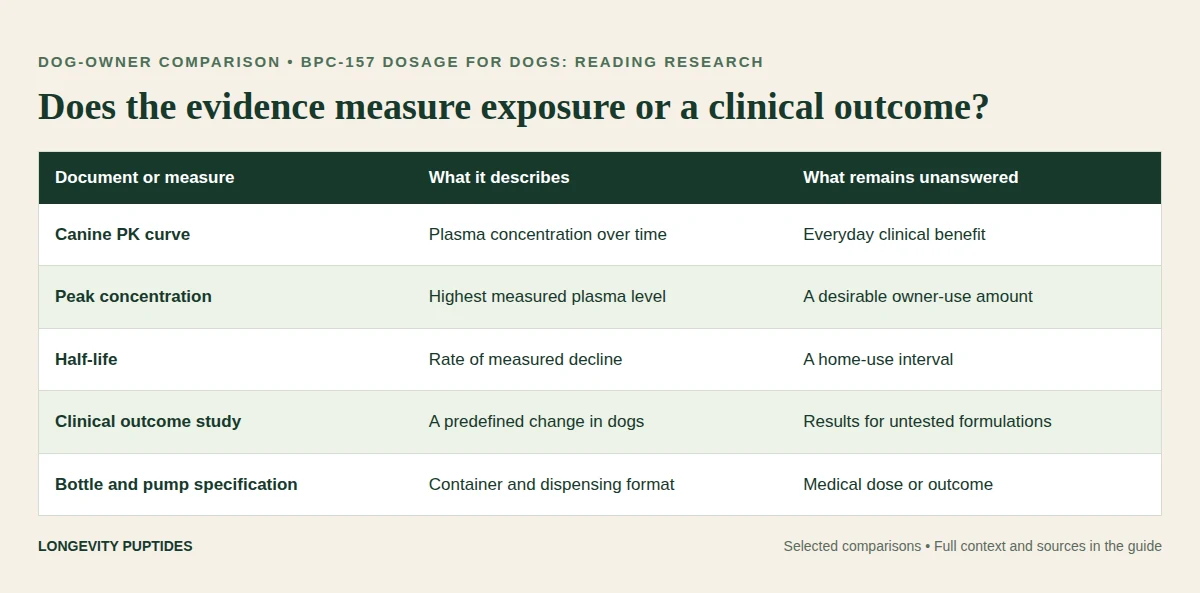
The comparison below helps you identify what a document can answer before you decide whether it belongs in your buying decision. Its PK examples come from the original canine experiment; the product-format row reflects the approved Longevity Puptides catalog. Neither row should be read as a clinical recommendation.
For a clinical claim, look for the actual outcome, comparison group, relevant dogs and follow-up period. A laboratory marker and a dog's daily function can both be worth measuring, but they are not synonyms. A statement about joint comfort, for example, needs evidence about that outcome rather than only an exposure graph. Our dog joint supplements guide provides a separate framework for comparing movement-related evidence.
| Document or measure | What it describes | What remains unanswered |
|---|---|---|
| Canine PK curve | Plasma concentration over time | Everyday clinical benefit |
| Peak concentration | Highest measured plasma level | A desirable owner-use amount |
| Half-life | Rate of measured decline | A home-use interval |
| Clinical outcome study | A predefined change in dogs | Results for untested formulations |
| Bottle and pump specification | Container and dispensing format | Medical dose or outcome |
Can a short half-life tell you how often to use something?
No home-use interval follows from the half-life reported in this paper. Half-life describes the time associated with a halving of measured concentration during the relevant elimination phase. It is not a countdown to the end of a clinical benefit. The Beagle results characterize the injected parent peptide under the investigators' sampling and analytical conditions.
Similarly, the paper's repeated-administration arm was a way to investigate exposure under another experimental condition. It was not selected by testing several household routines and finding which produced the best daily outcome. Similar concentration-time curves do not establish that a particular frequency is appropriate, or that a longer observation period would answer every practical question.
If a seller uses rapid clearance as a reason to suggest frequent application, ask for the study connecting that exact product and proposed use with the stated outcome. A dosing rationale requires more than identifying a short-lived plasma signal. This distinction is especially important when the product being discussed uses a different route from the experiment.
What do 60 mL and 600 metered sprays tell a buyer?
Longevity Puptides' approved collection consists of ten dog food-bowl sprays, each described as 2 fl oz / 60 mL with 600 metered sprays. Those are format specifications. They identify the bottle and its dispensing design; they do not state the BPC-157 concentration, a medical dose, sprays per meal or how long an individual dog should use a product.
Metered is useful vocabulary because it refers to dispensing rather than an unmeasured pour. But a pump dispenses formulation, not a diagnosis-specific amount chosen for a particular dog. Even a verified liquid output would still need ingredient-specific documentation to characterize what was dispensed. Characterizing that output remains a different task from determining a clinical regimen.
Use the bottle and spray count to compare catalog formats, not to estimate medical strength or treatment duration. A buyer can reasonably ask for a complete label, ingredient-specific concentration information and documentation of the pump specification. There is no reason to turn those questions into a spray-count calculator. Missing documentation should remain visible instead of being filled with assumptions from an injection paper.
What does FDA compounding context establish?
FDA distinguishes extralabel use of certain approved drugs from animal drugs compounded from bulk drug substances. Under AMDUCA, specified extralabel uses of approved human or animal drugs can occur under stated conditions within a valid veterinarian-client-patient relationship. That is not general permission to treat an unapproved research substance as an approved veterinary drug.
FDA's GFI #256 questions and answers describe circumstances in which the agency does not intend to take enforcement action against certain animal bulk-drug compounding. Patient-specific prescriptions and office stock are distinct situations. Enforcement discretion is not product approval. A pharmacy listing or veterinary involvement therefore needs its actual regulatory context, rather than the assumption that compounded means FDA-approved.
BPC-157 also appears on FDA's separate human-compounding risk page, current as of April 22, 2026, under bulk substances nominated but withdrawn. The entry identifies potential immune-response concerns for certain routes, peptide-related impurities and difficulties characterizing the active pharmaceutical ingredient, alongside limited information for the proposed human routes. This is human regulatory context, not a canine risk-rate estimate or an assessment of Recovery Ranger.
For a buyer, the useful distinction is between scientific publication, a compounding framework and approval of a specific finished product. One does not automatically supply another. This guide does not determine the legal classification of an individual catalog item or establish that BPC-157 qualifies for any veterinary office-stock list.
What should you bring to a veterinary conversation?
If your search began with limping, pain, repeated vomiting, diarrhea or a meaningful change in appetite or behavior, seek veterinary evaluation rather than selecting BPC-157 from a symptom list. Bring a description of what changed and when, along with the complete product information you have seen. An ingredient guide or food-bowl spray is not a substitute for assessment or prescribed care.
For a research question, bring the original paper rather than only a screenshot of its abstract. You can ask whether the animals, route and outcome match the claim that interested you. For a product question, bring the label and ingredient list, plus current medicines, other supplements and relevant health history. Keeping these documents together lets the veterinarian address your dog's situation without reconstructing a seller's abbreviated description.
You do not need a proposed dose to make that appointment useful. A clear question such as whether a claim is supported by canine outcome research is more informative than a number borrowed from a methods table. For everyday feeding decisions, the dog nutrition and longevity guide offers broader context without turning experimental peptide quantities into a meal plan.
Where does Recovery Ranger fit in this comparison?
Recovery Ranger is the Longevity Puptides catalog formula listing TB-500 + BPC-157. It shares the collection's 2 fl oz / 60 mL, 600-metered-spray food-bowl format. That ingredient listing is the reason it belongs beside this reading guide. The name Recovery Ranger is a catalog identity, not a result demonstrated by the canine PK study.
The paper studied BPC-157 alone. It cannot be treated as an experiment on the listed combination simply because one ingredient overlaps. The catalog also distinguishes TB-500, described as a thymosin beta-4-related fragment, from full-length thymosin beta-4. Our Wolverine stack for dogs guide examines combination terminology separately; a familiar nickname does not identify the complete research material or establish a combination outcome.
Longevity Puptides writes this guide and has a commercial interest in its catalog. The useful fit here is transparent ingredient education: compare the listed actives with what a paper actually tested, then keep product specifications separate from medical conclusions. The research library is the place to follow original records rather than infer finished-formula performance from a matching peptide name.
Common questions
Is there a BPC-157 dosage for dogs on this page?
No. This guide explains research measurements without giving dog administration amounts or schedules. The cited canine paper measures injected exposure; it does not establish a feeding regimen for your dog.
Was BPC-157 actually studied in dogs?
Yes. He and colleagues' 2022 paper includes six Beagles given laboratory BPC-157 by intravenous and intramuscular routes. The canine results concern plasma pharmacokinetics, not a trial of everyday mobility or digestion.
Does the paper study an oral dog spray?
No. Its canine routes were injections, and its test material was not a Longevity Puptides food-bowl spray. Oral-product questions require their own formulation-specific documentation.
Why does the paper include rats as well as dogs?
Different parts of the program used different animals and measurements. The detailed radiolabeled tissue-distribution, metabolism and excretion work was in rats. Those results should not be relabeled as canine tissue findings.
Does a short plasma half-life imply frequent application?
No. A half-life describes measured concentration decline under the experiment's conditions. It does not establish a home-use interval or how long a clinical effect lasts.
Is a 600-spray bottle a 600-dose bottle?
The catalog specifies 600 metered sprays, not 600 medical doses. Spray count and bottle volume describe the format; they do not specify a regimen, active concentration or duration for an individual dog.
Does compounded mean FDA-approved?
No. FDA distinguishes approved-drug starting materials from bulk-drug compounding and describes specific enforcement circumstances. A compounded finished animal drug is not made FDA-approved by the compounding process.
Did the canine study test TB-500 with BPC-157?
No. The cited canine PK experiment tested BPC-157, not TB-500 or the combination listed in Recovery Ranger. A shared ingredient is not evidence that the finished formula was studied.
What if my dog has symptoms and I found a dosage chart online?
Seek veterinary evaluation and bring the chart's source, the complete product label and your dog's medication history. Do not use an online chart to replace assessment or change prescribed care.
About this guide
Author and publisher: Longevity Puptides.
Written and source-checked by Longevity Puptides as an educational buyer guide; no veterinarian or other clinician is credited as its reviewer or endorser.
Editorial standards and correctionsRead the original sources
- He et al. (December 2022): Pharmacokinetics, distribution, metabolism, and excretion of body-protective compound 157, a potential drug for treating various wounds, in rats and dogs — primary study ↗
- FDA: Animal Medicinal Drug Use Clarification Act of 1994 (AMDUCA) — content current October 24, 2024 ↗
- FDA: Q&A: GFI #256 — Compounding Animal Drugs from Bulk Drug Substances ↗
- FDA: Certain Bulk Drug Substances for Use in Compounding that May Present Significant Safety Risks — content current April 22, 2026 ↗