
Where Science Meets Love
Peptides for Dog Skin Allergies: Evidence Guide
Peptides discussed for dog skin allergies often include GHK-Cu, a copper-linked peptide studied in cells and wound models rather than a verified canine allergy regimen. This guide separates those findings from allergic-skin care and introduces the GHK-Cu ingredient story behind Skin & Shine.
Published · Updated
In this guide
Are you shopping for coat care or looking for an allergy answer?
Searching for peptides for dog skin allergies often starts with a very ordinary wish: you want your dog to feel comfortable again. But a product category cannot tell you why a dog is scratching. The useful first decision is whether you are exploring an ingredient associated with skin research or trying to understand a medical symptom. Those questions lead to different evidence and different next steps.
Skin-and-coat shopping might involve comparing ingredient names, grooming routines and product formats. Allergy care involves identifying the cause of discomfort and choosing a veterinarian-directed plan. A beautiful coat is not a diagnostic test, and a label that says skin does not identify an allergy treatment. Keep your dog's symptoms separate from the appealing language on a bottle so that each decision gets the attention it deserves.
Our broader peptides for dogs guide introduces the ingredient landscape. This page narrows the question to GHK-Cu, the ingredient in Skin & Shine, and asks what its actual experiments measured. It also explains why those measurements should not become an allergy-treatment ranking.
What should happen when itching is the reason you are shopping?
Persistent scratching, repeated licking, inflamed skin or recurring ear trouble deserves veterinary evaluation rather than a guessed supplement change. The 2023 AAHA allergy guidelines begin with a detailed history and physical examination. They ask about seasonality, the level of itching, parasite-control history, age when signs began and responses to previous care. Your observations are useful because a clinic visit captures only one point in that history.
AAHA recommends a minimum dermatologic database: skin cytology, flea combing, skin scrapings and ear cytology when ear disease is present. Cytology means examining collected material under a microscope. These steps help a veterinarian evaluate contributors that an owner cannot reliably sort out from appearance alone. Flea allergy, food allergy and atopy are distinct possibilities, and secondary bacterial or yeast problems can complicate the picture.
Bring photographs, dates and a list of foods, treats, supplements and medications. Note whether scratching interrupts rest or whether ear signs recur. You do not need to arrive with a diagnosis. If a previously successful plan stops working, AAHA recommends returning to the history, examination and dermatologic testing rather than assuming that a new product is the missing piece. Ask your veterinarian what needs reassessment and when to return.
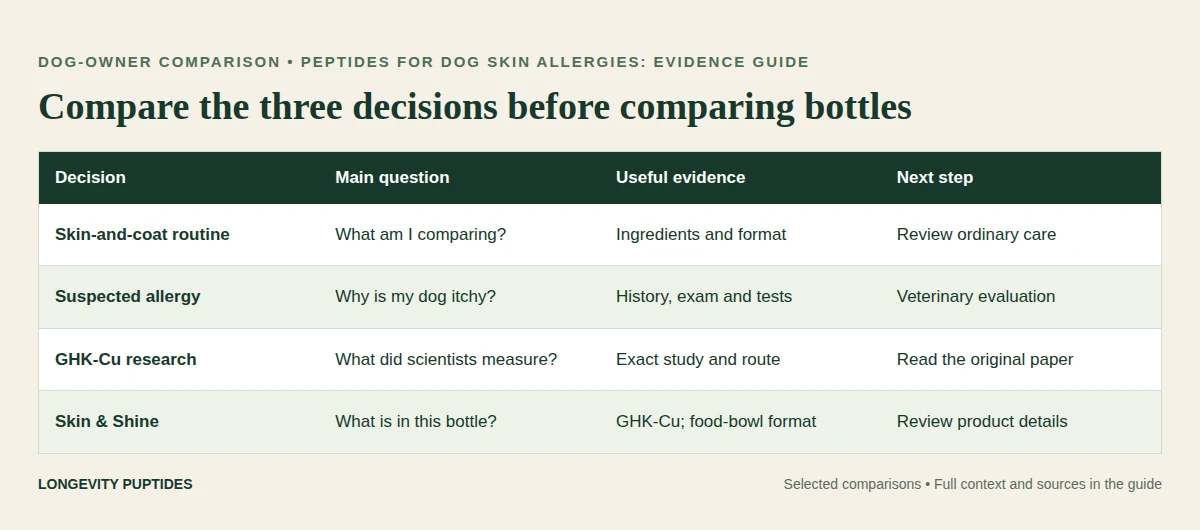
Compare the three decisions before comparing bottles
A useful comparison separates your goal, the evidence needed and the person responsible for the decision. Ingredient research can answer why scientists are interested in a molecule. Product information can describe a bottle. Neither does the work of a clinical examination. Use this table to keep the questions organized, especially when a product name and a research headline seem to promise the same thing.
These categories can coexist in one household, but they should not be collapsed into one purchase. A dog receiving veterinary allergy care can still have ordinary grooming and nutrition questions; those questions belong within the care plan rather than being treated as alternatives to it.
| Decision | Main question | Useful evidence | Next step |
|---|---|---|---|
| Skin-and-coat routine | What am I comparing? | Ingredients and format | Review ordinary care |
| Suspected allergy | Why is my dog itchy? | History, exam and tests | Veterinary evaluation |
| GHK-Cu research | What did scientists measure? | Exact study and route | Read the original paper |
| Skin & Shine | What is in this bottle? | GHK-Cu; food-bowl format | Review product details |
What is GHK-Cu, and what does its collagen research mean?
GHK stands for glycyl-L-histidyl-L-lysine, a three-amino-acid peptide with affinity for copper(II) ions. GHK-Cu names its copper-bound form. The 1988 Maquart study describes GHK isolated from human plasma and investigates the copper complex in fibroblast cultures. Fibroblasts are cells involved in producing connective-tissue material. This is the basis for a specific collagen-related research discussion, not a reason to describe every copper ingredient as equivalent.
The authentic paper title is Stimulation of collagen synthesis in fibroblast cultures by the tripeptide-copper complex glycyl-L-histidyl-L-lysine-Cu2+, published October 10, 1988. Direct exposure to GHK-Cu increased collagen synthesis under the experiment's conditions, independently of a change in cell number. The accessible abstract does not explicitly identify the fibroblast species, so the result should remain labeled cell-culture evidence rather than being silently described as a dog-cell study.
Collagen synthesis is a laboratory endpoint. It is not a measurement of scratching, allergic flares, hair growth or coat shine. Likewise, the word mechanism means a proposed or observed biological process; it does not tell an owner what a finished bottle will do. The GHK-Cu ingredient guide and research library provide routes into the original literature without turning a cell result into an everyday promise.
What did the actual dog experiment test?
There is genuine canine research in this source set, but its context matters. Swaim and colleagues published Effect of locally injected medications on healing of pad wounds in dogs in March 1996. The original study abstract describes 12 mature English Pointers with experimentally created full-thickness paw-pad wounds. Researchers used local injections of a tripeptide-copper complex, a separate immunostimulant or saline and examined wound measurements and collagen-related material.
At day six, wounds receiving the tripeptide-copper complex had more type-I collagen than control wounds. At day fourteen, their type-I collagen amount was significantly greater than in the other wounds. Those are the copper-complex findings worth reporting. The abstract's strongest early healing-rate and hydroxyproline findings concerned the separate immunostimulant, so it would be misleading to assign every favorable result in the paper to the copper complex.
This experiment answers a narrow question about a locally administered research material in created canine wounds. It did not enroll dogs because they had allergic dermatitis or measure owner-observed itch. The original abstract calls the material a tripeptide-copper complex; it does not identify Skin & Shine as the preparation tested. For a buyer, the valuable takeaway is that tested in dogs needs the rest of the sentence: which material, which route, which condition and which outcome?
Why the often-cited topical study is not dog allergy evidence
Canapp and colleagues' The effect of topical tripeptide-copper complex on healing of ischemic open wounds appeared in Veterinary Surgery in November–December 2003. Despite the journal and veterinary authorship, the study used 24 adult male Sprague-Dawley rats, not dogs. Investigators created wounds in skin flaps with restricted blood supply and compared a topical copper-tripeptide gel with its vehicle and with untreated controls.
By day thirteen, initial wound area had decreased by 64.5% in the copper-complex group, 45.6% in the vehicle group and 28.2% in untreated controls. Those percentages describe changes in experimental wound area, not the proportion of dogs whose allergies improved. Significant differences against the vehicle occurred on days three and nine; the paper should not be summarized as consistent superiority to vehicle at every observation.
The researchers also measured lower wound-tissue concentrations of TNF-alpha and MMP-2 and MMP-9 compared with untreated controls at specified follow-up points. TNF-alpha is an inflammation-related signal, while MMPs are enzymes involved in tissue remodeling. These are local tissue measurements in a rat wound model. Describing them precisely is more informative than replacing them with a broad phrase such as immune balancing or claiming that a spray calms allergic skin.
Do all topical GHK-Cu experiments show the same result?
No. Parker and colleagues published Effects of topical copper tripeptide complex on wound healing in an irradiated rat model in September 2013, following online publication June 6. Their rat experiment compared topical GHK-Cu gel with a control ointment on surgical skin flaps after irradiation. The researchers examined flap ischemia, blood-vessel number and area, and expression of vascular endothelial growth factor, or VEGF, a vessel-growth signal.
The study reported no significant differences in those endpoints under its prespecified statistical threshold. The copper-gel group's mean ischemic area was numerically larger, but the reported comparison did not cross that threshold. A fair summary includes the null findings without recasting them as proof of harm or universal ineffectiveness. Different experimental settings can produce different results. A buyer deserves that full picture, not just the most encouraging paragraph from one earlier paper.
What belongs in ordinary coat care, and what belongs in an allergy plan?
For everyday care, start with questions you can actually organize: what your dog eats, which grooming products are used, how the coat usually looks and what has recently changed. Our dog nutrition and longevity guide provides broader food-planning context. Keep a full ingredient list rather than tracking only the name on the front of a package. A skin-themed product remains a product to evaluate, not a diagnosis.
Allergy management is a different conversation. The AAHA guidelines describe an individualized, often multimodal approach. Depending on the clinical findings, a veterinarian may address parasites, secondary infection, diet investigation and itch management. Ask how each part of the plan contributes and how progress will be assessed. That makes the plan understandable without asking a supplement to carry responsibilities it has not been shown to meet.
Atopy is a diagnosis of exclusion. AAHA states that intradermal or serum allergy testing does not independently diagnose atopy; those tests are used to identify allergens when immunotherapy is planned. This distinction helps owners interpret a proposed test: ask what decision its result will inform. A commercial ingredient comparison cannot replace that diagnostic sequence, and a change in coat appearance cannot confirm that an allergy's cause has been found.
Could a food-bowl extra complicate a food-allergy investigation?
Food-allergy investigation is especially relevant to a food-bowl product. The full AAHA guideline explains that history and physical findings cannot reliably distinguish food allergy from atopy. It also states that serum, saliva and hair tests are of no value for diagnosing or managing food allergy. A veterinarian-directed elimination diet and, after a positive response, a food challenge address a different question from simply changing brands.
During that investigation, everything your dog eats matters. AAHA specifically highlights treats, pill pockets, flavored items, table scraps and access to other animals' food. A food-bowl spray belongs on that same disclosure list. Do not assume that a small amount or an unfamiliar ingredient makes an addition irrelevant. Ask the veterinary team whether an extra belongs in the agreed trial, and follow their plan rather than designing a version around a preferred product.
Improvement during a diet change alone does not confirm food allergy; the guideline describes the subsequent challenge as essential to confirmation. The team also decides how needed itch management fits into the investigation. You do not have to choose between careful observation and medical care. Keep the trial interpretable by communicating changes instead of adding several new products and then trying to guess which one explains the result.
How should you evaluate a peptide product without an efficacy ranking?
Ask for the exact ingredient, complete product information and the paper supporting the statement being made. Check the study's species, route, comparison group and measured outcome. A seller citing Swaim should describe local injections in dogs; a seller citing Canapp should describe topical gel in rats. If those details are absent, the research headline is doing more work than the evidence permits. The product research checklist can help structure those questions.
Separate research on an ingredient from research on the actual formulation. A human skincare discussion, an animal wound experiment and a swallowed food-bowl format are not interchangeable. Our oral peptides for dogs guide explores that route distinction. For this buying decision, the important point is simpler: changing the route changes the question, even when the ingredient name stays the same.
Choose your spending priorities around your dog's actual need. If symptoms prompted the search, clarify the examination, diagnostic and follow-up plan before treating a bottle as the answer. If your interest is educational, compare the transparency of the product information and citations rather than promises of faster results. Longevity Puptides has a commercial interest in Skin & Shine; that is why this page separates our catalog description from the outcomes the papers measured.
Where does Skin & Shine fit in the collection?
Skin & Shine is the GHK-Cu formula in the Longevity Puptides Skin & Coat family. Its catalog invitation is to discover copper-peptide science, with affection for a familiar coat and a good cuddle. The name identifies its collection theme; it is not a promise of shine, less shedding or relief from itching. It is the relevant product page when your question is about this ingredient, not an allergy-treatment substitute.
The collection contains ten named formulas, all in the same exclusive format: 2 fl oz / 60 mL metered food-bowl sprays, with 600 metered sprays per bottle. Skin & Shine is not a topical skin spray, despite the topical experiments discussed above. The spray count describes the package rather than a dog-use schedule or a predicted duration of benefit.
A practical next step is to read the ingredient and format details, keep the original papers available and bring the complete information into any veterinary conversation about your dog. You can be curious about peptide science while keeping medical decisions with the veterinary team. That is a thoughtful place for this guide to end: clearer questions, accurately described research and a product understood for what it is.
Common questions
Is GHK-Cu an established treatment for dog skin allergies?
The cited studies do not establish that use. They examine cultured cells, locally injected material in dog wounds and topical rat wound models, not canine allergic dermatitis. Suspected allergies need veterinary evaluation.
Was the Canapp copper-peptide study done in dogs?
No. The 2003 study used 24 adult male Sprague-Dawley rats with experimentally created ischemic wounds. Publication in a veterinary journal does not make its subjects dogs.
What did the GHK-related dog study measure?
The 1996 Swaim experiment measured created paw-pad wounds and collagen-related endpoints after local injections of a tripeptide-copper complex. Its copper-complex findings included more type-I collagen at specified follow-up points, not an itch outcome.
Does increased collagen in a study mean less scratching?
No. Collagen synthesis or content is a different endpoint from scratching or allergic flares. A clinical itch claim would need relevant clinical measurements, not a substitution of one outcome for another.
Is Skin & Shine sprayed on a dog's skin?
No. The approved Longevity Puptides format is a metered food-bowl spray. Skin & Shine contains GHK-Cu and is not the topical gel used in the rat studies.
Can blood allergy testing diagnose atopy by itself?
AAHA says atopy is a diagnosis of exclusion. Serum and intradermal tests are used to identify allergens when immunotherapy is planned, not to independently establish the diagnosis.
Should I mention a food-bowl spray during an elimination diet?
Yes. Give the veterinary team the complete product information and disclose all extras. AAHA emphasizes that everything eaten can matter to a diet trial; the team should decide what belongs in the agreed plan.
Does a better-looking coat confirm that food allergy was the cause?
No. Appearance alone does not establish the cause. AAHA describes a veterinarian-directed diet trial followed by a challenge after a positive response as the diagnostic approach for confirming food allergy.
How large is a Skin & Shine bottle?
The catalog specifies 2 fl oz / 60 mL with 600 metered food-bowl sprays, the same format used across all ten formulas. That count is a package description, not an administration schedule.
What should I bring to a veterinary skin appointment?
Bring symptom dates, photographs, your dog's diet and treat history, current medications and supplements, and complete information for any product you are considering. Ask what needs investigation and how follow-up will be organized.
About this guide
Author and publisher: Longevity Puptides.
Written and source-checked by Longevity Puptides as an educational buyer guide, with a commercial interest in the collection described; no veterinarian or clinician endorsement is claimed.
Editorial standards and correctionsRead the original sources
- Swaim et al. (March 1996): Effect of locally injected medications on healing of pad wounds in dogs — original study abstract ↗
- Canapp et al. (November–December 2003): The effect of topical tripeptide-copper complex on healing of ischemic open wounds — original rat study abstract ↗
- Maquart et al. (October 10, 1988): Stimulation of collagen synthesis in fibroblast cultures by the tripeptide-copper complex glycyl-L-histidyl-L-lysine-Cu2+ — original study abstract ↗
- Parker et al. (September 2013): Effects of topical copper tripeptide complex on wound healing in an irradiated rat model — original study abstract ↗
- AAHA (October 28, 2023): 2023 AAHA Management of Allergic Skin Diseases in Dogs and Cats Guidelines — official overview ↗
- AAHA (November–December 2023): 2023 AAHA Management of Allergic Skin Diseases in Dogs and Cats Guidelines — full clinical guideline ↗