
Where Science Meets Love
Peptides for Dog Gut Health: An Evidence Guide
Peptides for dog gut health can mean nutritional protein fragments or specific experimental ingredients such as BPC-157. Explore the digestive research by species and route, the role of veterinary assessment for ongoing symptoms, and the BPC-157 ingredient story behind Belly Balance's food-bowl format.
Published · Updated
In this guide
Are you reviewing nutrition or investigating symptoms?
Start with the question you want answered, rather than the bottle you hope to find. If your dog is eating normally and you are curious about everyday feeding, the useful questions concern the main diet, life stage, treats and mealtime routine. If your dog has recurring diarrhea, vomiting, appetite changes or unexplained weight loss, you are investigating a health problem. A digestive-wellness category cannot tell you why that change is happening.
These decisions can overlap, but they should stay distinct. The WSAVA Nutritional Assessment Guidelines evaluate the animal, diet and feeding environment together. They identify altered gastrointestinal function and unexplained weight changes as reasons for closer assessment. That makes nutrition part of a useful veterinary history, not an alternative explanation that lets an owner skip investigation.
Our peptides for dogs guide explains the wider ingredient landscape. Here, the buyer decision is narrower: whether a source actually addresses your dog's digestive question, and whether you are comparing a nutritional food, a research ingredient or a named catalog product. Keeping those categories separate makes the next step much clearer.
Review the main diet before comparing additions
For an everyday nutrition review, look first at the nutritional adequacy statement on the food label. FDA's “Complete and Balanced” Pet Food explanation says this statement identifies food intended as a sole diet and explains the nutrient-profile or feeding-trial basis for that claim. The intended life stage matters too: adult maintenance is not the same nutritional category as growth and reproduction.
Write down the exact food, including its variety, rather than only the brand. Then add everything else offered: treats, table food, chews, supplements and the food used to give medication. WSAVA includes these items in a dietary assessment because the main bag does not describe the entire feeding pattern. Two households feeding the same named food may still have very different daily routines.
Do not treat a peptide ingredient as a missing nutrient simply because it is made from amino acids. A named signaling compound is a different question from whether a meal supplies appropriate protein and other nutrients. A spray also does not turn an incomplete diet into a complete one. Use the dog nutrition and longevity guide to organize the food discussion before comparing optional products. Ask your veterinarian to interpret the overall diet in light of your dog's age, body condition and medical history.
Hydrolyzed protein and BPC-157 are different purchases
The word peptide can appear in a food discussion without referring to BPC-157. In a hydrolyzed-protein diet, proteins have been broken into smaller components, including peptides. The MSD Veterinary Manual's chronic-enteropathy reference describes these diets as a veterinary dietary option intended to reduce antigenic reactions. This is a food-formulation concept, not evidence about adding a particular experimental compound.
BPC-157, by contrast, identifies a specific 15-amino-acid synthetic peptide. Xue and colleagues describe its sequence in their original 2004 gastric-ulcer study. Its identity is not interchangeable with the mixture of smaller protein fragments in a hydrolyzed food. An owner searching for peptide nutrition could otherwise mistake two very different categories for competing versions of the same thing.
If your veterinarian has prescribed a particular diet for an assessment, ask which additions fit that plan before changing the bowl. The manual describes dietary trials as exclusive feeding, so unrecorded treats or additions can make the planned comparison harder to interpret. The purchase decision is therefore not 'which peptide is stronger?' It is whether you need a complete food, a veterinarian-directed dietary plan or information about a research ingredient.
Compare what each evidence type can answer
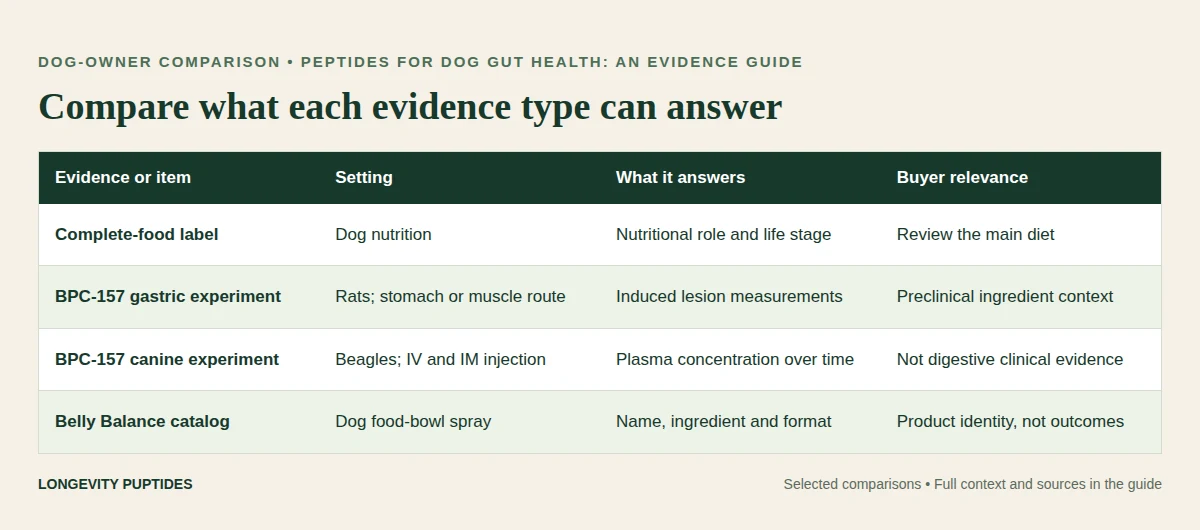
Use this comparison when a search result places nutrition, animal experiments and a commercial formula side by side. The important differences are the material tested, the setting and the measurement. The linked rat gastric study and Beagle pharmacokinetic study supply the experimental examples below; the food-label row follows FDA's nutritional-adequacy explanation.
These are not competing benefit scores. A nutritional label addresses a feeding role, while a laboratory experiment addresses a defined scientific question. For a buyer, the strongest-looking result is not necessarily the most relevant result. Match the evidence to the decision you are actually making.
| Evidence or item | Setting | What it answers | Buyer relevance |
|---|---|---|---|
| Complete-food label | Dog nutrition | Nutritional role and life stage | Review the main diet |
| BPC-157 gastric experiment | Rats; stomach or muscle route | Induced lesion measurements | Preclinical ingredient context |
| BPC-157 canine experiment | Beagles; IV and IM injection | Plasma concentration over time | Not digestive clinical evidence |
| Belly Balance catalog | Dog food-bowl spray | Name, ingredient and format | Product identity, not outcomes |
What the BPC-157 rat gastric study actually found
The paper “Protective effects of pentadecapeptide BPC 157 on gastric ulcer in rats” was published on April 1, 2004, in the World Journal of Gastroenterology. It involved 330 male Wistar rats distributed across three induced gastric-ulcer models and multiple groups. The models used indomethacin, surgical pylorus ligation or acetate injury. These were deliberately created stomach injuries, not observations of ordinary feeding in companion dogs.
Researchers administered laboratory BPC-157 intragastrically, meaning into the stomach, or intramuscularly, meaning into muscle. They measured ulcer areas and, in the chronic acetate model, tissue features involving glandular epithelium and granulation tissue. The paper reported smaller ulcer areas and differences in those tissue measurements compared with controls in specified comparisons. Intramuscular administration generally produced stronger effects than intragastric administration in the reported comparisons.
Those details explain why BPC-157 appears in digestive-tissue research. They also define the finding: a particular test material, injury model, route and measurement. The total of 330 animals should not be read as 330 animals in a single comparison; each model contained several groups, with ten rats per group. A large headline sample can otherwise make the evidence look more uniform than the experiment actually was.
For an owner, smaller induced rat lesions are not a measurement of canine stool quality, appetite or everyday digestive comfort. Keep the original results attached to their experiment. The BPC-157 for dogs article offers compound-specific context without turning the rat paper into a product recommendation.
The dog study measured blood concentrations, not gut health
He and colleagues' 2022 pharmacokinetic paper included six Beagle dogs given BPC-157 by intravenous and intramuscular injection. Published on December 14, 2022, it measured plasma concentrations over time, including after repeated intramuscular administration. Pharmacokinetics is the study of how a substance moves through the body; here, the key canine measurements were concentration-time profiles rather than digestive clinical outcomes.
The researchers reported that measured parent-peptide concentrations declined rapidly, with an elimination half-life under 30 minutes in the tested conditions. That is a description of a blood-concentration curve. It is not a timetable for a dog to feel different, a duration of digestive benefit or an instruction for using a bottle. The paper's separate rat distribution and metabolism experiments also remain rat findings.
When a retailer says 'studied in dogs,' ask what was studied. A dog in an injection experiment is direct canine research, but it is not automatically a dog in a digestive clinical trial. A relevant clinical comparison would need defined digestive outcomes, appropriate comparison groups and the actual formulation and route under discussion. The research library is a starting point for locating papers; read the original methods before interpreting a study label as a buyer benefit.
Do not choose a bottle from an IBD or 'leaky gut' label
Recurring digestive signs deserve a description before they receive a diagnosis. The MSD Veterinary Manual explains that chronic enteropathies are investigated by excluding other causes and considering history, examination and additional assessment as appropriate. Vomiting, diarrhea, appetite changes and weight loss can occur, but those signs alone do not identify one cause.
If a website attaches 'IBD' or 'leaky gut' to a peptide name, ask what diagnosis and outcome support that pairing. An induced rat stomach-ulcer experiment does not answer a canine inflammatory-bowel-disease question. Likewise, a marketing phrase is not a clinical finding. Do not use either label as a reason to assign your dog a condition or select a product from a symptom checklist.
A better appointment question is, 'What are we trying to explain, and what information would distinguish the possibilities?' That keeps attention on your dog's history instead of asking whether a fashionable ingredient matches a broad disease word. A product name cannot supply the missing investigation.
When symptoms change the next step
Contact your veterinary team promptly when diarrhea is accompanied by vomiting, loss of appetite or lethargy, or when stool contains fresh blood or appears black and tarry. These are signs highlighted by Cornell's Riney Canine Health Center. Persistent or recurring digestive changes also belong in a veterinary conversation. Tell the team what is happening so they can advise on the appropriate urgency for your dog.
Mention recent food changes and any possible access to unfamiliar food or objects. Cornell lists multiple causes of diarrhea and explains that diagnostic choices depend on the situation, including fecal testing, bloodwork or imaging when indicated. You do not need to decide which test is required before calling. Accurate observations are more useful than arriving with a diagnosis borrowed from an advertisement.
Do not pause that conversation to compare gut-health products. Veterinary evaluation and prescribed care are not interchangeable with a food-bowl addition. If you are uncertain how serious a change is, the useful action is to contact the veterinary team, not to wait for a peptide purchase to answer the question.
Build a record that makes the appointment more useful
Keep a short timeline in everyday language: when the change began, whether it recurs, what the stool looks like, whether vomiting occurred and how appetite changed. Add dated weights if you already have them, rather than estimating a trend from appearance alone. Note what was happening around the first episode, such as a food change, boarding stay or new addition to the bowl. Record observations separately from your guesses about the cause.
Include the exact food label and a list of treats, chews, table food, medicines and supplements. This follows the dietary-history approach in the WSAVA guidelines. If different family members feed the dog, ask each person to contribute. A shared bowl or an extra snack from another caregiver can leave gaps in an otherwise careful history.
The dog emergency records planner can hold current contacts, veterinary documents and feeding notes. It is an organization worksheet, not a symptom checker. Keep the timeline alongside that packet so the latest information is available when you call or attend an appointment. Ask the clinic whether it wants a stool sample and how to provide it.
For the appointment itself, use the vet-visit question planner to bring the product label and source links into the same conversation. If a veterinarian directs a change, record the date and the instructions given. Keeping the sequence clear helps everyone distinguish what was observed from what was changed.
Where Belly Balance fits in the catalog
Belly Balance is the Longevity Puptides catalog product containing BPC-157. Its catalog description invites owners to understand digestive-wellness science. That describes an ingredient-interest category, not a measured change in digestion. The product name should be read as a name, rather than a result you can expect in your dog's bowl.
The approved collection consists only of ten 2 fl oz / 60 mL metered food-bowl sprays, each with 600 metered sprays per bottle. Bottle size and spray count identify the format. They do not specify a dog-use schedule, an amount per meal or how long a bottle should last for your dog. No injection, topical application or alternative format is being offered through this guide.
For this particular buyer question, Belly Balance is the focused catalog match because it lists BPC-157 alone. Adding more peptide names to a comparison would not fill the gap between ingredient research and digestive clinical evidence. Our oral peptides for dogs guide examines route distinctions for owners comparing research descriptions with food-bowl products. Keep the exact catalog label available when discussing an addition with your veterinarian.
Make the decision from documents, not a promised result
Before committing to any digestive-wellness purchase, ask for the complete product label and the original paper behind the claim that matters to you. Check whether the paper tested dogs, whether it measured a digestive outcome and whether it used the item being offered. A testimonial about firmer stool cannot tell you what else changed in that dog's food or care. It is not a substitute for a defined clinical comparison.
Use the dog product research checklist to keep those documents together. A useful seller response identifies the ingredient, distinguishes catalog facts from experimental results and answers the question without changing the subject to a different species or route. 'There is a study' is less useful than knowing what that study actually measured.
Your next step can be modest and still worthwhile: review the main diet, prepare a symptom history or learn more about BPC-157's research record. If Belly Balance remains of interest, compare its catalog details with the evidence question you started with. Let the product conversation follow a clear understanding of nutrition and veterinary needs, rather than asking a bottle to define them.
Common questions
Are all peptides discussed for gut health the same?
No. Protein fragments in a food and a specific synthetic compound such as BPC-157 are different materials. Start by identifying whether the source is discussing nutrition, an experimental ingredient or a finished product.
Has BPC-157 been studied in dogs?
Yes. The linked 2022 Beagle study used intravenous and intramuscular injections and measured plasma concentrations. It did not test digestive clinical outcomes or a food-bowl spray.
What did the rat gastric study show?
The 2004 study reported smaller induced gastric-ulcer areas and specific tissue differences in rats given laboratory BPC-157 into the stomach or muscle. Those results remain rat injury-model findings, not everyday canine digestion measurements.
Is Belly Balance a hydrolyzed-protein diet?
No. Belly Balance is a BPC-157 metered food-bowl spray in the approved catalog. A hydrolyzed-protein diet is a different food-formulation category, and a spray does not replace a complete main diet.
Does BPC-157 cure IBD or 'leaky gut' in dogs?
The sources verified for this guide do not support either claim. Recurring digestive signs need veterinary investigation; a disease label on a product page does not establish a diagnosis or justify replacing prescribed care.
What should I record before a digestive appointment?
Record the timeline, stool appearance, vomiting, appetite changes, known weights and recent feeding changes. Bring the exact food label and a complete list of treats, medicines and supplements, plus any product label you want to discuss.
Which signs should prompt a veterinary call?
Contact your veterinary team promptly about blood or black, tarry stool, diarrhea with vomiting, appetite loss or lethargy. Persistent or recurring changes also need assessment. Describe the signs so the team can determine the appropriate urgency.
Can I add a spray during a veterinarian-directed dietary trial?
Ask the treating veterinarian first. The prescribed feeding plan may require exclusive feeding, and an unrecorded addition can complicate interpretation. Bring the full label rather than asking only about the peptide name.
Does 600 metered sprays mean a particular treatment duration?
No. It is the approved bottle-format count, not a dog dose, meal schedule or duration. This guide provides no administration regimen.
Who wrote and reviewed this guide?
Longevity Puptides wrote and source-checked this educational buyer guide. No veterinary clinician review or endorsement is represented; individual digestive symptoms and care decisions belong with your dog's veterinarian.
About this guide
Author and publisher: Longevity Puptides.
Written and source-checked by Longevity Puptides as an educational buyer guide; no veterinary clinician review or endorsement is represented.
Editorial standards and correctionsRead the original sources
- Xue et al. — Protective effects of pentadecapeptide BPC 157 on gastric ulcer in rats (2004) ↗
- He et al. — Pharmacokinetics, distribution, metabolism, and excretion of body-protective compound 157, a potential drug for treating various wounds, in rats and dogs (2022) ↗
- Freeman et al. — WSAVA Nutritional Assessment Guidelines (2011) ↗
- FDA — “Complete and Balanced” Pet Food (content current February 28, 2020) ↗
- Cornell Riney Canine Health Center — Diarrhea (updated March 2024) ↗
- MSD Veterinary Manual — Chronic Enteropathies in Small Animals ↗