
Where Science Meets Love
Peptides for Dog Anxiety: Evidence and Care
Peptide research relevant to dog anxiety includes canine oxytocin studies of social behavior and Selank experiments in rats, each answering a different scientific question. This guide explains those findings, veterinary approaches to persistent distress, and the Oxytocin + Selank + Semax ingredient story behind Calm Companion.
Published · Updated
In this guide
Is this a passing reaction or a persistent problem?
A dog who briefly startles at a dropped pan is responding to something happening now. A dog who remains watchful and unsettled before anything happens may be anticipating a threat. The Merck Veterinary Manual distinguishes fear, a response to an immediate perceived danger, from anxiety, sustained apprehension about danger that is not nearby. Both can be normal when proportionate and appropriate to the situation. The useful question is not whether your dog ever looks worried, but how the response fits the circumstances and affects ordinary life.
Notice whether your dog can return to familiar activities after the event. An occasional cautious response differs from repeated pacing, prolonged hiding, difficulty settling or distress across several settings. Intensity matters alongside frequency: a severe reaction to an occasional event still deserves attention. You do not need to wait for daily problems or assign your own diagnosis before contacting the veterinary team. There is no universal number of worried minutes that separates normal behavior from a disorder.
Shopping becomes clearer once you separate scientific curiosity from an immediate care need. Our peptides for dogs guide explains the wider ingredient landscape. Here, the priority is understanding the behavior first, then deciding whether reading about a peptide adds anything useful to that conversation. A product name cannot answer why an individual dog is distressed.
What should you record before choosing a product?
Describe what you actually see rather than starting with the label anxious. Record the event, who was present, where your dog went and what happened next. For example, trembling when keys appear tells a different story from panting after vigorous play. AAHA's behavioral-assessment guidance lists both obvious signs, such as shaking, and less conspicuous ones, such as freezing, turning away or scanning the surroundings. These are nonspecific observations, not a diagnosis from a single gesture.
If the concern happens while you are away, ordinary home-camera footage can provide details that a damaged cushion cannot. The Merck separation-distress section explains that video helps distinguish separation-related distress from other triggers, exploratory chewing, incomplete housetraining or discomfort with confinement. Record routine circumstances when possible; do not deliberately provoke a frightening event to get a clearer clip. Note sounds or visitors that might explain what appears to be an absence-related problem.
Add appetite, rest and changes in movement to your notes. A short timeline of when the pattern began is more useful than a long list of products already tried. Include changes in household schedules and all current medicines or supplements. This gives the veterinarian something concrete to assess and helps avoid interpreting every new behavior as a reason to buy another ingredient.
When do you need a veterinarian rather than a shopping shortlist?
New medical symptoms need veterinary evaluation, including appetite changes, apparent pain or a marked change in normal activity. Behavior and physical health are not separate compartments. The Merck Veterinary Manual emphasizes a history and clinical examination, with medical contributors ruled out; pain is particularly important. A dog who suddenly avoids touch or familiar activities should not have that change explained away as temperament or managed by switching a food-bowl product.
Your veterinarian can assess the medical picture and help determine whether the concern involves fear, separation distress, another behavioral condition or normal behavior that needs different management. A qualified reward-based trainer can help with learning and practical household skills. Persistent, complicated or intense distress may warrant referral to a veterinary behavior specialist. These roles can work together; training expertise does not replace medical assessment, and an ingredient guide does not perform either role.
Bring the complete product label if you are considering a spray, not just the word peptide. Ask what the care plan is trying to change and how progress will be assessed. Veterinary care may include prescribed medication when appropriate, alongside environmental and behavioral work. Do not substitute a catalog formula for that plan. If movement has changed too, our dog joint supplements guide offers a separate discussion rather than turning mobility concerns into an anxiety-product choice.
What belongs in a behavior plan before ingredient comparisons?
A useful plan starts with the situations your dog finds difficult and the everyday needs you can meet consistently. Discuss comfortable resting spaces, appropriate activity and predictable household arrangements with your care team. Routine is a context for care, not a guarantee that distress will disappear. It also makes observations easier: if schedules, visitors and products all change together, you lose track of what your dog is responding to.
Two learning terms often appear in professional plans. Desensitization means controlled exposure in small enough steps that the dog remains comfortable. Counterconditioning builds a different association with a trigger, often by pairing it with something the dog enjoys. The MSD Veterinary Manual's behavior-modification guide explains these approaches and why overwhelming exposure or confrontational punishment can worsen fear. The pace should follow the individual dog's response, not a fixed challenge schedule borrowed from a social post.
Ask a professional to explain what to do when your dog cannot engage comfortably, rather than pushing through a session. A quiet dog is not necessarily a relaxed dog; freezing is among the distress signs AAHA identifies. Familiar meals can be part of an ordinary routine, but eating is not proof that an anxiety problem has resolved. Our dog nutrition and longevity guide keeps everyday feeding decisions separate from behavioral diagnosis.
What did the companion-dog oxytocin study actually find?
Oxytocin is a naturally occurring signaling peptide investigated in social behavior. In Oxytocin promotes social bonding in dogs, published in PNAS in June 2014, Romero and colleagues studied sixteen companion dogs. Each dog received oxytocin alone through the nose and saline in separate, counterbalanced sessions. Owners did not know which condition their dogs received. Researchers observed interactions with owners and familiar dog partners in a controlled room.
After intranasal oxytocin, dogs showed greater orientation and affiliation toward their owners, with greater affiliation and approach toward dog partners than after placebo. Affiliation means friendly social interaction; it is not another word for anxiety relief. The crossover design is useful because each dog contributes observations under both conditions. The small sample and specific setting still matter when deciding what the result answers.
This was a social-bonding experiment with familiar partners present, not a clinical study of dogs diagnosed with separation anxiety. It did not ask whether a worried dog could remain comfortable during an ordinary absence or cope with fireworks over time. The word spray in a research description also needs its route attached: this was intranasal research, whereas the Longevity Puptides catalog uses food-bowl application. Keep the study's actual observation in view rather than replacing it with a more appealing owner-facing outcome.
Why does a second canine study change the buying question?
The title of a paper can sound more uniform than its results. Intranasal Oxytocin Improves Social Behavior in Laboratory Beagle Dogs (Canis familiaris) Using a Custom-Made Social Test Battery, published February 24, 2022, studied thirty-six adult laboratory Beagles. Turcsán and colleagues used a double-blind crossover design with intranasal oxytocin and saline. The dogs completed eight situations involving social interaction and responses to threatening stimuli.
Results depended on baseline performance and context. Some dogs with lower baseline social performance showed more human-directed contact seeking after oxytocin. In a social-threat test, dogs with higher baseline performance showed a more negative, fearful response. The authors also reported that only two of four baseline-by-condition interactions remained significant in a less-sensitive analysis. These details belong beside the favorable result, not hidden behind a broad claim that oxytocin makes dogs calmer.
Baseline performance here came from the dogs' placebo-session behavior. It was not an owner questionnaire that can tell you whether your dog is a good product candidate. Laboratory Beagles and household dogs also have different experiences. The practical buying question becomes, 'What behavior, in which setting, was measured?' You cannot answer it with a blanket temperament label such as shy, clingy or friendly, and owners should not recreate the study's threatening situations at home.
Is Selank evidence canine evidence?
The directly relevant Selank experiment verified for this guide used rats, not dogs. Kasian and colleagues' Peptide Selank Enhances the Effect of Diazepam in Reducing Anxiety in Unpredictable Chronic Mild Stress Conditions in Rats appeared in Behavioural Neurology on February 9, 2017. Forty-eight male Wistar rats were divided between stress and non-stress conditions, then smaller intervention groups. Selank was administered intranasally; diazepam was administered orally. Researchers assessed behavior using an elevated plus maze.
That maze compares exploration of open and enclosed arms as an experimental measure of anxiety-like behavior. Results varied with stress conditions and the intervention. The Selank–diazepam combination had the strongest reported effect in the chronic-stress condition, while administration procedures themselves worsened some indicators in non-stressed animals. This is a particular rodent model, not a canine clinical outcome or an invitation to combine products with a dog's medication. Diazepam appears here only to describe what the experiment tested.
The catalog also names Semax in Calm Companion. A 2006 Semax primary-study abstract reports increased brain-derived neurotrophic factor, a signaling protein, in rat basal forebrain after intranasal Semax and binding measurements in isolated rat membranes. Those molecular findings answer a different question from the Selank maze experiment. More ingredient names do not automatically mean more directly relevant dog-anxiety evidence.
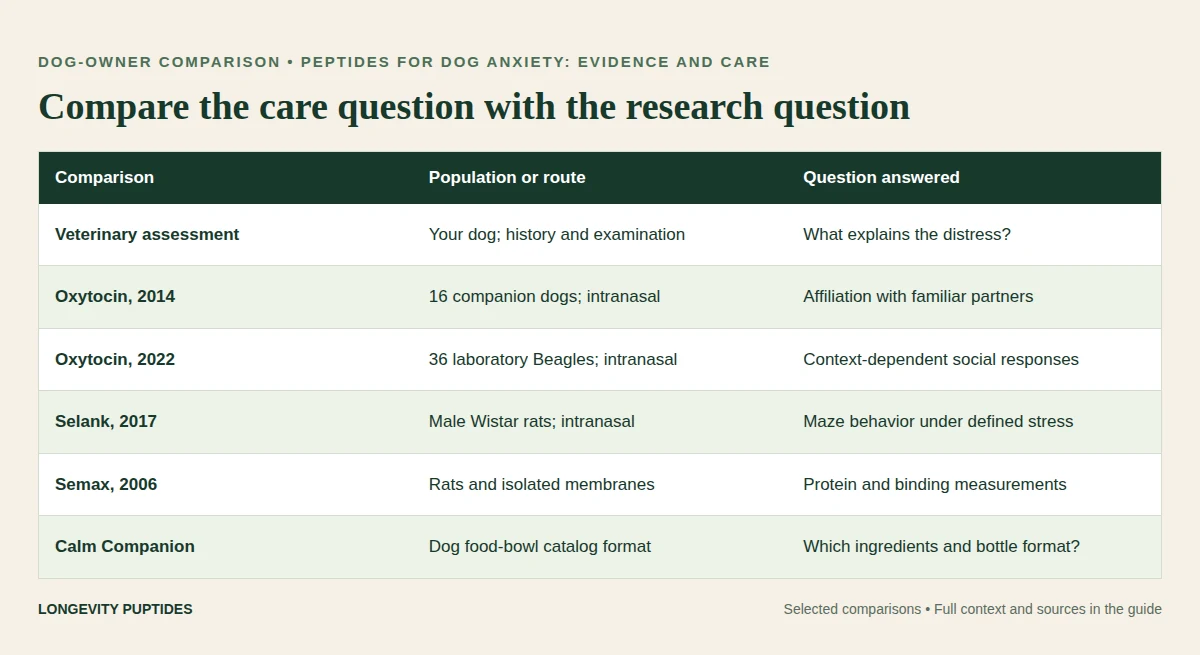
Compare the care question with the research question
Use this comparison to distinguish evidence types rather than rank ingredients by an unmeasured benefit. The first row concerns assessment of your individual dog. The research rows concern defined experiments described above. The final row identifies a catalog format. These belong in the same conversation, but they do not supply interchangeable answers.
A clear product page should let you trace a sentence back to the relevant study population, route and observation. Our research library helps with that reading. For another example of keeping an ingredient distinct from a catalog formula, see BPC-157 for dogs; its presence elsewhere in the collection is not a reason to select it for anxiety.
| Comparison | Population or route | Question answered |
|---|---|---|
| Veterinary assessment | Your dog; history and examination | What explains the distress? |
| Oxytocin, 2014 | 16 companion dogs; intranasal | Affiliation with familiar partners |
| Oxytocin, 2022 | 36 laboratory Beagles; intranasal | Context-dependent social responses |
| Selank, 2017 | Male Wistar rats; intranasal | Maze behavior under defined stress |
| Semax, 2006 | Rats and isolated membranes | Protein and binding measurements |
| Calm Companion | Dog food-bowl catalog format | Which ingredients and bottle format? |
What exactly are you considering with Calm Companion?
Calm Companion is the Longevity Puptides formula containing Oxytocin + Selank + Semax. Its catalog introduction centers on the moments when a familiar routine matters most. That language expresses the collection's theme; it does not turn the ingredient papers into a promised change in your dog's emotions. Read all three names rather than assuming that a short oxytocin/Selank description is the complete formula.
The collection contains ten named products, exclusively in 2 fl oz / 60 mL metered food-bowl spray bottles with 600 metered sprays per bottle. That count describes the package, not sprays per meal or how many days a bottle should last. This guide provides no administration schedule. Nasal research is not a nasal product option, and the familiar food-bowl setting is not evidence that the research routes are interchangeable.
If route differences are what brought you here, continue with oral peptides for dogs. For this buying decision, first identify the exact formula and the information available about it. Keep a copy of the label for your veterinary conversation, especially if your dog already has a behavioral care plan.
How should you make the next decision?
If your dog has persistent distress, prioritize the appointment and a practical behavior plan. If your interest is educational, read the ingredient studies with the comparison above beside you. If you are exploring the collection, choose based on transparent ingredient identity and clearly stated evidence, not the strongest promise. These are different reasons to visit the same page, and none requires treating a scientific hypothesis as an established result.
Ask whether a claimed finding comes from dogs, rats or isolated laboratory material; whether it measured everyday behavior or a molecular marker; and whether the tested item matches the product being discussed. Ask which documents describe the finished formula rather than assuming a source list supplies them. Longevity Puptides publishes this guide and discusses its own collection, so it should be read as commercially affiliated education, not an independent clinical recommendation.
For owners drawn to Calm Companion's familiar-routine theme, the useful next step is its ingredient-focused formula page. Bring that information into the existing veterinary conversation rather than replacing the conversation with a purchase decision. A thoughtful choice can also be to keep reading or postpone a product decision while your dog's needs become clearer.
Common questions
Are peptides proven to relieve dog anxiety?
Not by the studies discussed here. The canine oxytocin experiments measured specific social behaviors, while the Selank experiment used rats. Neither establishes anxiety relief from Calm Companion. Persistent distress needs an individualized veterinary assessment.
Is normal fear the same as an anxiety disorder?
No. Fear responds to an immediate perceived threat; anxiety involves apprehension about a threat that is not nearby. Either can be normal when proportionate. Excessive, persistent or disruptive reactions deserve assessment rather than an owner-assigned diagnosis.
Does following me around mean my dog has separation anxiety?
Not on its own. Merck notes that close attachment behaviors do not by themselves indicate greater separation-anxiety risk. What happens during or before an absence matters; routine video can help your veterinarian identify the pattern and other possible triggers.
Does the oxytocin research show a calming effect in every dog?
No. In the 2022 laboratory-Beagle study, results varied with baseline behavior and test context, including more fearful responses in some dogs during a social-threat test. Social contact seeking is also different from clinical anxiety relief.
Was Selank tested in dogs in the cited stress study?
No. It used male Wistar rats, intranasal Selank and, in some groups, oral diazepam. Its elevated-plus-maze findings are rodent experimental evidence, not a result in anxious household dogs or a recommendation to combine ingredients with medication.
Does Calm Companion contain Semax too?
Yes. The approved catalog lists Oxytocin + Selank + Semax for Calm Companion. The Semax source discussed here concerns rat molecular measurements, which should not be described as a canine anxiety trial.
Is Calm Companion a nasal spray or a sedative?
It is a metered food-bowl spray, not a nasal product. Intranasal appears in this guide only as a study route. Calm Companion is not presented as a sedative, and quiet behavior alone does not demonstrate relaxation.
Does 600 metered sprays tell me how long a bottle lasts?
No. It is a catalog bottle-count description, not an individual use schedule. This guide does not specify sprays per meal, frequency or a dog dose.
What should I bring to a veterinary behavior appointment?
Bring a brief timeline, descriptions of triggers, routine video if available, current medicines and supplements, and the complete label of any product you are considering. Include changes in appetite, rest, movement and household circumstances.
Can a food-bowl spray replace training or prescribed care?
No. A catalog formula does not replace veterinary evaluation, a professional behavior plan or prescribed care. New medical symptoms need assessment rather than a product substitution.
About this guide
Author and publisher: Longevity Puptides.
Written and source-checked by Longevity Puptides as an educational buyer guide. No veterinarian is credited with reviewing or endorsing this guide; Longevity Puptides has a commercial interest in the collection discussed.
Editorial standards and correctionsRead the original sources
- Merck Veterinary Manual: Behavior Problems of Dogs — updated September 2025 ↗
- AAHA: Incorporating behavioral assessments into every examination — May 10, 2019 ↗
- MSD Veterinary Manual: Behavior Modification in Dogs — updated April 2026 ↗
- Romero et al. (2014): Oxytocin promotes social bonding in dogs — primary study ↗
- Turcsán et al. (2022): Intranasal Oxytocin Improves Social Behavior in Laboratory Beagle Dogs (Canis familiaris) Using a Custom-Made Social Test Battery — primary study ↗
- Kasian et al. (2017): Peptide Selank Enhances the Effect of Diazepam in Reducing Anxiety in Unpredictable Chronic Mild Stress Conditions in Rats — primary study ↗
- Dolotov et al. (2006): Semax, an analogue of adrenocorticotropin (4-10), binds specifically and increases levels of brain-derived neurotrophic factor protein in rat basal forebrain — primary abstract ↗