
Where Science Meets Love
PawTides & Longevity Puptides: Product Names and Ingredients
Looking for the Longevity Puptides name that corresponds to a PawTides catalog formula? Start with the ten-formula name guide below, then open the related dog-only food-bowl spray. Name correspondence is not proof of identical current ingredients, concentrations or manufacturing; the Gut Health formula discrepancy remains unresolved.
Published · Updated
In this guide
Which Longevity Puptides name corresponds to each catalog formula?
This is a product-name reference, not a brand contest or a claim that current finished products are interchangeable. The Longevity Puptides column uses our approved catalog names and active ingredients. Open a formula to see its product facts first, with related research supporting that page.
The links in the PawTides column identify the source-brand references. They are not evidence that every current source label matches our catalog. In particular, Gut Health has conflicting current descriptions; Belly Balance remains BPC-157 alone until authoritative specifications resolve that conflict.
| PawTides name reference | Longevity Puptides formula | Our catalog active ingredients |
|---|---|---|
| Chillax | Calm Companion | Oxytocin + Selank + Semax |
| Bedtime Buddy | Dreamy Dog | DSIP |
| Wound Warrior | Recovery Ranger | TB-500 + BPC-157 |
| Joint Juice | Flex & Fetch | AOD-9604 |
| Gut Health | Belly Balance | BPC-157 |
| Pampered Pet | Skin & Shine | GHK-Cu |
| Forever Young | Prime Pup | CJC-1295 + Ipamorelin |
| Forget Me Not | Bright Mind | MOTS-c |
| Healthy Heart | Heart Hero | Tesamorelin |
| Super Defense | Daily Defense | Cardiogen |
Current source-label details that need clarification
Gut Health → Belly Balance: our supplied catalog identifies Belly Balance as BPC-157 alone. The current PawTides Gut Health page describes TB-500/BPC-157 in its short copy but TB-500 in its body. We retain our documented ingredient identity. A current manufacturer-approved specification and final-label reconciliation are needed before describing exact current formula equivalence.
Healthy Heart → Heart Hero: our original catalog and bottle artwork spell the active Tesamorelin. The current source page uses Tessamorelin. We preserve our catalog spelling, without claiming a current production-label or concentration match.
Pretty Kitty / Pampered Pet name reference: the PawTides Pretty Kitty source page identifies GHK-Cu and uses both names. The original PawTides catalog, page 8, also records Pretty Kitty as a Pampered Pet label alias. Skin & Shine is our GHK-Cu dog-only counterpart. This accounts for an additional source-brand name, not an eleventh Longevity Puptides formula or confirmation of identical current formulations, concentrations or suitability for cats.
Start with the formula, then the evidence
The useful starting point is the bottle, not the most appealing product name. Longevity Puptides has ten named formulas in one approved format: 2 fl oz / 60 mL metered food-bowl sprays, with 600 metered sprays per bottle, for dogs. PawTides has its own public collection and purchasing pages, including the three bottles examined below. Its official website presents products for pets more broadly. That difference in audience does not establish a difference in quality or results.
This guide is written by Longevity Puptides and follows our catalog's ten-formula architecture. It helps you move from a source-brand name to the corresponding Longevity Puptides product page, then compare exact label details. If peptide terminology is new to you, the peptides for dogs guide provides supporting context.
The practical differences at a glance
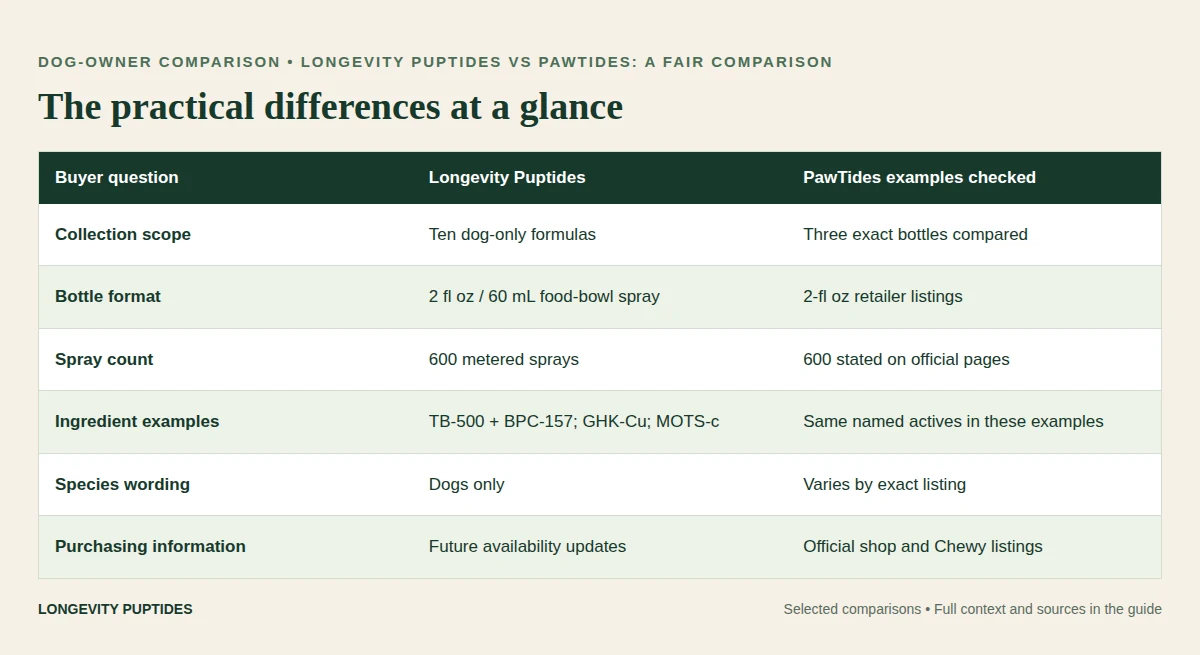
The table compares our approved collection with three checked PawTides examples, not every product the other brand has ever offered. PawTides' official Wound Warrior, Pampered Pet and Forget Me Not pages each describe a 2 fl oz bottle containing 600 sprays. Their exact Chewy listings confirm 2-fl oz sizes, but the extracted retailer text does not establish a spray count for every bottle. That distinction keeps an official-page statement from silently becoming a retailer-verified specification.
| Buyer question | Longevity Puptides | PawTides examples checked |
|---|---|---|
| Collection scope | Ten dog-only formulas | Three exact bottles compared |
| Bottle format | 2 fl oz / 60 mL food-bowl spray | 2-fl oz retailer listings |
| Spray count | 600 metered sprays | 600 stated on official pages |
| Ingredient examples | TB-500 + BPC-157; GHK-Cu; MOTS-c | Same named actives in these examples |
| Species wording | Dogs only | Varies by exact listing |
| Purchasing information | Future availability updates | Official shop and Chewy listings |
| Head-to-head results | Not established by reviewed sources | Not established by reviewed sources |
Which PawTides bottles were verified?
Wound Warrior: the official PawTides page names TB 500/BPC 157 and states 2 fl oz with 600 sprays. The exact Chewy listing is titled PawTides Wound Warrior Spray Joint Supplement for Dogs, 2-fl oz. Its ingredient panel names TB 500/BPC 157. A retailer Q&A answer dated July 6, 2026 says the product is intended to be ingested through application to pet food, despite wording elsewhere that could suggest an external wound spray.
Pampered Pet: the official page identifies GHK Cu and a 2 fl oz, 600-spray bottle. The Chewy bottle is titled PawTides Pampered Pet Skin & Coat Supplement Spray for Dogs & Cats, 2-fl oz bottle. Its active-ingredient panel uses a proprietary-blend description discussed below. Both the complete title and that panel matter; a familiar product photograph alone would miss the distinction.
Forget Me Not: the official PawTides page identifies MOTS-c and a 2 fl oz, 600-spray bottle. The exact Chewy listing is PawTides Forget Me Not Brain & Nervous System Supplement for Dogs, 2-fl oz, with MOTS c named as the active ingredient. These checks establish what the public pages say about these bottles, rather than guessing specifications from another formula or an older catalog.
Do matching ingredient names mean the products are identical?
There are straightforward ingredient-name overlaps. Recovery Ranger lists TB-500 + BPC-157, as Wound Warrior does. Skin & Shine lists GHK-Cu, which appears on Pampered Pet's pages. Bright Mind lists MOTS-c, the ingredient named for Forget Me Not. Those are useful comparisons for someone researching a particular molecule. They are not proof that the complete liquids, ingredient quantities, packaging specifications or manufacturing processes are identical.
Think of a matching ingredient name as the beginning of a comparison, not its conclusion. To go further, you would need the full current labels and product-specific documentation. Even a shared bottle size and spray count would leave the amount of each ingredient unresolved. We do not infer a manufacturing relationship, shared origin or ownership from those similarities. Nor do we treat a different public name as evidence that one brand has a different or better biological effect.
What is in the Longevity Puptides collection?
The Longevity Puptides collection uses the following exact public names and active ingredients. All ten share the dog-only 2 fl oz / 60 mL, 600-metered-spray food-bowl format. This is a catalog identity map, not a menu of treatments. It also prevents a common comparison mistake: assuming that a product's friendly name tells you which peptide it contains, or that every formula in a wellness family contains the same ingredients.
A single-ingredient formula and a blend also deserve separate comparison. Belly Balance lists BPC-157 alone, while Recovery Ranger lists TB-500 + BPC-157. If your search is specifically about BPC-157, record that distinction before comparing labels. The presence of a second ingredient does not demonstrate added benefit, and the shared bottle size does not tell you how much BPC-157 each contains. Similarly, Skin & Shine's GHK-Cu identity is clearer than guessing its ingredients from a skin-and-coat category label.
| Formula | Public name | Active ingredients |
|---|---|---|
| 01 | Calm Companion | Oxytocin + Selank + Semax |
| 02 | Dreamy Dog | DSIP |
| 03 | Recovery Ranger | TB-500 + BPC-157 |
| 04 | Flex & Fetch | AOD-9604 |
| 05 | Belly Balance | BPC-157 |
| 06 | Skin & Shine | GHK-Cu |
| 07 | Prime Pup | CJC-1295 + Ipamorelin |
| 08 | Bright Mind | MOTS-c |
| 09 | Heart Hero | Tesamorelin |
| 10 | Daily Defense | Cardiogen |
Which label details need closer attention?
Pampered Pet provides a concrete reason to read the ingredient panel rather than stop at GHK-Cu. Chewy's listing displays “Proprietary Blend GHK Cu” alongside “4x, 12x, 13x.” The official page identifies GHK Cu without explaining those retailer entries. We do not translate that notation into a milligram quantity or assume that it matches Skin & Shine. A buyer should request an explanation of the notation and a readable current label for the exact bottle being supplied.
The three Chewy pages also display inactive-ingredient text naming potassium sorbate, citric acid and purified water. Our approved catalog data identifies Longevity Puptides' active ingredients and bottle format; it does not provide a complete comparative inactive-ingredient panel here. Copying the retailer's list into our formula descriptions would therefore overstate what is documented. If you are comparing complete formulations, request both full labels rather than treating information missing from a comparison as proof of either similarity or difference.
How should you read claims and professional-sounding wording?
Product-page descriptions belong to their speaker. Chewy describes Wound Warrior using pain, tissue-repair and faster-healing language. Its Forget Me Not description includes memory-loss and cognitive-performance claims. Those are retailer claims, not findings we adopt as established facts. Likewise, professional-team descriptions on the PawTides homepage are the brand's representations; this guide has not independently verified the contributors or their credentials.
A retail category, domestic-origin badge or attractive science description answers a different question from whether a finished product has been evaluated for a specific outcome. Customer ratings can describe shopping experiences, but they do not provide a controlled comparison between brands. We are not using either brand's marketing confidence as a substitute for evidence. The useful follow-up is to ask what document supports the precise statement, which product it covers and whether the underlying result was measured in dogs.
The FDA's pet-food claims guidance explains that disease claims and certain nonfood structure/function claims can indicate intended use as a new animal drug. That is regulatory context, not a legal verdict about either company. Retail placement alone should not be read as FDA approval or a professional endorsement.
What do the relevant ingredient papers actually show?
For BPC-157, He and colleagues published Pharmacokinetics, distribution, metabolism, and excretion of body-protective compound 157, a potential drug for treating various wounds, in rats and dogs on December 14, 2022. The Beagle experiments used intravenous and intramuscular administration and measured concentrations over time. The parent peptide peaked and disappeared rapidly, with elimination half-lives under 30 minutes under the tested conditions. Despite the title's broader wording, these canine measurements were not a trial of movement or digestive outcomes. Our BPC-157 for dogs guide gives further ingredient context.
For the copper-peptide comparison, Swaim and colleagues' March 1996 paper, Effect of locally injected medications on healing of pad wounds in dogs, involved twelve mature English Pointers. Researchers locally injected a tripeptide-copper complex into experimentally created paw-pad wounds. Complex-injected wounds had more type-I collagen at reported time points, including a significant difference at day fourteen. This was a local wound experiment, not a coat, nail or eye study, and not administration through food.
For MOTS-c, Reynolds and colleagues published MOTS-c is an exercise-induced mitochondrial-encoded regulator of age-dependent physical decline and muscle homeostasis on January 20, 2021. Injected MOTS-c improved certain physical-performance measures in mice; learning and memory did not improve in the young-mouse Barnes-maze experiment. A separate component measured naturally occurring MOTS-c around cycling exercise in ten healthy young men, without administering the peptide to them. The species, route and endpoints matter when interpreting cognition-oriented product language. The research library helps keep these original findings attached to the experiments that produced them.
What documentation makes a comparison more useful?
Request the readable current label first, followed by any product-specific ingredient quantities and available lot documentation. A certificate of analysis is most useful when it identifies the material tested, the relevant lot, the test date, the laboratory and the reported result. Ask whether it concerns a raw ingredient or the finished liquid. A report about one input should not be presented as though it describes every bottle in a collection.
Apply that same request to both brands. Do not assume a document exists because a page uses technical language, or assume it does not exist because it was not included in a retailer description. The product research checklist can help organize the answers. If a representative supplies additional documents, compare the actual material and lot described rather than collecting badges. Identity, quantity and finished-product outcomes are separate questions, and each needs an appropriately matched source.
How do availability and purchasing details differ?
Longevity Puptides presents formula facts and availability-interest actions on this education site. A separate Puptide Life homepage is publicly visible with ten product listings, but that does not verify payment, inventory, subscriptions or fulfillment. This guide is not a price comparison or a shipping promise. The where to buy peptides for dogs guide separates a public listing from a confirmed offer.
Availability can differ by channel. The official Forget Me Not page displayed out of stock when checked, while its Chewy listing displayed in stock. That is a difference between the pages reviewed, not a guarantee of present fulfillment. Confirm the exact item, seller information, current availability and applicable return terms in the channel you choose. A promotion or automatic-reorder option is a purchasing feature, not evidence about the formula's biological effects.
What matters for your dog and household?
Species wording deserves attention in a mixed-pet home. Chewy titles Pampered Pet for dogs and cats, while Forget Me Not's title says dogs even though its descriptive copy mentions kitties and pups. Those are the retailer's exact audience descriptions, not instructions to extend one product to another species. Longevity Puptides' collection is dog-only. Shared bowls can also make it unclear which animal encounters an addition, so practical questions belong alongside ingredient questions.
The phrase food-bowl spray describes a format; the 600-metered-spray count is not a dog-use schedule or a stated number of days per bottle. This guide does not convert another brand's directions into directions for our collection. Your dog's complete diet remains an important part of the conversation, as discussed in dog nutrition and longevity. Limping, persistent itching, repeated vomiting or a notable behavior change needs veterinary evaluation, not selection of a bottle by its name. Neither brand should substitute for veterinary care or prescribed treatment.
How can you make a clearer buyer decision?
Choose the question you need answered before comparing the brands. If it is ingredient identity, compare the complete label names and quantities. If it is purchasing logistics, inspect the exact seller and current terms. If it is whether a product produces a particular result, request evidence about that product rather than borrowing a study of an ingredient. These questions can lead to different conclusions; a well-documented shopping option is not automatically a clinically established one.
For a movement-related concern, the dog joint supplements guide offers a separate starting point for nutritional questions and veterinary discussion. For broader aging interests, canine longevity keeps the focus on the whole dog rather than a product name. A fair outcome from this comparison may simply be knowing which details are confirmed and which you still want explained. There is no need to declare a brand winner to make progress toward a better-informed conversation.
Common questions
Is Longevity Puptides the same brand as PawTides?
This guide maps product names from the source catalog to our ten Longevity Puptides formulas. It does not establish corporate ownership, a manufacturing relationship or identical current specifications. Our public identity remains Longevity Puptides.
Which PawTides bottles were checked on Chewy?
The exact 2-fl oz listings checked were Wound Warrior Spray Joint Supplement for Dogs, Pampered Pet Skin & Coat Supplement Spray for Dogs & Cats, and Forget Me Not Brain & Nervous System Supplement for Dogs. Other competitor bottles were not inferred from these examples.
Which Longevity Puptides formula has the same named actives as Wound Warrior?
Recovery Ranger lists TB-500 + BPC-157. Wound Warrior's official and Chewy pages name TB 500/BPC 157. That is an ingredient-name comparison, not proof of identical quantities, complete formulations or outcomes.
Why not convert Pampered Pet's ingredient notation into an amount?
Chewy displays Proprietary Blend GHK Cu with 4x, 12x, 13x, without an explanation in the extracted panel. We do not turn those entries into a milligram amount. Ask for the current label and an explanation for the exact bottle.
Is Wound Warrior described as a food-applied or external spray?
The official page describes application to food, and Chewy's July 6, 2026 Q&A answer says it is intended to be ingested through pet food. Some promotional wording could suggest external use, so the full current label matters more than the product name.
Does a Chewy listing prove a product's claims?
No. It verifies what the retailer lists and claims about a specific item. It is not itself a controlled canine trial, FDA approval or independent professional endorsement.
Are all Longevity Puptides bottles the same size?
Yes. The approved ten-formula collection consists only of dog-only 2 fl oz / 60 mL metered food-bowl sprays with 600 metered sprays per bottle. That count describes packaging, not a dog-use schedule.
Can I compare prices or order Longevity Puptides from this guide?
This guide does not take payment, reserve inventory or promise shipping. A separate Puptide Life homepage is publicly visible, but operational readiness has not been verified here. Explore the local formula facts and request confirmed availability updates.
Does either brand replace veterinary evaluation?
No. Medical symptoms need veterinary evaluation, and a food-bowl spray should not substitute for veterinary care or prescribed treatment. Bring the exact label and your dog's current food, medicine and supplement information to the conversation.
About this guide
Author and publisher: Longevity Puptides.
Authored by Longevity Puptides, which has a commercial interest in its collection. The product-name guide follows the supplied catalog architecture and the November 6 alignment direction. The three detailed retailer examples below retain their November 2 checks; the Gut Health, Healthy Heart and Pretty Kitty source-page questions were revisited November 6. This is not a veterinarian-authored review or a head-to-head trial.
Editorial standards and correctionsRead the original sources
- PawTides official homepage — brand self-descriptions and collection links ↗
- PawTides Wound Warrior — official ingredient and bottle description ↗
- Chewy Wound Warrior, 2-fl oz — exact retailer listing and July 6, 2026 Q&A ↗
- PawTides Pampered Pet — official ingredient and bottle description ↗
- Chewy Pampered Pet, 2-fl oz bottle — exact retailer ingredient panel ↗
- PawTides Forget Me Not — official ingredient, bottle and availability description ↗
- Chewy Forget Me Not, 2-fl oz — exact retailer listing ↗
- He et al., December 14, 2022 — BPC-157 pharmacokinetics in rats and dogs ↗
- Swaim et al., March 1996 — Effect of locally injected medications on healing of pad wounds in dogs ↗
- Reynolds et al., January 20, 2021 — MOTS-c physical-decline and muscle-homeostasis study ↗
- FDA: Animal Food Labeling and Pet Food Claims — current March 2, 2026 ↗
- PawTides Gut Health — conflicting current ingredient descriptions, checked November 6 ↗
- PawTides Healthy Heart — source spelling, checked November 6 ↗
- Puptide Life visible homepage — listings only, not operational readiness, checked November 6 ↗
- PawTides Pretty Kitty — GHK-Cu and Pretty Kitty / Pampered Pet name usage, checked November 6 ↗